Impact of Various Surface Treatments on Bonding of Zirconia a Literature Review
Department of Prosthodontics AMEs Dental College & Hospital, Raichur, India
ABSTRACT
In Modern Prosthetic dentistry Zirconia holds a unique place amongst other oxide ceramics. Zirconia crowns have provided a treatment alternative with its excellent Biocompatibility, chemical and dimensional stability and superior mechanical properties, which all together guarantees optimal therapeutical results in complex prosthodontic reconstruction. However, the stumbling block in the clinical longevity of zirconia is the problematic bonding of zirconia framework to dental luting cements and tooth structures, which has opened the room for discussion. The well-known methods of mechanical and chemical bonding used on glass-ceramics are not applicable for use with zirconia. This article presents a literature review on the impact of various surface treatments for enhancing the bonding of zirconia and enriching its clinical success.
Key words:- Zirconia, bonding, surface treatment, oxide ceramics
INTRODUCTION
Transformation-toughened zirconia is prone to be a successful alternative in the different clinical situations com-pared to other all-ceramic systems.1 Very good optical properties, wear resistance, strength and biocompatibility allowed them to be used as a framework material however properties such as brittleness, unpredictable crack propagation, low repair potential and marginal accuracy and more importantly problematic bonding to tooth structure and different luting cements could bring limitations in their use. Hence the knowledge of different bonding mechanism or surface treatment to Zirconia can enhance the longevity and clinical success.
ZIRCONIA –CHEMISTRY AND PROPERTIES
Zirconia is a polycrystalline material, occurring in three temperature and pressure dependent forms2
- Monoclinic
- Tetragonal
- Cubic
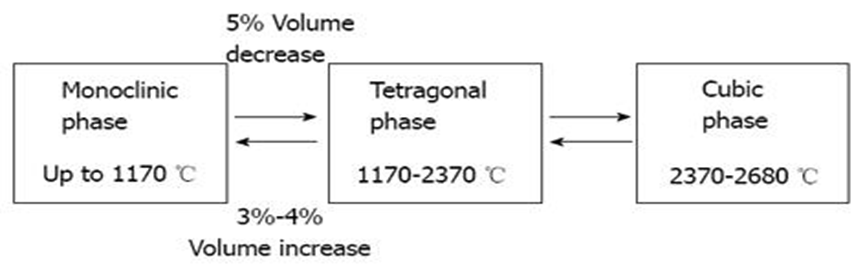
Pure zirconia is monoclinic at room temperature and could be stable up to 1179°C.
Above this temperature, it transforms into more dense, tetragonal phase, with volume decrease (5%) and initiation of cracks within its structure.
The tetragonal form is stable between 1170 and 2370°C, while at higher temperatures ZrO2 acquires a cubic structure.
Reversely, during cooling, T-M transformation occurs, followed by volume expansion (3-4%).

TRANSFORMATION TOUGHENING OF ZIRCONIA
Zirconia materials differ from other high strength dental ceramics due to their stress induced transformation toughening. This characteristic means that material undergoes microstructural changes when submitted to stress and can actively resist crack propagation through transformation from tetragonal to monoclinic phase at the tip of a crack. This phenomenon is accompanied by a local expansion which favors crack closure. Such an increase in volume results in compressive stresses zone generated around and at the tip of crack, which then counteract the tensile stresses acting on the fracture tip. Subsequently Y-TZP exhibits high values of flexural strength (900-1200 MPa) and fracture toughness (Kic) of 5-9 MPa-m1/2, which are at least three times higher compared to alumina and lithium disilicate-based ceramics.2
BONDING OF ZIRCONIA –AN ENIGMA
One of the main drawback of zirconia is its lack of bonding with tooth and luting cements unlike other ceramic oxides.
Due to chemical inertness and resistance to aggressive chemical agents (strong acid, alkalis, organic and inorganic dissolving agents), bonding of zirconia to tooth tissues or other synthetic materials is difficult when compared to silica-based ceramic material3
The well-known methods of mechanical and chemical bonding used on glass-ceramics are not applicable for use with zirconia. The most important reason for this is the absence of silica in the zirconia microstructure which ignores the viability of etching as a roughening method essential for mechanical bonding, as well as nullified the use of silanes, forming surfaces hydroxyls and developing the chemical bond4.
However Dental zirconia can no longer be considered un-bondable to tooth tissue. In today’s literature, multiple papers can be found reporting on bond-strength measurements to zirconia; a large range of different pre-treatment methods has been tried out to ameliorate the bonding effectiveness to zirconia and its bond durability. The combination of mechanical and chemical pre-treatment appeared particularly crucial to obtain durable bonding to zirconia ceramics.5
SURFACE TREATMENT OPTIONS FOR BONDING OF ZIRCONIA
- Surface abrasion or roughening
- Tribochemical silica coating
- Silica coating techniques
- Chlorosilane treatment
- Selective infiltration etching
- Nanostructured alumina coating
- Hot chemical etching solution
- Laser application
- Zirconia ceramic powder coating
- Gas fluorination process
- Application of phosphate ester primers and phosphate modified resin cements
1. SURFACE ABRASION OR ROUGHENING
Surface abrasion or roughening (grinding, airborne particle abrasion, rotary abrasion using diamond burs) establishes adhesion only through micro-mechanical retention with no chemical bonding benefits. However, Magne et al. noted that using particles upto 50 µm in size at 0.25 µm for surface abrasion does not reduce the strength of zirconia and is effective in roughening and cleaning the bonding surface of zirconia6. Various studies have stated in past that even though any of the surface treatment [Er:YAG laser ,silica and air abrasion] can be used for micromechanical retention ,air abrasion has been proven to be the most effective.7
Roya Zandparsa et all noted that Airborne-particle abrasion followed by the application of a zirconia primer produced the highest bond strength to enamel. Therefore, it can be recommended as a promising surface treatment method to achieve a durable bond to densely sintered zirconia ceramics.8
On the contrary controversial belief regarding surface abrasion as treatment on the mechanical properties of zirconia is also present there have been studies proving that Although alumina air-abrasion considerably enhanced bonding between zirconia and indirect composites, subsequent heat treatment had a negative effect on the durability of bond strength. Also some authors reinforced the opinion that mechanical adhesion alone is not suitable for providing the optimal resin bond strength. So, they promote the chemical adhesion in zirconia bonding.9
2. SILICA COATING TECHNIQUES
These techniques are used to facilitate a siloxan bond between zirconia surface and resin cement. Fusion of glass bead and plasma spray is a complicated technique to achieve adequate coverage (e.g. thermal spray). Some articles have confirmed that silica coating produced significant resin bonding for zirconia ceramics, while others certified reduced bond strength after artificial aging, with explanation that silica coverage was not firmly attached to zirconia. Other studies which compared long-term microtensile bond strength of different thickness of silica seed layers (3.2 nm, 5.8 nm, 30.4 nm) deposed on the zirconia substrate, showed similar or superior bond strength to resin cement, when compared to traditional silanization, but lower than that for silane–treated dental porcelain2.
3. APPLICATION OF TRIBOCHEMICAL SILICA COATING
In this technique alumina particles are modified with silica for air abrasion at 0.28 MPa and silica particles are embedded in the ceramic surface. These silica particles create a base for micromechanical bonding and interlocking in ceramic. Following which is the application of silane which enables chemical adhesion between ceramic and resin cement.2.
But there has been doubts concerning the mechanism of bonding whether transfer of silica is caused by particles embedded in target surface, mechanical/chemical transference (tribochemistry) or both. It is supposed that in case of very hard zirconia cores, (target material) embedding of silica coated particles is difficult. Therefore, it is possible that silica-coated particles „bounce off“ ceramics, but after actual transference of silica from particles to ceramic substrate10 The presence of this vitreous component allows the use of silane as a coupling agent. It binds both to the composite and to the silica deposited on the zirconia and improves adhesion.
TBS is carried out mainly by two methods: the Rocatec system consists of a traditional sandblasting pretreatment, and a subsequent use of silica-coated alumina particles (110μm). The Cojet system uses coated alumina particles of silica (30μm) and can be applied by the chair. The size of the particles used for alumina sandblasting (50μm and 120μm) or for tribological-chemical treatment (30μm and 110μm) does not affect SBS.11
Hong cheng et al12 conducted a study to evaluate the effect of tribochemical silica coating for zirconia bonding, it was found that Combination of tribochemical silica coating with silane coupling can effectively enforce the bond strengths of zirconia (Y-TZP)
Literature reviews11 have also shown that the use of a primer containing silane and 10-MDP allows the achievement of a better bond between composite and zirconia compared to the application of silane alone.
Several studies agree that TBS, followed by the application of silane-containing primer, is more stable than alumina sandblasting followed by the application of10-MDP-based primers.11
Although many studies demonstrate an adhesion-promoting effect of TSC on zirconia, its actual interaction mechanism has not been fully elucidated. Studies conducted on characterization of the ultrastructure of TSC-treated zirconia and shear-bond strength test found that solely silane coupling agent was less effective than the combined 10-MDP/silane ceramic primer for bonding to zirconia pretreated by TSC.13
4. CHLOROSILANE TREATMENT
By using a chloro-silane-based vapor-phase pretreatment, a silica-like surface layer was created on zirconia and used to increase the binding sites for the subsequent organo- silane primer for conventional dental adhesive applications. The result is very thin coating (till 2.6 nm) which increased the number of chemical binding sites (SixOy) for the subsequent organ-saline primer, used in conventional adhesive technique.
This approach supports the concepts that chemical surface modification can improve resin adhesion to zirconia using traditional silanation and bonding techniques. Mechanical data support that utilizing a gas-phase chloro-silane pretreatment to deposit ultra-thin silica-like seed layers can improve adhesion to zirconia using traditional silanation and bonding techniques.14
5. SELECTIVE INFILTRATION ETCHING
SIE is based on inter-grain metastable tetragonal grains, created during thermal pre-stressing of the surface grains using a specific thermal regime. Due to this procedure, the bonding zirconia surface is ready to accept the adhesive resin which infiltrates and „interlocks“ the bond.2 SIE transforms dense, Nano-retentive, relatively smooth and low energy surface of zirconia to highly active and well bonding surface3. The proposed technique utilized the characteristics of zirconia on an ultra-structural level.
In SIE method the surface of zirconia is coated with a glass-containing conditioning agent silica (65% wt), alumina (15% wt), sodium oxide (10% wt), potassium oxide (5% wt) and titanium oxide (5% wt) with closely-matched thermal expansion coefficient to zirconia. Later on, the material is heated above glass transition temperature, until the optimal grain boundary diffusion is achieved. After cooling to room temperature, the glass is dissolved in an acidic bath to eliminate all traces of conditioning agent. The cooling and heating rates are controlled by a computer-calibrated induction furnace.3
There has been assuring results in the literature regarding selective infiltrative etching technique that it prevents any sort of Nano leakage due to infiltration of adhesive resin into the created micro porosities on the surface of zirconia.3
Merve et al conducted a study to evaluate the shear bond strength of resin cements to zirconia treated with the selective infiltration etching technique (SIE) and said that use of SIE method combined with MDP monomer containing resin cement can provide clinically acceptable bond strength between zirconia and resin cement.15
Amidst the positive results of this technique, still there has been point of concern regarding the effect of the created inter-grain porosities on the mechanical properties of the SIE zirconia.3
6. NANOSTRUCTURED ALUMINA COATING
Nanostructured alumina coating is presented as a new approach which is able to provide a strong and durable resin bond to Y-TZP. It is based on the idea of a rapid precipitation of aluminium hydroxides that originate from the hydrolysis of AlN powder in a diluted aqueous suspension. The result is heterogeneous nucleation of lamellar boehmite (γAlOOH) onto the surface of the immersed Y-TZP substrate. The nanostructured coatings consist of 6 nm thick and 240 nm long interconnected polycrystalline γAlOOH lamellas that grow perpendicular to the zirconia surface. During a heat treatment up to 900°C, these coatings are transformed into transient alumina, but without any change in the morphology.
This non-invasive process can be classified as chemical pretreatment method that increases the surface area and penetrates the lamellar network, implying good wetting. The proposed technique offers some advantages over conventional surface treatment. Firstly, it does not create any flaws that can decrease the strength of zirconia ceramics. Secondly, functionalization of zirconia surface is more effective compared to air abraded and polished surface, even after thermo cycling procedures. Thirdly, technique is simple and can be easily transferred to dental laboratories2.
7. HOT CHEMICAL ETCHING SOLUTION
This technique selectively etches the zirconia and creates micro-retentions on the surface by modifying the grain boundaries through removal of the less arranged atoms.2 Wenyong Dai et all stated that The experimental hot chemical etching solution provides enhanced bonding for zirconia than sandblasting, and the bond strengths remain stable after artificial ageing.16
In a study conducted by George J K Cheung et al17 Sintered zirconia was surface treated with hydrofluoric acid etching (HFE), alumina particle abrasion (APA), and alumina particle abrasion with hydrofluoric acid etching (APAHFE) and it was found that etched, fired ceramic liner with silane treatment provided the strongest and most durable bond under the conditions tested.
However, According to other literature data’s, this new technique must be checked through further studies which would confirm its effects on bond strength of complex zirconia/cement combination.2
8. LASER APPLICATION
The most commonly used lasers for both hard and soft tissue oral surgery are neo-dymium-doped yttrium aluminum garnet (Nd: YAG) and erbium-doped yttrium aluminum garnet (Er: YAG). Recently, attention has been focused on the role of Nd: YAG in in-creasing the surface roughness and wettability of the zirconia for adhesive luting. The energy of the laser beam is absorbed by the zirconia/ceramic. This energy creates a heat induction pro-cess that produces shell-like ruptures on the ceramic surface, providing micromechanical interlocking for enhanced bonding.18
Loghman Ret al19 investigated the effect of Erbium-doped yttrium aluminium garnet laser laser (Er: YAG laser), sandblast and several universal bonding on the shear bond strength of zirconia ceramic to composite resin and found that the preparation of Er:YAG laser is a more ap Effect of Er: YAG Laser, Sandblast and Several Types of Universal Bonding on Shear Bond Strength of Zirconia Ceramic to Composite Resin.
However other studies in literature also says that In order to increase surface roughness and promote better bonding to resin luting agents, Er:YAG laser etching may be an alternative to air-particle abrasion for zirconia ceramics. However, high levels of pulse energy and longer pulse length may have an adverse effect on micromechanical locking properties, because of a decrease in surface roughness.20
And it has been suggested to lower the laser power and to enable surface irradiation with constant water cooling.2
9. ZIRCONIA CERAMIC POWDER COATING
It is produced by coating zirconia framework (presintered or fully sintered) with slurry containing zirconia powder and a pore former. During the sintering process pore former burns off leaving a porous modified surface2 The advantage21 of this procedure is the possibility to change the pore size by using different sizes of pore former or repeating the coating process,it is already present, applied by the manufacturer of the framework. The restoration would be provided ready to bond, eliminating the chairside or laboratory step of airborne-particle abrasion.also in SEM photogarphs The machined surface is smooth and evenly flat with a regular crystal grain pattern. While the modified surface revealed microporosities which might provide micromechanical interlocking with the cement.
Uses:- This modified surface has the potential to be used as the intaglio surface of restorations that rely heavily on successful bonding, for example, resin-bonded FPDs and veneers. In addition, use for the intaglio surface of frameworks for conventional high-strength ceramic crowns and FPDs might be a possible application
Further evaluation of the effect of the modified surface configuration on the mechanical properties of zirconia is required before making any clinical recommendations.
Also Airborne-particle abrasion of the modified zirconia surface is not recommended.21
10. GAS FLUORINATION PROCESS
In this technique oxyfluoride conversion layer is created on the surface of zirconia ceramic and thus increasing its reactivity. The procedure for this surface modification requires a plasma power source, vacuum (∼35 mT), and handling of a fluorine containing precursor gas.
Essentially, the goal of the process is to apply the fluorinated plasma to the zirconia surface, to convert the top 1-3 nm into a ZrO3F4, which would further react with organo-silanes, enabling silicon bonding to the surface.
The data shows that the fluorinated treatment on roughened zirconia displayed the highest shear bond strength; and, even more promising is that the fluorinated treatment on polished zirconia was statistically the same (or higher) as compared to other clinically accepted methods. This suggests that the fluorination treatment could be used on as-received substrates, where roughening or other surface modification techniques are neither possible nor desired.
However, should this process be adopted for general clinical use, the authors envision that a small, low-cost, counter-top system could be implemented for surface modification in either a clinical or dental lab setting. Furthermore, potential surface contamination with biological fluids needs to be investigated in future studies to validate whether this modification can be a viable technique for bonding zirconia to dental materials in clinically relevant environments.6
CONCLUSION
Optimal surface preparation methods for mechanical and /or chemical bonding to porcelain substrates are critical to ensure clinical success when placing restorations. A variety of surface preparation techniques have been advocated ,which includes the use of acids ,particle abrasion ,and silane coupling agents. However these procedures alone are not sufficient to generate a reliable long term bond.10 Hence a combination of pretreatment methods is imperative. Therefore, under critical clinical situations, selection of the bonding mechanism should be focused onto two important points: high initial bond strength value and long-term bond strength between zirconia-resin interface.
Nevertheless, the problem of zirconia bonding to resin cement is still questionable. It is important to remember that zirconia crowns can also be luted with conventional cements if adequate crown preparation design provides sufficient retention without bonding.2
REFERENCES
- Daou EE. The zirconia ceramic: strengths and weaknesses. The open dentistry journal. 2014;8:33 PMID: 24851138, DOI: 10.2174/1874210601408010033
- Obradović-ÄÂuriÄÂić K, Medić V, Dodić S, Gavrilov D, Antonijević ÄÂ, Zrilić M. Dilemmas in zirconia bonding: A review. Srpski arhiv za celokupno lekarstvo. 2013;141(5-6):395-401. PMID: 23858816 DOI: 10.2298/sarh1306395o
- Aboushelib MN, Feilzer AJ, Kleverlaan CJ. Bonding to zirconia using a new surface treatment. Journal of Prosthodontics: Implant, Esthetic and Reconstructive Dentistry. 2010 Jul;19(5):340-6. PMID: 20202104 DOI: 10.1111/j.1532-849X.2010.00575.x
- Blatz MB, Sadan A, Kern M. Resin-ceramic bonding: a review of the literature. The Journal of prosthetic dentistry. 2003 Mar 1;89(3):268-74. PMID: 12644802 DOI: 10.1067/mpr.2003.50
- Inokoshi M, De Munck J, Minakuchi S, Van Meerbeek B. Meta-analysis of bonding effectiveness to zirconia ceramics. Journal of dental research. 2014 Apr;93(4):329-34. PMID: 24563487 DOI: 10.1177/0022034514524228
- Piascik JR, Wolter SD, Stoner BR. Development of a novel surface modification for improved bonding to zirconia. Dental Materials. 2011 May 1;27(5):e99-105. PMID: 21353693 DOI: 10.1016/j.dental.2011.01.005
- Subaşı MG, Ä°nan Ö. Evaluation of the topographical surface changes and roughness of zirconia after different surface treatments. Lasers in medical science. 2012 Jul 1;27(4):735-42. PMID: 21786139 doi: 10.1007/s10103-011-0965-3.
- Zandparsa R, Talua NA, Finkelman MD, Schaus SE. An in vitro comparison of shear bond strength of zirconia to enamel using different surface treatments. Journal of prosthodontics. 2014 Feb;23(2):117-23. PMID: 23890275 DOI: 10.1111/jopr.12075
- Kern M, Barloi A, Yang B. Surface conditioning influences zirconia ceramic bonding. Journal of dental research. 2009 Sep;88(9):817-22. PMID: 19767578 DOI: 10.1177/0022034509340881
- Mehta D, Shetty R. Bonding to zirconia: elucidating the confusion. Int Dent SA. 2010;12(2):46-52.
- Russo DS, Cinelli F, Sarti C, Giachetti L. Adhesion to Zirconia: A Systematic Review of Current Conditioning Methods and Bonding Materials. Dentistry Journal. 2019 Sep;7(3). PMID: 31374820 DOI: 10.3390/dj7030074
- Cheng H, Dong C, Zhang FQ. Influence of tribochemical silica coating on shear bond strength of a dental zirconia ceramic to resin cements. Shanghai kou qiang yi xue= Shanghai journal of stomatology. 2018 Jun 1;27(3):248-51. PMID: 30411117
- Nagaoka N, Yoshihara K, Tamada Y, Yoshida Y, Van Meerbeek B. Ultrastructure and bonding properties of tribochemical silica-coated zirconia. Dental materials journal. 2018 Nov 29:2017-397. PMID: 30298858 DOI: 10.4012/dmj.2017-397
- Piascik JR, Swift EJ, Thompson JY, Grego S, Stoner BR. Surface modification for enhanced silanation of zirconia ceramics. Dental Materials. 2009 Sep 1;25(9):1116-21. PMID: 19376572 DOI: 10.1016/j.dental.2009.03.008
- Çakırbay Tanış M, Akay C, Åžen M. Effect of selective infiltration etching on the bond strength between zirconia and resin luting agents. Journal of Esthetic and Restorative Dentistry. 2019 May;31(3):257-62. PMID: 30565846 DOI: 10.1111/jerd.12441
- Wenyong D, Houcai Y, Chen C, Haifeng X, Feimin Z. Effect of hot chemical etching on bond strength of zirconia to resin. West China Journal of Stomatology. 2013 Dec 1;31(6). PMID: 24437288
- Cheung JK, Botelho MG. Zirconia surface treatments for resin bonding. The journal of adhesive dentistry. 2015. PMID: 26734680 DOI: 10.3290/j.jad.a35249
- Khan AA, Al Kheraif AA, Jamaluddin S, Elsharawy M, Divakar DD. Recent trends in surface treatment methods for bonding composite cement to zirconia: a review. J Adhes Dent. 2017 Jan 1;19(1):7-19. PMID: 28195271 DOI: 10.3290/j.jad.a37720
- Sofi LR, Fekrazad R, Akbarzadeh M, Maleki M. Effect of Er: YAG laser, sandblast and several types of universal bonding on shear bond strength of zirconia ceramic to composite resin. Dental Practice. 2018 Oct 1;19(10):1246-53. PMID: 30498181
- Turp V, Akgungor G, Sen D, Tuncelli B. Evaluation of surface topography of zirconia ceramic after Er: YAG laser etching. Photomedicine and laser surgery. 2014 Oct 1;32(10):533-9. PMID: 25244244 DOI: 10.1089/pho.2014.3730
- Phark JH, Duarte Jr S, Blatz M, Sadan A. An in vitro evaluation of the long-term resin bond to a new densely sintered high-purity zirconium-oxide ceramic surface. The Journal of prosthetic dentistry. 2009 Jan 1;101(1):29-38. PMID: 19105989 DOI: 10.1016/S0022-3913(08)60286-3
Disclaimer from Guident
The views and opinions expressed in articles published in Guident are solely those of the authors and do not necessarily reflect the views of the editors, the editorial board or the publisher, Ivory India. Guident does not endorse any product, technique or treatment described. Clinical content is intended for qualified dental and medical professionals and is not a substitute for individual clinical judgement. Guident, its editors and the publisher accept no liability for any consequence arising from the use of information published in the journal.
How to cite this article
Dr. Amritha Chandran, Dr. Sunil Dhaded. Impact of Various Surface Treatments on Bonding of Zirconia a Literature Review. Guident. 2020 Dec;14(1). Available from: https://guident.net/articles/prosthodontics/impact-of-various-surface-treatments-on-bonding-of-zirconia-a-literature-review.html