Evaluate the Efficacy of NBF Gel as an Adjunct to Scaling in Gingivitis-a Clinical Study
Department Of Periodontology, The Oxford Dental College, Bangalore
Healthy gingiva is a term used to describe the level of gingival health that may be attained by subjects who clean their teeth in a meticulous manner. The clinical signs of redness, swelling and bleeding on probing occur when there is host microbial imbalance changing the situation of healthy gingiva to gingivitis. Inflammation is a immunologic response involving blood vessels and blood cells to local injury, infection, hypersensitivity, physical reaction, chemical reaction, necrosis of tissues and emotional stress.
Scaling is considered as the gold standard treatment for these conditions. As an adjunct to scaling many chemical and herbal formulations have been tried and found to be efficacious in the past. Out of the large number of chemical agents tested few which have gained popularity are NSAIDS, antimicrobial agents such as chlorhexidine, cetylpyridium chloride, doxycycline and metronidazole.
Chemical preparations are known to cause conditions such as drug resistance with reports of drug allergy along with staining of teeth, and thus a shift toward the herbal remedies has been seen in the near past and gaining popularity in present.
Few of the herbal remedies tried before are propolis, aloe vera, green tea extracts, neem, curcumin etc. Propolis, one of the herbal products, which is a resinous mixture produced by honeybees from substances collected from parts of plants, buds and exudates. Etymologically the word propolis derived from the Greek word pro (for ‘in front of’, ‘at the entrance to’) and polis (for ‘community’ or ‘city’).1
Propolis has been extensively employed by man since ancient times, especially in folk medicine to treat several maladies. The first scientific work with propolis, reporting its chemical properties and composition, was published in 1908. In 1968, the first patent was obtained in Romania.Nowadays; propolis is a natural remedy in different forms for topical use. Additionally, propolis is used in mouthwashes and toothpastes to prevent caries and treat gingivitis and stomatitis.
Vit C plays an important role in cell growth and regeneration of the oral tissue. It helps in formation as well as stabilization of collagen along with osteoblast function and osteoid formation. Vitamin E works in synergy with Vitamin C and plays an important role in maintaining the integrity of the cell membranes. Vitamin E acts as an antioxidant to limit free radicle reactions and to protect cell from lipid peroxidation2.
The Nano Bio-Fusion technology amplifies the antioxidant power and allows the ultra-fine antioxidants to surpass the moist intraoral environment, enter the cells and rejuvenate, revitalize, support, protect and optimize gum and soft oral tissue.
Nano-Bio Fusion (NBF) Gingival Gel has been formulated, which is a patented scientifically formulated, bio-adhesive antioxidant gel harvesting naturally occurring antioxidants for targeted action. The Nano Bio-Fusion technology amplifies the NATURAL antioxidant power of Propolis, Vitamin C and Vitamin E. For example, nano Vitamin C is 10 times more potent in 100 times smaller quantities, than vitamin C on its own. Once applied, NBF Gingival Gel creates nano-bioactive protective film which results in increased absorption, resulting in improved clinical effectiveness and visible results after application.
Thus the aim of the present study is to compare the efficacy of N.B.F Gingival gel alone and as an adjunct to scaling, in patients with gingivitis.
METHODS
Study design and population
The study was carried out in the department of periodontology, the Oxford Dental college, Bangalore, Karnataka. The inclusion criteria were subjects visiting the department with in the age group of 20 to 55 years, with minimum of 20 teeth, classified as stage II and stage III gingivitis based upon the gingival score given by Loe and Silness 19643
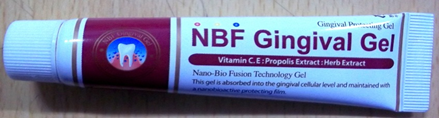
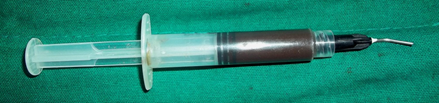
NBF GEL
The exclusion criteria include the systematically compromised patients and those on medications, grade II and grade III mobile teeth, pregnant and lactating women, subjects who underwent periodontal treatment within a period of one year, smokers and alcoholic subjects.
15 Subjects, divided into 45 quadrants satisfying the above mentioned criteria, were recruited in the study and with all the subjects, an initial examination with baseline data was recorded which include (fig 1)
- Gingival index 19643
- Papilla bleeding index 19774
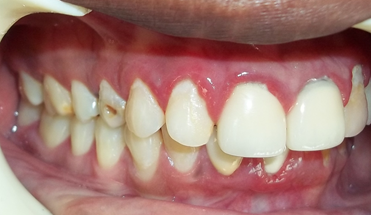
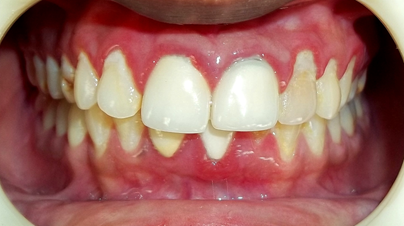

Scalling Plus Gel Placement
Gingival index of Loe and Silness (1964) is one of the most commonly used indices for assessing the status of gingival health and inflammation.
Papillary bleeding index: Muhlemann papillary bleeding index (1977) is based upon the rationale that gingivitis and periodontitis begin interproximally and effectiveness of preventive procedures are more easily related to the presence or absence of interproximal plaque. The results are translated into numerical scores which can be used to assess the patient.
Following the initial examination, quadrants were divided randomly into three groups 45 quadrants)
- IST group –scaling only
- IINDgroup –scaling followed by gingival instillation of NBF gel (fig 2)
- IIIRD group – gingival instillation of the NBF gel alone
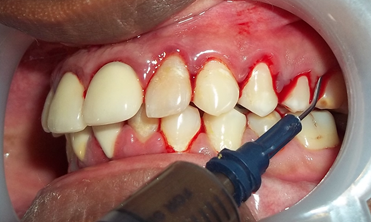
SALING PLUS GEL PLACEMENT
The NBF gel was applied on to the gingiva through a blunt cannula and prior to application, with the help of cotton rolls the particular quadrant was isolated. After application, the subjects were asked not to rinse for the next 30min. All the subjects were asked to follow proper oral hygiene measures.
All the subjects were evaluated at baseline and after one month of rendering treatment.
RESULTS
The study was carried out on 15 subjects fulfilling the eligibility criteria. Statistical analysis performed was the paired t test to evaluate the results
GINGIVAL INDEX
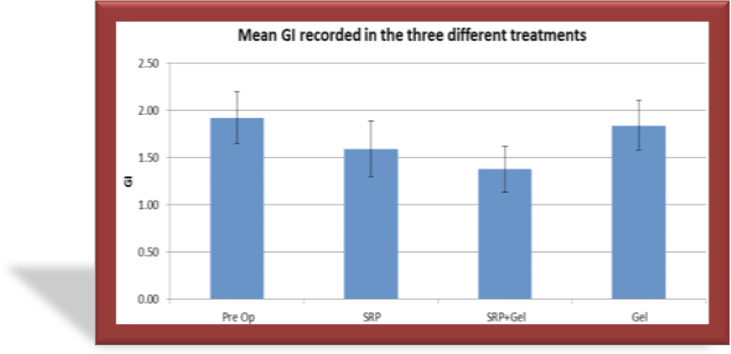
On comparing the gingival index(GI) it was noted that a mean difference noted in GI scores preoperatively and after application of gel alone was least ( 0.083), compared to that of pre-operative and scaling alone ( 0.331), but maximum difference in the mean GI scored were recorded with the group treated with scaling followed by gingival instillation of gel (0.545).
Thus the GI scores denotes clinically significant results for both the groups treated with gel alone and SRP with gel, but the results were better in the quadrant treated with scaling and gel placement.
Comparison of GI
|
GI |
Mean |
StdDev |
SE of Mean |
Mean Difference |
T |
P-Value |
|
Pre Op |
1.92 |
0.27 |
0.07 |
0.331 |
4.184 |
0.001* |
|
SRP |
1.59 |
0.30 |
0.08 |
|||
|
Pre Op |
1.92 |
0.27 |
0.07 |
0.545 |
8.626 |
<0.001* |
|
SRP+Gel |
1.38 |
0.24 |
0.06 |
|||
|
Pre Op |
1.92 |
0.27 |
0.07 |
0.083 |
3.540 |
0.003* |
|
Gel |
1.84 |
0.27 |
0.07 |
*denotes significant difference
The reduction in mean GI between Pre-Op and SRP was found to be statistically significant (P<0.01).
The reduction in mean GI between Pre-Op and SRP+Gel was found to be statistically significant (P<0.001).
The reduction in mean GI between Pre-Op and Gel was found to be statistically significant (P<0.01).
PAPILLA BLEEDING INDEX (PBI)
Correlating with the gingival index the PBI scores showed that a mean difference noted in PDI scores preoperatively and after application of gel alone was least ( 0.200), compared to that of pre-operative and scaling alone ( 0.449), and maximum difference in the mean GI scored were recorded with the group treated with scaling followed by gingival instillation of gel (0.638).
Thus the PBI scores denotes clinically significant results for both the groups treated with gel alone and scaling with gel, but the results were better in the quadrant treated with scaling plus placement of gel.
Comparison of PBI
|
PBI |
Mean |
StdDev |
SE of Mean |
Mean Difference |
T |
P-Value |
|
Pre Op |
2.69 |
0.53 |
0.14 |
0.449 |
4.508 |
<0.001* |
|
SRP |
2.24 |
0.46 |
0.12 |
|||
|
Pre Op |
2.69 |
0.53 |
0.14 |
0.638 |
6.699 |
<0.001* |
|
SRP+Gel |
2.05 |
0.45 |
0.12 |
|||
|
Pre Op |
2.69 |
0.53 |
0.14 |
0.200 |
3.877 |
0.002* |
|
Gel |
2.49 |
0.48 |
0.13 |
*denotes significant difference
The reduction in mean PBI between Pre-Op and SRP was found to be statistically significant (P<0.001).
The reduction in mean PBI between Pre-Op and SRP+Gel was found to be statistically significant (P<0.001).
The reduction in mean PBI between Pre-Op and Gel was found to be statistically significant (P<0.01).

DISCUSSION
Propolis is a resinous mixture collected from trees by the Apismelliferabee. It has important pharmacological properties and it can be used for a wide range of purposes as anti-inflammatory and hypotensive agent, immune system stimulant, and bacteriostatic and bactericidal agent, among many other uses. All such applications have increased its pharmaceutical demand and have rendered it an interesting subject of study. It’s fairly complex chemical composition includes phenols, tannins, polysaccharides, terpenes, aromatic acids and aldehydes, among other compounds.
Propolis has antibiotic activities that help the hive block out viruses, bacteria, and other organisms. Commercial preparations of propolis appear to retain these antibiotic properties, according to test tube studies. Test tube and animal studies have also shown that propolis exerts antioxidant, anti-inflammatoryand anticancer properties.5-7
Besides showing antimicrobial activity against periodontopathic bacteria, the propolis extract does not demonstrate selection of superinfectant organisms. Propolis mechanism of antimicrobial action, though not completely understood, seems to be complex and may vary according to its composition.
As an anti-inflammatory agent, propolis is shown to inhibit synthesis of prostaglandins, activate the thymus gland, aid the immune system by promoting phagocytic activity, stimulate cellular immunity, and augment healing effects on epithelial tissues. Additionally, propolis contains elements, such as iron and zinc that are important for the synthesis of collagen8.
Hence with the appropriate drug carrier agent, it is possible to administer the beneficial effect of this drug to the target site in the oral cavity
Nanotechnology uses the modern techniques to manufacture a material or structure purposefully with dimensions between 1 and 100 nanometers to leverage the unique properties it has at that size. The whole point behind it is the targeted delivery of vitamins, botanicals, and other active ingredients into gingiva. The smaller their size, the better is their penetrability. But with all these beneficial attribute comesthe controversies with nanoparticles. Firstly being how deeply can nanoparticles penetrate, secondly whether they can enter the blood stream, and if so, then to what extend. Some authors believe using nanoparticles crosses the line in terms of function and others are concerned about whether the use of nanoparticles is harmful.
Regarding the use of nanoemulsion base to carry drug Study done by chang-et-al9, on the effect of nanoemulsion for the presentation and treatment of gingival inflammation, it was observed nanoemulsion is effective in protection of gingiva and treatment of gingival diseases showed to be effective against the bacteria causing gingival disease. The results concluded significantly reduced edema in mice conformed by electron microscope, the mRNAs of Interleukin-1β significantly decreased, and it was also confirmed that the nanoemulsion inhibited the release of inflammatory cytokines. As a result of experiments with Staphylococcus and E. coli, it showed that it was antimicrobial with significant association with concentration.
The present study similar to the previous study uses NBF gingival gel in which Propolis is the main component along with Vitamin C and Vitamin E to compare its efficacy alone and as an adjunct to scaling, in patients with gingivitis
The present study indicated that the gingival heath of the subjects improved significantly in all the three sites irrespective of the treatment rendered. However, the sites which were treated with a combination of scaling and NBF gel application showed better results (P<0.001) as compared to the other sites. The results obtained are in accordance with the previous reports suggesting the anti-inflammatory and antibacterial effect of NBF gel
The present study uses propolis in a gel carrier whereas previous studies have been conducted where in propolis mouth wash have be tried and tested. In accordance with the study conducted by Koo et al. (2002)10 who evaluated the effect of a mouth rinse containing propolis on 3-day dental plaque accumulation. Six volunteers took part in a double-blind crossover study performed in two phases of 3 days. During each phase the volunteers refrained from all oral hygiene and rinsed with 20% sucrose solution 5 times a day to enhance dental plaque formation and with mouth rinse (placebo or experimental) twice a day. On the 4th day, the plaque index (PI) of the volunteers was scored. The plaque index for the experimental group was, significantly less than for the placebo group.
Study conducted by Coutinho Amita11where the clinical and microbiological parameters were assessed after subgingival irrigation with propolis extract, showed subgingival irrigation with propolis extract as an adjuvant to periodontal treatment was more effective than scaling and root planing. Apart from this Wolff et al. (in 1994) have also reported that the total viable counts are related to low numbers of periodontopathogenic organisms.12In this study, a reduction in the total viable counts of anaerobic bacteria was detected at 2 weeks after the irrigation procedures for group A, and this reduction was maintained at 6 weeks after the irrigation procedures.
Apart from the antigingivitis effect of propolis, its use in dentinal hypersensitivity is also evaluated. Mahmoud et al.13 conducted a pioneer study on the effect of propolis on dentinal hypersensitivity in vivo. It was concluded that propolis had a positive effect in the control of dentinal hypersensitivity.
Recent studies have shown weak but significant associations with development of gingivitis in subjects with vitamin C deficiency. Vitamin C has many metabolic functions relevant to the health of the periodontium, including collagen synthesis and immune function. Vitamin C is also powerful antioxidant, thus even marginal shortfalls in vit C supply may reduce its protective antioxidant effect. Increased levels of oxidative stress due to excessive production of reactive oxygen species are involved in the pathogenesis of periodontitis. Studies suggest a negative association between plasma vitamin C level and the severity of periodontitis.14
Ligature induced periodontitis in rats showed, gene expression encoding inflammation, including interleukin-1 alpha and interleukin-1 beta, was more than twofold down-regulated by vitamin C intake. The results suggest that systemic administration of vitamin C could be clinically beneficial in improving periodontitis-induced oxidative stress by down-regulating inflammatory gene expression.
Vitamin E is a lipid soluble antioxidant vitamin. Despite early studies showing no difference between plasma vitamin E in patients with and without gingivitis disease, more recent in vitro studies have shown vitamin E to have mitigating effects on indicators of gingival inflammation.
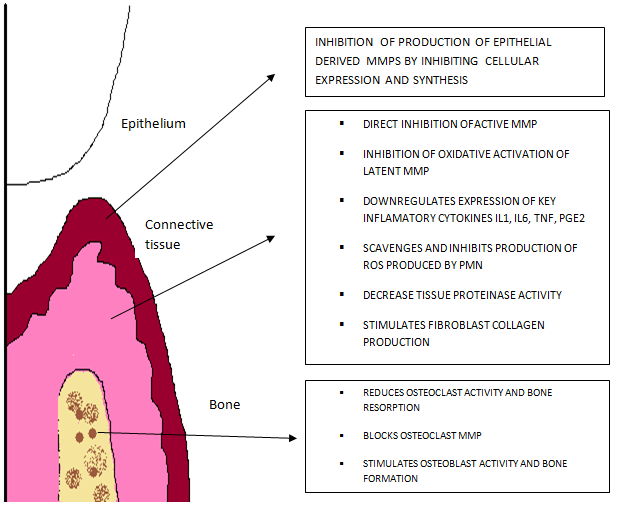
Research suggests that powerful antioxidant properties of vit E protect periodontal tissue from oxidative damage. Bacterial pathogens in plaque results in the host polymorphonuclear leukocytes, producing reactive oxygen species. ROS are universally aimed at bacterial targets and are also released into the host extracellular environment, causing damage to DNA, cell proteins, and memebrane lipid peroxidation. ROS also stimulate proinflammatory cytokine release by monocytes and macrophages15 and macrophages may also stimulate osteoclast activation.16 Patients with gingivitis and periodontitis have high levels of many ROS in gingival fluid17, and thus a relationship between ROS and periodontal inflammation has been reporter.
Although the antimicrobial properties of propolis have been the subject of many investigations, it is difficult to compare the results of different studies, due to the difference of composition of propolis and the different methods used for the evaluation of propolis antibacterial activities. Based on present study, nanaoemulsion significantly
reduced inflammation and this could be alluded to activation of the nano-sized propolis and vitamins.
CONCLUSION
Thus, with the results obtained from the present study it can be concluded that propolis along with vitamin C and E plays a beneficial role in preventing disease progression and the nano technology amplifies this effect. Though the results indicate anti-inflammatory property of the NBF gel, scaling still remains the gold standard treatment protocol and NBF gel can be used as an adjunct for improving the gingival status of an individual. Further research with a larger sample size is warranted to have a better understanding of the effectiveness of NBF gel in protection of gingiva and treatment of gingival diseases.
ACKNOWLEDGEMENTS
The authors acknowledge Dr.Vinod, Professor,Deptarment of conservative dentistry and endodontics,Theoxford dental college, Bangalore for his constant support throughout the study.
REFERENCES
- Ikeno K, Ikeno T, Miyazawa C. Effects of propolis on dental caries in rats, Caries Res 1991;25:347-51.
- Newman MG, Takei H, Klokkevold PR, Carranza FA. Carranza's clinical periodontology. 11th ed. Elsevier;2011.p.433.
- Silness J, Loe H. Periodontal disease in pregnancy. II. Correlation between oral hygiene and periodontal condition. ActaOdontolScand1964;22:121-35.
- Muhlemann HR. Psychological and chemical mediators of gingival health. J Prev Dent 1977;4:6-17.
- Pascual C, Gonzalez R, Torricella RG. Scavenging action of propolis extract against oxygen radicals. J Ethnopharmacol 1994;41:9–13.
- Dobrowski JW, Vohora SB, Sharma K, Shah SA, Naqvi SA, Dandiya PC. Antibacterial, antifungal, antiamoebic, antiinflammatory and antipyretic studies on propolis bee products. J Ethnopharmacol 1991;35:77–82.
- Choi YH, Lee WY, Nam SY, Choi KC, Park YE. Apoptosis induced by propolis in human hepatocellular carcinoma cell line. Int J Mol Med 1999;4:29–32
- Özana F, Sümerb Z, Polatc ZA, Erd K, Özane U, DeÄŸerf O. Effect of Mouthrinse Containing Propolis on Oral Microorganisms and Human Gingival Fibroblasts. Eur J Dent. 2007;1:195–201.
- Chae CH, Park JW. The study on the effect of nanaoemulsion for the prevention and treatment of gingival inflammation. J kor oral maxillofacsurg 2007;33(5)
- Koo H, Cury JA, Rosalen PL, Ambrosano GM, Ikegaki M, Park YK. Effect of a Mouthrinse Containing Selected Propolis on 3-Day Dental Plaque Accumulation and Polysaccharide Formation. Caries Res 2002;36(5):445–8
- Coutinho A. Honeybee propolis extract in periodontal treatment: A clinical and microbiological study of propolis in periodontal treatment. Indian J Dent Res 2012; 23( 2):294.
- Wolff L, Dahlen G, Aeppli D. Bacteria as risk markers for periodontitis. J Periodontol 1994;65:498-510.
- Mahmoud AS, Almas K, Dahlan AA. The effect of Propolis on dentinal hypersensitivity and level of satisfaction among patients from a university hospital, Riyadh, Saudi Arabia. Indian J Dent Res. 1999;10:130–7.
- Tomofuji T, Ekuni D, Sanbe T, Irie K, Azuma T, Maruyama T et al. Effects of vitamin C intake on gingival oxidative stress in rat periodontitis. Free RadicBiol Med 2009;46(2):163-8.
- Chapple ILC. Reactive oxygen species and antioxidants in inflammatory diseases. J ClinPeriodontol 1997;27:287-96
- Hall TJ, Schaeublin M, Jeker H, Fuller K, Chambers TJ. The role of reactive oxygen intermediates in osteoclastic bone resorption. BiochemBiophys Res Commun 1995;207(1):208-87.
- Diab-Ladki R, Pellat B, Chahine R. Decrease in total antioxidant activity of saliva in patients with periodontal disease. Clin Oral Investig 2003;7:103-7
Disclaimer from Guident
The views and opinions expressed in articles published in Guident are solely those of the authors and do not necessarily reflect the views of the editors, the editorial board or the publisher, Ivory India. Guident does not endorse any product, technique or treatment described. Clinical content is intended for qualified dental and medical professionals and is not a substitute for individual clinical judgement. Guident, its editors and the publisher accept no liability for any consequence arising from the use of information published in the journal.
How to cite this article
Dr. Anirban Chatterjee, Dr. V. Sneha. Evaluate the Efficacy of NBF Gel as an Adjunct to Scaling in Gingivitis-a Clinical Study. Guident. 2014 Jul;7(8). Available from: https://guident.net/articles/research/evaluate-the-efficacy-of-nbf-gel-as-an-adjunct-to-scaling-in-gingivitis-a-clinical-study.html