An Extra Coronal Attachment Retained-Bilateral Distal Extension-Kennedy Class 1-Cast Partial Denture
Department of Prosthodontics MCODS, Karnataka, Mangalore (India)
Abstract
In our fast paced and upwardly & upwardly mobile society, patients will see a dentist for two main reasons:-discomfort &/ esthetics. The dental professional must be able to relate to patient’s concerns both physically & psychologically. An attachment retained removable partial denture is not an outdated treatment modality. There are a significant number of patients who could benefit from this treatment option both short & long term. In this particular case, a lower attachment retained cast partial denture was chosen as a treatment modality. This article provides a simplified approach to this treatment option.
Key words:-Extra coronal attachments, Cast partial denture.
INTRODUCTION
Rehabilitation of partially edentulous situations can be challenging especially when it is a distal extension situation and fixed prosthesis cannot be fabricated. Implant retained restoration can be a treatment option but it is not always possible due to insufficient amount of bone or economic reasons. Attachment retained RPD is the treatment modality that can facilitate both esthetic & functional replacement of missing teeth & oral structures. The few retrospective studies available show a survival rate of 83.3% for 5 yrs, 67.3% up to 15 yrs, & 50% when extrapolated to 20 yrs.
This article describes a case report of a patient with mandibular bilateral distal extension Kennedy’s class I condition which is prosthetically restored by a cast partial denture retained using an extra coronal castable precision attachment (RHEIN 83 OT CAP attachments system).
CASE REPORT
A 66 yr old female patient reported to the department of Prosthodontics, with a chief complaint of missing upper & lower teeth and inability to chew food. She gave a history of unsatisfactory acrylic upper and lower removable denture. She was wearing a lower bilateral distal extension removable partial denture & presence of mandibular extra coronal clasp retainers was negatively affecting the aesthetics.
On intra- oral examination, it was noted that the patient had a completely edentulous upper arch & partially edentulous lower arch. Periodontally stable, 31, 32, 33, 34, 41, 42, 43 were present. Generalised attrition was seen with the remaining natural lower teeth. In lieu of compromised aesthetics, impaired function with existing partial denture, it was planned to fabricate mandibular removable cast partial denture with extra coronal attachment & upper acrylic complete denture after a thorough clinical & radiographic examination.
Intra Oral view showing upper complete edentulous arch and lower Kennedy Class 1 situation

Fig 1
STEP WISE PROCEDURE
1) After a complete oral prophylaxis, diagnostic impressions were made & mounted on a Hanau Wide Vue articulator using a face bow. Following which a diagnostic wax-up was done on the mounted casts.
2) A putty matrix (Reprosil, Dentsply) was made over the completed diagnostic wax up for evaluation of existing space for the extra coronal resilient attachment.
3) The attachment system was selected on the basis of the available space (OT CAP RHEIN 83 Inc, USA – Extra coronal castable attachments).
4) Tooth preparation was done from 31 to 34 and 41 to 43 to receive full coverage metal ceramic restorations. The final impression was made (“Reprosil, Dentsply ) & poured in die stone.(fig 2 )
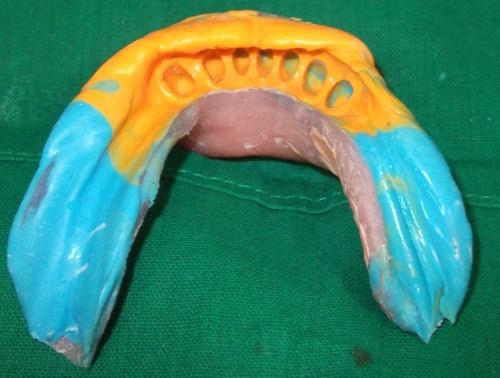
Fig 2
5) Following which crowns (splinted 41, 42, 43, 44 & 31, 32,33 ) have been waxed to full contour and milled in wax for maximum guiding plane surfaces.
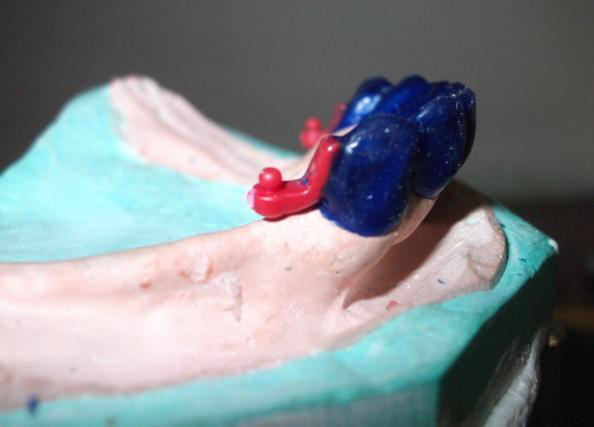
6) The patrices were added to the axial surfaces of the abutment using a dental surveyor, lingual to the centre of the proximal contour. This ensures that the bulk of the patrix does not interfere with the aesthetic of buccal cusp of the replacing denture tooth. (Fig 3)

(Fig 3 a)
(Fig 3 b)
7) Following which casting, finishing and veneering of the fixed component was done. (Fig 4)

( Fig 4 a)

( Fig 4 b)

( Fig 4 c)
8) The fixed component including the veneered metal ceramic crowns & the patrices were tried in the patient’s mouth & a pick-up impression (Reprosil (medium body) was made (fig 5).

(fig 5)
9) Master cast was poured with Die stone. The matrices for the attachments (nylon ring into the acrylic resin steel housings) were placed in the receptacles (patrices of the attachment) which were in the crowns of the master cast. After surveying, designing & block out, the master cast was duplicated (Reversible Hydrocolloid Impression material). (fig 6 )

(Fig 6)
10) The wax up for the metal framework of the cast partial denture was done on the refractory cast, casted & invested. (fig 7)

(fig 7)
11) After finishing & polishing of the metal framework, the framework was evaluated in the patient’s mouth & a functional impression was made using the metal framework. (fig 8 & 9)

(fig 8)
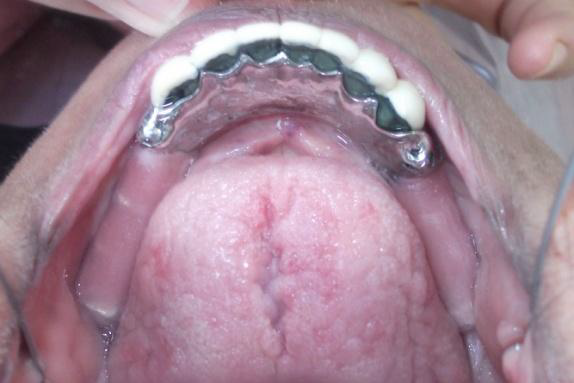
(fig 9 a)
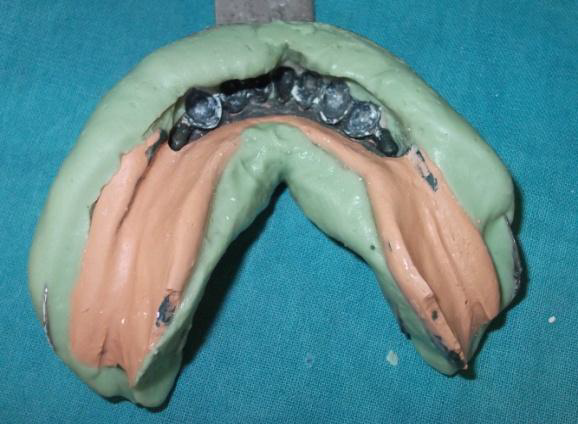
(fig 9 b)
12) Jaw relations was done using occlusal rims, followed by try-in (fig 10) & acrylisation of the upper complete denture & lower cast partial denture.

fig-10-Try- in appointment

fig-10b-Try- in appointment

fig-10c-Left Lateral view

fig-10d-Right lateral view
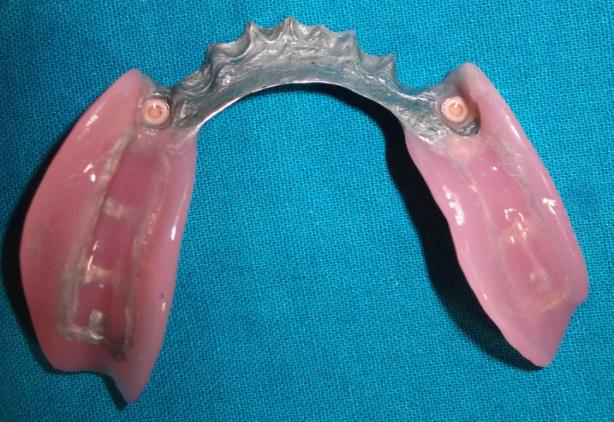
fig-10e-Lower cast partial denture

fig-10f-Intra oral View

DISCUSSION
The disadvantages reportedly associated with RPD, such as patient discomfort, ill-fitting loose prosthesis, decreased phonetics & masticatory efficiency were avoided. Dr Herman Chayes1 first reported the invention of attachment in the early 20th century. Precision attachment has exceptional feature of being a removable prosthesis with improved aesthetics, less post operative adjustments & better patient comfort & compliance. They are mostly indicated in long term edentulous spans, distal extension bases & non parallel adjustments.
The stress control on the abutment is an essential factor for the success of distal extension cast partial denture which is achieved through a dual impression technique, broad coverage & stable denture base, rigid design, physiologic shimming, splinting of abutments & proper selection of attachment2,3.
In this case report, abutment were of adequate clinical crown height to receive attachment, multiple abutments were splinted anterior to edentulous span to aid in better distribution of stresses.
Moreover, extra coronal OT CAP are castable attachments with elastic retention. With its elasticity, it is possible to control the flexure & construct a resilient & shock absorbing prosthesis1,3.
SUMMARY
Distal extension removable partial dentures fabricated with precision attachment are viable options for patients in whom fixed prosthesis, implants are contra indicated. Adherence to precision techniques, proper diagnosis & periodic follow up of the patient will result in successful treatment & preservation of patient’s existing dentition.
REFERENCES
- Sumit Makkar, et al:Attachment retained removable partial denture - A case report : IJCDS May 2011; 39-43
- Burns DR, Ward|£: A review of attachments for removable partial denture design: Part 1. Classification and Selection, Int J Prosthodont 1990; 3; 9e-10
- Burns DR, Ward|£: A review of attachments for removable partial denture design: Part2. Classification and Selection, Int J Prosthodont 1990; 3 ;9e-102
- Preiskel HW. Precision attachment in prosthdontics.1&2. London: Quintessence Publishing Co Ltd, 1995
- Preiskel H. Precision attachments for free-end saddle prostheses. Br Dent J 1969;127: 462-468.
- Preiskel H. Precision attachments in Prosthodontics .Overdentures & telescopic prosthesis. London: Quintessence Publishing Co Ltd, 1995
Disclaimer from Guident
The views and opinions expressed in articles published in Guident are solely those of the authors and do not necessarily reflect the views of the editors, the editorial board or the publisher, Ivory India. Guident does not endorse any product, technique or treatment described. Clinical content is intended for qualified dental and medical professionals and is not a substitute for individual clinical judgement. Guident, its editors and the publisher accept no liability for any consequence arising from the use of information published in the journal.
How to cite this article
Dr. Divya Raigangar Dr. Shobha Rodrigues Dr. Umesh Pai. An Extra Coronal Attachment Retained-Bilateral Distal Extension-Kennedy Class 1-Cast Partial Denture. Guident. 2014 Jul;7(8). Available from: https://guident.net/articles/prosthodontics/an-extra-coronal-attachment-retained-bilateral-distal-extension-kennedy-class-1-cast-partial-denture.html