Simplifying Anterior Rehabilitation: A Case Report Using Prefabricated Post and Core and Custom Tray Impression Techniques
Department of Prosthodontics and Crown & Bridge, K.D. Dental College & Hospital, Mathura, UP, India.
ABSTRACT
Anterior rehabilitation plays a crucial role in restoring the esthetics, function, and structure of compromised anterior teeth. This case report highlights the use of prefabricated post and core systems in combination with custom tray impression techniques to restore severely worn and missing anterior teeth. A 42-year-old female patient presented with concerns about the poor aesthetics of her anterior teeth, with teeth 11 and 21 missing and tooth 12 severely worn. Radiographic evaluation revealed that teeth 12 and 21 had undergone root canal treatment. The treatment plan involved placing a fiber post in tooth 12, followed by full coverage porcelain-fused-to-metal crowns on teeth 13, 12, 11, 21, 22, and 23. The clinical steps included post space preparation, tooth preparation, provisional restorations, and definitive impressions using a custom tray. The final restorations were fabricated and cemented, achieving a functional and esthetically pleasing result that met the patient's expectations. This case demonstrates the effectiveness of combining prefabricated post and core systems with custom tray impressions for predictable and successful anterior rehabilitation.
INTRODUCTION
Anterior rehabilitation is a crucial aspect of restorative dentistry, focusing on the restoration of esthetics, function, and structure in the anterior segment of the dental arch. It involves careful consideration of both biomechanical and esthetic requirements to ensure long-term success and patient satisfaction. One of the key challenges in anterior rehabilitation, especially in cases of severely compromised teeth, is achieving sufficient retention and resistance for the final restoration. This often necessitates the use of post and core systems.
The use of prefabricated post and core systems has gained popularity due to their ease of use, time efficiency, and predictable outcomes. These systems provide an immediate solution for teeth with significant coronal destruction, where conventional crown preparation would lack adequate support. Prefabricated posts, typically made from materials such as stainless steel, titanium, or fiber-reinforced composites, offer the advantage of uniform size and shape, simplifying the restoration process.
In conjunction with the use of prefabricated post and core systems, accurate impressions are essential for the fabrication of prosthetic restorations. The custom tray impression technique plays a pivotal role in ensuring precise replication of the intraoral structures, including the post-restored teeth and surrounding soft tissues. Custom trays, tailored to the patient's specific anatomy, enhance the accuracy of impressions by providing even distribution of impression material and minimizing distortion.
This combination of prefabricated post and core systems with the custom tray impression technique allows for predictable, efficient, and esthetically pleasing anterior rehabilitations, making it an invaluable approach in modern prosthodontic practice.
CASE REPORT
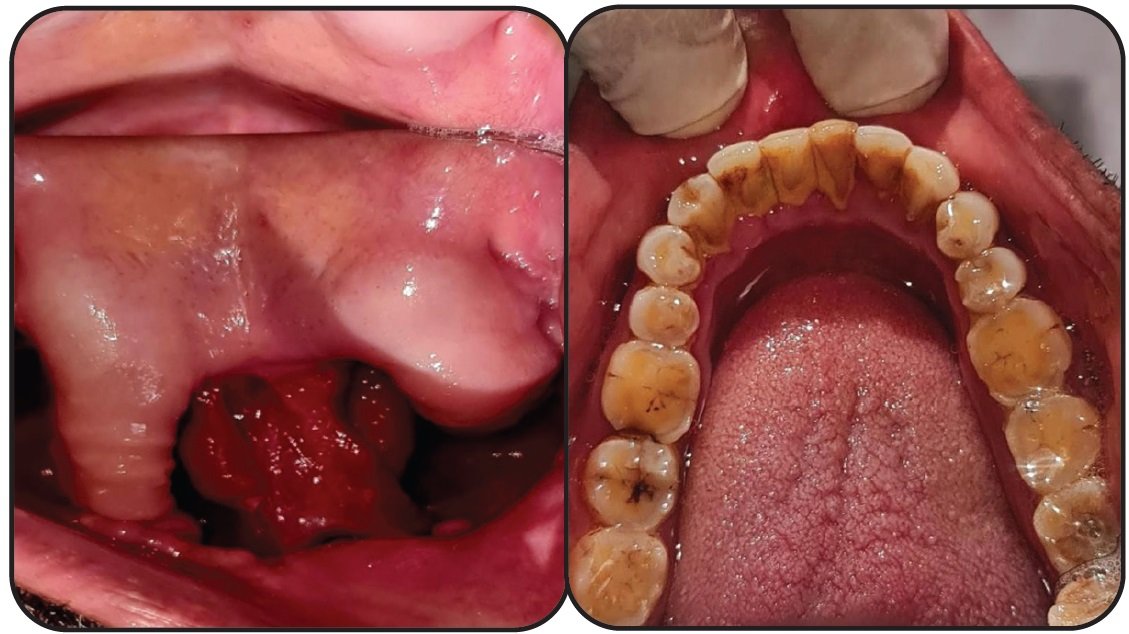
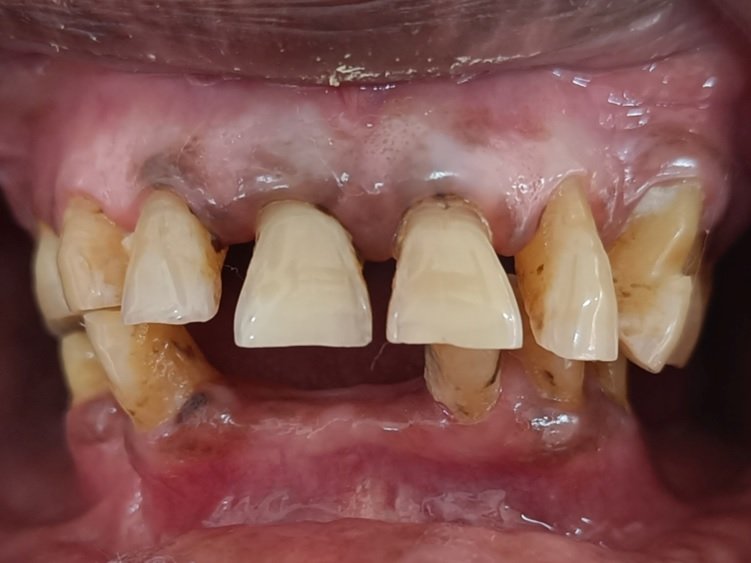
A 42-year-old female patient presented to the Department of Prosthodontics and Crown & Bridge at K D Dental College and Hospital, Mathura, with the primary concern of unsatisfactory aesthetics caused by several missing and severely worn anterior teeth. The patient expressed a desire to have them restored.
Intraoral examination revealed that teeth 11 and 21 were missing, while tooth 12 was severely worn. Radiographic evaluation showed that teeth 12 and 21 had undergone root canal treatment. The treatment goal was to restore the form and function of the compromised teeth. The planned treatment included placing a fiber post in tooth 12, followed by full coverage porcelain-fused-to-metal crowns on teeth 13, 12, 11, 21, 22, and 23.

CLINICAL STEPS
Diagnostic impressions of the maxillary and mandibular arches were made. and the impressions were poured with dental stone to create the diagnostic cast.
The post space preparation for tooth 12 was performed using Peeso reamers, progressing from sizes 1 to 4. Care was taken to retain 4 mm of gutta-percha at the apex to ensure the preservation of the periapical seal. Once the post space preparation was complete, the apical seal and the quality of the prepared canal were thoroughly assessed. A fiber post was then carefully positioned within the prepared canal to provide structural support. Following this, composite material was used to complete the core build-up, restoring the tooth's foundational structure in preparation for the final prosthetic restoration.


Tooth preparation was completed on teeth 13, 12, 11, 21, 22, and 23.

Definitive impressions were initially taken using alginate material, and the impressions were poured with type IV dental stone to create the definitive cast. The maxillomandibular relationship was then recorded using an interocclusal registration material. Following this, provisional restorations were fabricated and cemented in place using non-eugenol temporary cement to provide interim protection and aesthetics.
The patient was recalled after 2 days for the final impression. A custom tray had been fabricated beforehand using autopolymerizing acrylic resin.

Prior to taking the final impression, the wax spacer was removed from the tray, and multiple perforations were created to facilitate better flow and escape of excess impression material and tray adhesive were applied.
The final impression was made using a combination of addition silicone putty and light-body material to ensure accurate capture of the prepared teeth and surrounding tissues.

The metal framework was fabricated and then carefully tried in to ensure proper fit and alignment. Following the successful try-in.

The shade for the porcelain-fused-to-metal crowns was selected to match the patient's natural dentition. Once the crowns were fabricated, they were meticulously cemented in place using luting glass ionomer cement to ensure long-lasting retention and stability. The final restoration was evaluated, and the treatment outcome successfully met the patient's expectations, both functionally and aesthetically. The patient was satisfied with the overall result, which restored the appearance and function of the affected teeth.


DISCUSSION
Anterior rehabilitation is essential for restoring both function and esthetics in compromised anterior teeth. This case report highlights the use of prefabricated post and core systems, combined with custom tray impression techniques, to restore severely worn and missing anterior teeth. Prefabricated posts, particularly fiber-reinforced composites, provide necessary retention and structural support, especially when the coronal tooth structure is significantly compromised. These posts are advantageous because they have a similar modulus of elasticity to natural dentin, which reduces the risk of root fractures, and they bond effectively with composite materials used for core build-up (Zickert et al., 2007).
Custom tray impressions are key to ensuring that the final prosthetic restorations fit accurately. Custom trays, tailored to the patient’s unique anatomy, offer better control of impression material flow and help prevent distortions during the impression-taking process. The addition silicone materials used in this case are known for their dimensional stability, which ensures highly accurate impressions for crown fabrication (Miklus et al., 2004).
The successful outcome of this case, both functionally and esthetically, reflects the effectiveness of combining these two techniques. Fiber posts provided the necessary support for the final crowns, while the custom tray impression technique ensured the accurate capture of the prepared teeth and soft tissues. Porcelain-fused-to-metal crowns were selected for their strength and esthetic qualities, achieving a seamless integration with the patient's natural dentition. This approach demonstrates how prefabricated post and core systems, combined with custom tray impressions, offer a predictable and efficient method for anterior rehabilitation.
CONCLUSION
The combination of prefabricated post and core systems with custom tray impressions provides a reliable, predictable approach to anterior rehabilitation. Fiber posts offer the necessary structural support for compromised teeth, while custom tray impressions ensure the creation of precise restorations. This case highlights the effectiveness of these techniques in achieving both functional and esthetic outcomes in anterior restorations.
REFERENCES
- Cavalli, V., Leonardi, M. I., & Silva, E. M. (2000). A study on the stress distribution in teeth restored with composite resin and fiber posts. Journal of Prosthetic Dentistry, 84(3), 273-278.
- Kern, M., & Thompson, V. P. (2007). The clinical performance of porcelain-fused-to-metal crowns. Journal of Prosthetic Dentistry, 97(2), 57-67.
- Miklus, M. R., Tan, H., & Epstein, P. M. (2004). Comparison of impression materials in the restoration of implant-supported prostheses. Journal of Prosthodontics, 13(1), 39-42.
- Zickert, I., Wing, K. R., & Karlsson, S. (2007). Bonding of fiber-reinforced composite posts to root dentin: A review of current techniques and materials. Journal of Adhesive Dentistry, 9(4), 319-326.
- D Saini V Legha Esthetic rehabilitation of mutilated anterior teeth with custom cast post and core porcelain- fused-to-metal crownsInt J Experiment Dent Sci2015416971
- Satija R, Singla MG. Customizing the prefabricated fiber post: A case report. IP Indian Journal of Conservative and Endodontics. 2021;6(3):176-80.
- Bhatti UA, Javed MQ, Al Attas MH. Intra-radicular reinforcement using a modified fiber post customization technique: a case report. Pan African Medical Journal. 2021 Dec 20;40(1).
- Gopi A. An in vitro comparative evaluation of accuracy of impressions using different types of impression trays. Journal of Dentistry Defense Section. 2023 Jan 1;17(1):15-22.
- Priyadarshini KS, Nandini VV, Lathief J. Dimensional Stability and Retention Strength of Impressions to Custom Impression Trays Fabricated Using Conventional Method and Additive Technology-An In-vitro Study. Indian Journal of Dental Research. 2023 Oct 1;34(4):427-32.
Disclaimer from Guident
The views and opinions expressed in articles published in Guident are solely those of the authors and do not necessarily reflect the views of the editors, the editorial board or the publisher, Ivory India. Guident does not endorse any product, technique or treatment described. Clinical content is intended for qualified dental and medical professionals and is not a substitute for individual clinical judgement. Guident, its editors and the publisher accept no liability for any consequence arising from the use of information published in the journal.
How to cite this article
Dr. Shikha Shahi, Dr. Sanskriti Tomar, Dr. Manesh Lahori. Simplifying Anterior Rehabilitation: A Case Report Using Prefabricated Post and Core and Custom Tray Impression Techniques. Guident. 2024 Dec;18(1). Available from: https://guident.net/articles/prosthodontics/simplifying-anterior-rehabilitation-a-case-report-using-prefabricated-post-and-core-and-custom-tray.html