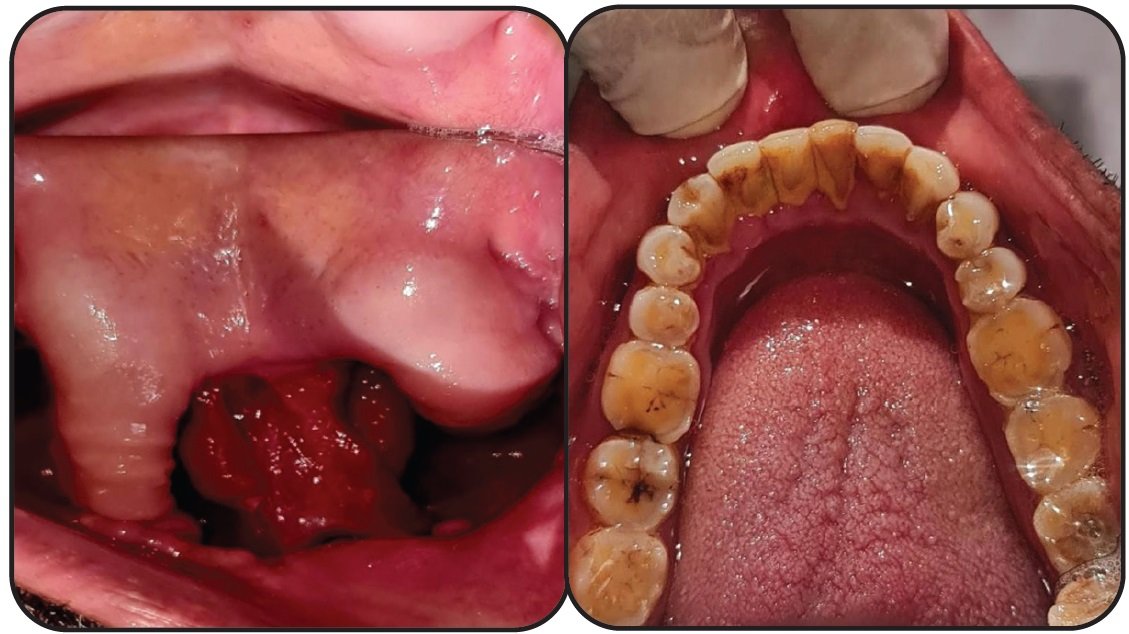
Beyond Traditional Methods: DMLS Cast Partial Denture with Saggix Attachment for Kennedy Class I Edentulous Space: A Case Report
Department of Prosthodontics and Crown & Bridge, Sardar Patel Post Graduate Institute of Dental and Medical Sciences, Lucknow, Uttar Pradesh, India
ABSTRACT
This case report highlights the successful rehabilitation of a patient with a Kennedy Class I edentulous space utilizing Direct Metal Laser Sintering (DMLS) technology coupled with Saggix extra-coronal attachments. The patient presented with a posteriorly bilateral edentulous space bounded by natural teeth anteriorly, necessitating a prosthetic solution that could deliver optimal retention, stability, comfort, and aesthetics. The final restoration achieved an excellent fit, harmonious occlusion, and natural esthetics, meeting the functional and aesthetic demands of the patient. Clinical evaluation revealed enhanced stability and comfort compared to conventional partial dentures, attributed to the customized design and secure retention provided by Saggix attachments. Furthermore, the utilization of DMLS technology facilitated rapid fabrication with minimal material waste, underscoring its efficiency and sustainability in prosthodontic practice. This case report demonstrates the transformative potential of integrating digital dentistry and innovative materials in the rehabilitation of Kennedy Class I edentulous spaces. Both traditional and modern treatment approaches and planning are necessary for this kind of success.
Keywords: Removable partial denture, Semi-Precision attachment, Custom attachments, Kennedy Class I, DMLS, Digital Dentistry
INTRODUCTION
The restoration of edentulous spaces presents a significant challenge in prosthodontic practice, particularly when addressing cases classified under Kennedy Class I. Traditional approaches to prosthetic rehabilitation often encounter limitations in providing optimal retention, stability, comfort, and aesthetics in such cases. However, advancements in digital dentistry have introduced innovative solutions that offer precision, customization, and improved patient outcomes.
This article presents a case report detailing the successful rehabilitation of a patient with a Kennedy Class I edentulous space using a Direct Metal Laser Sintering (DMLS) cast partial denture integrated with Saggix extra-coronal attachments. This approach not only addresses the functional and aesthetic requirements of the patient but also showcases the transformative potential of modern prosthetic techniques in overcoming conventional limitations. Through this case study, we aim to highlight the efficacy and advantages of employing DMLS technology and Saggix attachments in prosthodontic rehabilitation.
A number of reports have been published regarding the framework and the direct retainer designs to improve the comfort and acceptance of the patient wearing RPD.1 To achieve retention in cast partial dentures, precision attachments are commonly employed, which can be either extracoronal or intracoronal.2 Research indicates a survival rate of 83.35% for 5 years, 67.3% for up to 15 years, and a 50% projection for 20 years.3,4
CASE REPORT
A 63-year-old female reported with multiple missing teeth. On intraoral examination (Figure 1), it was noted that the patient had missing 16,17,26,27,35,36,37,31,41,42,44,46 & 47. The remaining teeth in maxillary and mandibular arch were periodontally stable. Extra-oral examination revealed decreased vertical dimension, drooping of the corner of the lips and everted lower lip. There was no abnormality detected on examination of TMJ.
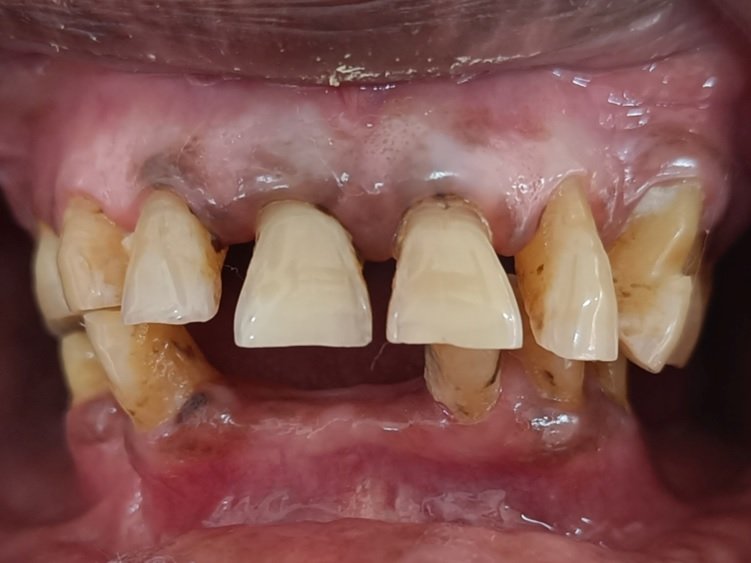
Fig. 1 : Intra-oral frontal view
After complete clinical and radiographic examination and understanding of the patient’s needs, age and economic status, a suitable treatment plan was selected. Cast partial denture with extra coronal precision (saggix) for maxillary and mandibular bilateral distal extension arch and FPD for mandibular & maxillary anterior teeth attachment was planned.
The diagnostic impressions were made using irreversible hydrocolloid impression material and casts were fabricated and a diagnostic jaw relation was done on a mean value articulator. Pre-prosthetic mouth preparation was done which included Root canal treatment was performed with respect to 11, 12, 13, 14, 15, 21, 22, 23, 24, 25, 32, 33, 34, 35, 43 & 45.
Tooth preparation of all the present teeth was performed to receive porcelain fused to metal crowns along with saggix attachment distally (Figure 2), a two-stage putty-light body impression using addition silicone were made. The prepared abutments were temporized after the final impression.
Impression were poured in type IV gypsum. Wax rims were fabricated on the casts, facebow transfer was done to a semi adjustable articulator, jaw relation was done and casts were mounted.
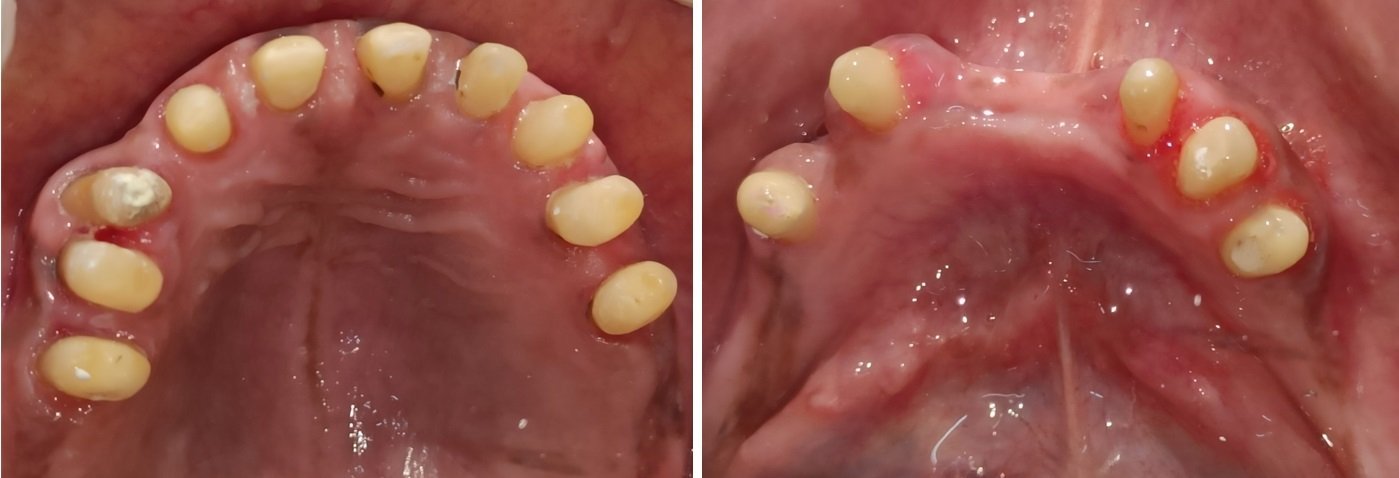
Fig. 2: Tooth preparation occlusal view
Lab scan of the cast was performed and splinted DMLS metal coping were fabricated along with the distal attachments for teeth 13 to 15, 23 to 25, 44-35 and individual DMLS metal coping were fabricated for the abutment 11,12,21 & 22 .
Copping trial (Figure:-3) was performed followed by ceramization . Bisque trail was done followed by pickup impression for the fabrication of DMLS cast partial denture Framework. Palatal stap major connector for maxillary arch and lingual bar major connector along with proximal rest seat on 45 & 35 for mandibular arch was designed.

Fig. 3: Metal coping try-in
DMLS framework along with teeth setting was tried intraorally with FPD (bisque) on the abutment tooth (Figure:-4). The trial denture was sent for acrylization and cast partial denture along with FPD was finished and polished. (Figure:-5)

Fig 4: CPD Try-In along with Bisque trail

Fig. 5a: Final metal housing in cast metal framework with polyacetyl female part

Fig. 5b: Occlusal surface of final prosthesis
Trial seating of the finished prosthesis was performed and cementation of crowns was done using Glass Ionomer cement (GC Fuji). Attachments are protected with a thin layer of petroleum jelly (Vaseline) in order to easily remove cast partial denture after joint PFM crowns with attachment have been seated. Complete seating of finished maxillary and mandibular combined prosthesis with distal extension precision attachment was evaluated clinically and the patient was recalled after 24 hrs for postinsertion follow-up. (Figure:-6)

Fig. 6a: Final prosthesis insertion

Fig. 6b: Extraoral pre-operative view & Fig.6c: Extraoral post-operative view
DISCUSSION
A precision attachment serves as a connector comprising multiple parts, with one part connected to a root, tooth, or implant, and the other part to the prosthesis, creating a mechanical link between them. These attachments offer the advantages of both fixed and removable restorations, as they allow prostheses to combine these features effectively.,sup>5 Dr. Herman Chayes is credited with inventing the attachment in the early 20th century.6 The use of precision attachments in removable prostheses provides notable benefits such as improved aesthetics, reduced postoperative adjustments, and enhanced comfort. They find particular indication in long-span edentulous arches, distal extension bases, and non-parallel abutments.7
A diverse range of precision attachments is available for various restorative procedures, including partial dentures and implant-supported prostheses. Through the analysis of study models and X-rays, clinicians can make crucial determinations that influence the final attachment selection. Precision attachments not only enhance the esthetics and retention of removable partial dentures but also offer greater flexibility in the design of such restorations. Correctly choosing the attachment can solve esthetic and retention challenges, eliminating the need for unnecessary surgery and the alteration of sound teeth for abutment preparation.
However, precision attachments come with some disadvantages. Many attachments are small and consist of several parts that require skilful assembly by dental technicians, necessitating specialized training. Additionally, the attachment parts are subject to wear and tear and may need replacement over time.8
The case discussed in this paper employs the Saggix attachments system, which is an extracoronal attachment positioned on the distal aspect of the crowns as an extension, providing ample vertical space for optimal aesthetics. During the designing stage, the Saggix male part can be easily shaped together with the crowns, eliminating the need for complicated adaptation procedures, such as welding a metal attachment after crown casting. The male component design features a sphere with a flat head, while the female component consists of retentive nylon caps color-coded according to their different retentive properties attached to the DMLS cast partial denture in the female housing.
CONCLUSION
Removable partial dentures remain a viable treatment option for partially edentulous individuals with Kennedy's class I and class II conditions. When carefully selected and planned, the inclusion of precision attachments like the RHEIN 83 OT CAP attachments system can significantly enhance the retention, aesthetics, and functionality of the removable partial denture. This approach allows the creation of highly functional and comfortable prosthetic solutions for patients with edentulous bilateral distal extension cases. Furthermore, the retention provided by the attachments can be monitored and improved over time simply by replacing the retentive caps within the denture framework, ensuring ongoing patient comfort and satisfaction.
REFERENCES
- Eggbeer D, Bibb R, William R. The computer aided design and rapid prototyping fabrication of removable denture frameworks. J Eng Med. 2005;219(3):195–202.
- J.L.BakersandR.J.Goodkind,PrecisionAttachmentRemovable Partial Dentures, Mosby, San Mateo, Calif, USA, 1981.
- Makkar S, Chhabra A, Khare A. Attachment retained removable partial denture: a case report. Int J Clin Dent Sci 2011;2(2):39–43
- Angadi PB, Aras M, William C, Nagaral S. Precision attachments: Applications and limitations. Journal of Evolution of Medical and Dental Sciences.2012;1(6):1113-1121.
- D. R. Burns and J. E. Ward, “Review of attachments for removable partial denture design: 1. Classification and selection,” The International Journal of Prosthodontics, vol. 3, no. 1, pp. 98–102, 1990.
- H W Preiskel Precision Attachments in Prosthodontics: Over- dentures and Telescopic Prostheses19852Quintessence Publish- ingChicago, Ill, USA
- H W Preiskel Precision Attachment in Prosthodontics1-2Quintessence PublishingLondon, UK1995
- E. Feinberg, “Diagnosing and prescribing therapeutic attachment-retained partial dentures,” The New York State Dental Journal, vol. 48, no. 1, pp. 27–29, 1982.
Disclaimer from Guident
The views and opinions expressed in articles published in Guident are solely those of the authors and do not necessarily reflect the views of the editors, the editorial board or the publisher, Ivory India. Guident does not endorse any product, technique or treatment described. Clinical content is intended for qualified dental and medical professionals and is not a substitute for individual clinical judgement. Guident, its editors and the publisher accept no liability for any consequence arising from the use of information published in the journal.
How to cite this article
Dr. Puja Saha, Dr. Shitij Srivastava, Dr. Unnati Agarwal. Beyond Traditional Methods: DMLS Cast Partial Denture with Saggix Attachment for Kennedy Class I Edentulous Space: A Case Report. Guident. 2024 Dec;18(1). Available from: https://guident.net/articles/prosthodontics/beyond-traditional-methods-dmls-cast-partial-denture-with-saggix-attachment-for-kennedy-class-i-edentulous.html