Modern Advances in Retentive Aids for Maxillofacial Prostheses in Cancer Rehabilitation: A Contemporary Review
Department of Prosthodontics and Crown & Bridge, K.D. Dental College & Hospital, Mathura, UP, India
ABSTRACT
Maxillofacial defects following oncologic resection cause significant functional, esthetic, and psychosocial impairment, requiring effective prosthetic rehabilitation. Retention is a key determinant of prosthesis success, especially in patients with altered anatomy and compromised tissues. Conventional retentive aids have limitations, prompting a shift toward implant-supported and digitally driven approaches. Craniofacial implants provide predictable retention, while magnetic and hybrid systems offer alternatives in complex cases. Digital workflows involving CBCT, CAD/CAM, and 3D printing have improved precision and prosthesis adaptation. Emerging advances, including improved adhesives and artificial intelligence, show promise. However, challenges such as radiotherapy effects and cost remain, necessitating individualized, multidisciplinary treatment strategies.
KEYWORDS- Maxillofacial prosthesis, Retentive aids, Cancer rehabilitation, Craniofacial implants, Digital workflow, 3D printing, Magnetic retention
1. INTRODUCTION
Maxillofacial defects following oncologic resection result in functional impairment, esthetic disfigurement, and psychological distress. Prosthetic rehabilitation remains a primary treatment modality when surgical reconstruction is limited or contraindicated. Retention and stability are key determinants of long-term prosthesis success and patient acceptance.1
Traditional retention methods such as anatomical undercuts, adhesives, and mechanical aids have been widely used; however, these approaches often show limitations in cancer rehabilitation patients due to scar tissue formation, altered anatomy, and radiation-induced tissue changes.2 Recent advances in implantology, digital workflows, and biomaterials have significantly transformed retention strategies in maxillofacial prosthodontics.3
This review summarizes modern advances in retentive aids with special emphasis on cancer rehabilitation and future technological directions.
2. LITERATURE SEARCH STRATEGY
A literature search was conducted using PubMed, Scopus, and Google Scholar databases. Keywords included maxillofacial prosthesis, retentive aids, craniofacial implants, digital workflow, 3D printing, and cancer rehabilitation. Articles published between 2018 and 2025 were included, focusing on systematic reviews, clinical studies, and contemporary narrative reviews.
3. CONVENTIONAL RETENTIVE AIDS
3.1 Anatomical Retention
Retention through natural undercuts is simple and non-invasive, but limited in the presence of extensive defects.1.
3.2 Adhesive Retention
Adhesives remain useful in patients unsuitable for surgery; however, inconsistent retention and skin irritation are common limitations.2;.
3.3 Mechanical Retention
Mechanical aids, such as spectacles, straps, and bar-clip systems, improve retention but may compromise esthetics and comfort.4
4. MODERN ADVANCES IN RETENTIVE AIDS
4.1 Implant-Supported Retention
Osseointegrated craniofacial implants are widely regarded as the most predictable and effective method of retention for both intraoral and extraoral maxillofacial prostheses. These implants provide direct anchorage to the craniofacial skeleton, thereby eliminating reliance on compromised soft tissues and significantly improving prosthesis stability, retention, and patient confidence. Implant-supported prostheses have been associated with improved functional outcomes, including enhanced speech, mastication, and esthetics, as well as increased patient satisfaction and quality of life.2,5
Advances in digital technology have further improved the predictability of implant-supported retention. The integration of cone-beam computed tomography (CBCT) with digital surface scanning allows for prosthetically driven implant planning, ensuring optimal implant positioning relative to the final prosthesis. Guided surgical techniques facilitate precise implant placement, minimizing surgical errors and enhancing osseointegration outcomes.13,16
Despite these advantages, radiation therapy can compromise bone healing and implant survival, necessitating careful case selection and planning.6,9 Implant-supported systems
remain the gold standard when adequate bone support is available (Fig. 1).
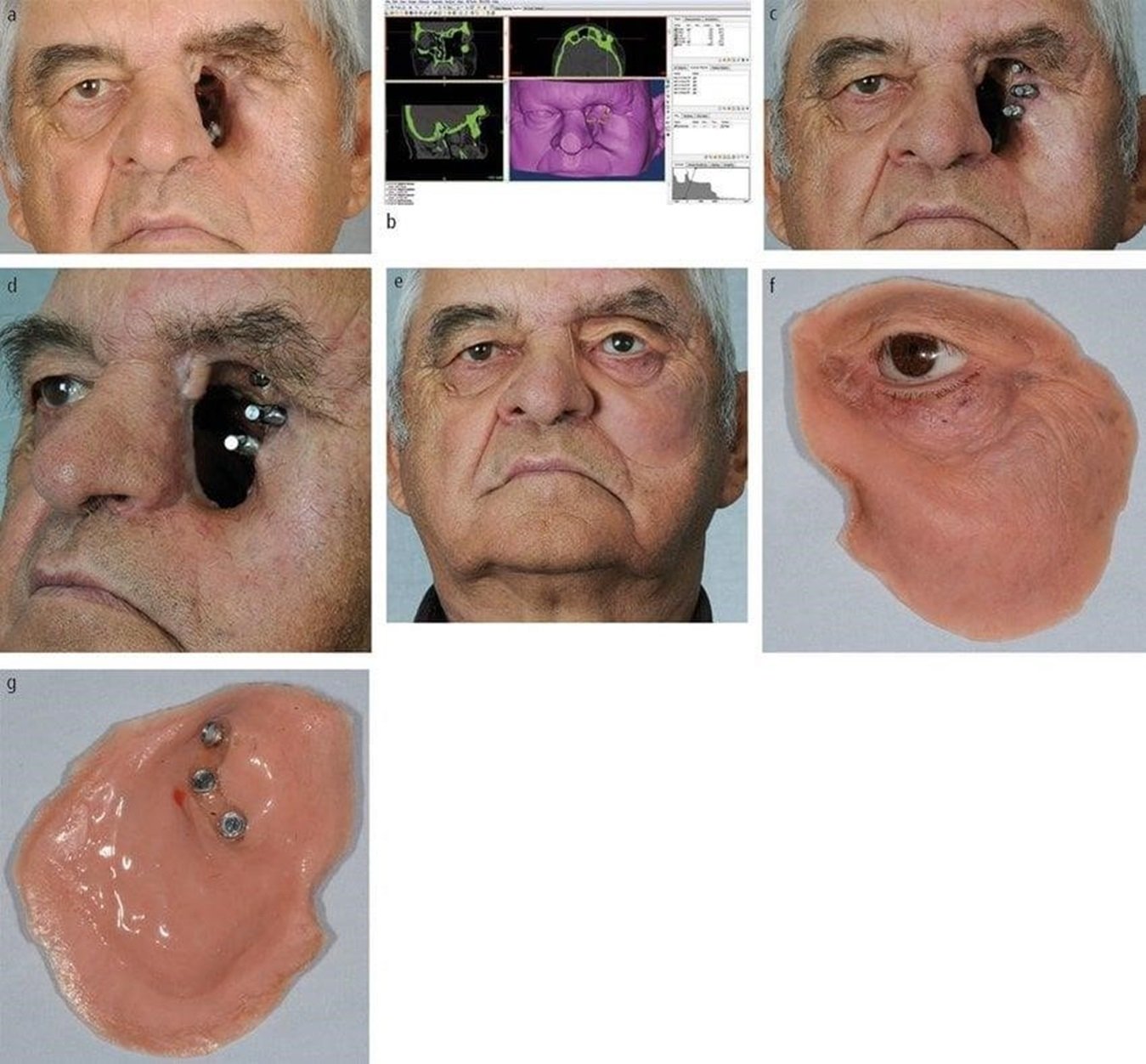
Figure 1. Implant-supported retention demonstrating craniofacial implants and attachment systems used in maxillofacial prostheses
4.2 Magnetic Retention Systems
Magnetic attachment systems have gained importance as an alternative retentive modality, particularly in situations where implant-supported retention is not feasible or when ease of prosthesis placement is required. Modern systems utilize rare-earth magnets, which provide improved magnetic strength and durability.10
These systems allow passive seating, easy insertion and removal, and improved patient comfort, especially in elderly or compromised individuals. Magnetic retention is particularly useful in sectional prostheses where accurate alignment is essential.11
Recent developments have improved corrosion resistance and biocompatibility; however, reduction in magnetic force over time remains a limitation.12 Magnetic systems serve as valuable adjuncts in maxillofacial prosthetic rehabilitation (Fig. 2).

Figure 2. Magnetic attachment systems are used for retention in maxillofacial prostheses.
4.3 Hybrid Retention
Hybrid retention systems combine multiple retention modalities to enhance prosthesis stability and adaptability. Common approaches include implant-supported frameworks combined with magnetic attachments or adhesive-assisted mechanical retention.3
These systems are particularly useful in complex maxillofacial defects where anatomical limitations or compromised tissue conditions prevent the use of a single retention method. Hybrid approaches allow clinicians to customize treatment strategies based on patientspecific requirements and clinical conditions.17
Although they increase treatment complexity, hybrid systems offer improved reliability and flexibility, particularly in oncology patients.
4.4 Digital Workflow and CAD/CAM
Digital workflows have significantly transformed maxillofacial prosthodontics by improving precision, efficiency, and reproducibility. Digital data acquisition techniques such as CBCT imaging and facial scanning enable accurate visualization of defect morphology.13,14
Computer-aided design (CAD) allows virtual planning of prostheses, ensuring optimal adaptation and retention, while computer-aided manufacturing (CAM) enables precise fabrication of prosthetic components.15
Improved adaptation achieved through digital workflows enhances prosthesis stability and reduces marginal discrepancies. Additionally, digital systems allow easy duplication and modification, which is advantageous in long-term cancer rehabilitation.16 Digital workflow integration plays a key role in modern retention strategies (Fig. 3).

Figure 3. Digital workflow in maxillofacial prosthodontics, including CBCT imaging, facial scanning, and CAD/CAM design.
4.5 Additive Manufacturing (3D Printing)
Additive manufacturing has emerged as a major advancement in maxillofacial prosthodontics, enabling the fabrication of highly customized prosthetic components. This technology allows layer-by-layer construction, resulting in improved accuracy and adaptation.18
Applications include fabrication of molds, frameworks, and definitive prostheses. The ability to create patient-specific designs improves prosthesis fit and retention while reducing fabrication time.19
Advances in printable biomaterials have expanded its clinical use; however, limitations related to material durability and surface finish remain under investigation.20 Additive manufacturing significantly contributes to modern prosthetic retention (Fig. 4).

Figure 4. Application of additive manufacturing in the fabrication of maxillofacial prostheses
4.6 Adhesive Material Innovations
Recent advancements in adhesive materials have led to improved formulations with enhanced mechanical properties and biocompatibility. Modern silicone-based adhesives demonstrate increased peel strength, improved shear resistance, and better durability.21
These materials are particularly useful in patients who are not candidates for implant placement and also serve as adjuncts in hybrid retention systems. However, adhesive retention remains technique sensitive and is influenced by environmental and patient-related factors.22
4.7 Artificial Intelligence and Future Trends
Artificial intelligence is emerging as a promising tool in maxillofacial prosthodontics, with applications in diagnosis, treatment planning, and prosthesis design. AI-based systems can assist in optimizing implant positioning and prosthetic design through predictive modeling.25 These technologies enable personalized rehabilitation strategies and may improve long-term retention outcomes. Although still in early stages, AI is expected to play a significant role in the future of maxillofacial prosthetic rehabilitation.26
5. RETENTION IN CANCER REHABILITATION
Cancer rehabilitation presents unique challenges, including fibrosis, scar tissue formation, and radiation-induced vascular compromise. These factors influence implant success and retention strategies?. Individualized planning and multidisciplinary collaboration are essential to optimize outcomes in oncology patients.3
6. DISCUSSION
Retention remains the most critical factor influencing the long-term success of maxillofacial prostheses, particularly in oncology patients where surgical resection and radiotherapy result in altered anatomy and compromised supporting tissues. Conventional retention methods such as anatomical undercuts, adhesives, and mechanical aids continue to play a role in clinical practice; however, their predictability is often limited in extensive defects and irradiated tissues.1,2 Consequently, modern rehabilitation strategies increasingly emphasize biologically and digitally driven solutions to achieve improved stability and patient satisfaction.
Hybrid retention approaches combining implants, magnets, and adhesives have shown promising clinical applicability, particularly in complex oncology-related defects where a single retention method may be insufficient.
One of the most significant developments in recent years is the incorporation of digital workflows into maxillofacial prosthodontics. Digital technologies including cone-beam computed tomography, facial scanning, CAD/CAM design, and additive manufacturing have improved precision during data acquisition and prosthesis fabrication.7,8 Improved adaptation achieved through digital workflows indirectly enhances retention by minimizing marginal discrepancies and improving prosthesis stability. Furthermore, additive manufacturing allows rapid fabrication of customized frameworks, which is especially beneficial in patients requiring complex rehabilitation.9
Despite technological advancements, several challenges persist in oncology rehabilitation. Radiation-induced fibrosis, reduced vascularity, and altered tissue resilience continue to compromise retention outcomes and complicate treatment planning.5
Future directions in maxillofacial prosthodontics are expected to focus on artificial intelligence-assisted treatment planning and smart biomaterials capable of improving personalization and clinical efficiency.11 Although these technologies remain in early stages of application, they represent promising avenues for enhancing retention predictability and long-term patient outcomes.
Overall, current evidence suggests a clear transition from conventional retention methods toward implant-supported and digitally assisted approaches.
7. CONCLUSION
Modern retentive strategies in maxillofacial prosthodontics integrate implant biology, digital precision, and advanced materials to improve rehabilitation outcomes in cancer patients. Continued technological innovation and long-term clinical research are necessary to optimize retention protocols and enhance patient quality of life.
8. REFERENCES
- Türksayar AA, et al. Retention systems used in maxillofacial prostheses: A review. J Indian Prosthodont Soc. 2019.
- Khan U, et al. Survival rate of retention systems for extraoral prostheses. Cureus. 2024.
- Goiato MC, et al. Retention modalities in maxillofacial prosthetics: Current trends. J Prosthet Dent. 2025.
- Cobein MV, et al. Retention systems for extraoral prosthetic rehabilitation. J Prosthet Dent. 2017.
- Alberga J, et al. Outcome of implants placed to retain craniofacial prostheses. Int J Implant Dent. 2022.
- Wigianto AYP, et al. Contemporary magnetic attachment systems. Materials. 2025.
- Cristache CM, et al. Digital workflow in maxillofacial prosthodontics. Appl Sci. 2021.
- Srivastava G, et al. Digital workflow in maxillofacial prosthodontics. J Family Med Prim Care. 2020.
- Tarba CI, et al. Digital workflows for 3D-printed maxillofacial prostheses. Appl Sci. 2025.
- Jaini JL, et al. Mechanical properties of tissue adhesives. J Prosthet Dent. 2024.
- Al Hendi KD, et al. Artificial intelligence in prosthodontics. Cureus. 2024.
- Riley MA, et al. Magnetic attachments in maxillofacial prosthetics. J Prosthodont. 2021.
- Cristache CM, et al. Digital workflow in maxillofacial prosthodontics. Appl Sci. 2021.
- Srivastava G, et al. Digital workflow in maxillofacial prosthodontics. J Family Med Prim Care. 2020.
- Tarba CI, et al. Advancements in digital workflows for 3D-printed maxillofacial prostheses. Appl Sci. 2025.
- Revilla-León M, et al. Digital technologies in prosthodontics. J Clin Med. 2025.
- Ciocca L, et al. CAD/CAM technologies in maxillofacial prosthetics. J Prosthet Dent. 2022.
- Fayad MI. Innovations driving the future of maxillofacial prosthetics. Semin Plast Surg. 2025.
- Unkovskiy A, et al. Additive manufacturing in prosthodontics. Dent Mater. 2023.
- Eggbeer D, et al. 3D printing applications in facial prostheses. Rapid Prototyping J. 2022.
- Jaini JL, et al. Mechanical properties of tissue adhesives for extraoral prostheses. J Prosthet Dent. 2024.
- Hatamleh MM, et al. Biomaterials in maxillofacial prosthetics. Materials. 2023.
- Implant failure in facial prostheses: Systematic review and meta-analysis. J Craniomaxillofac Surg. 2025.
- Toljanic JA, et al. Rehabilitation of oncology patients using craniofacial implants. Oral Oncol. 2020.
- Al Hendi KD, et al. Artificial intelligence in prosthodontics. Cureus. 2024.
- Gao S, et al. Artificial intelligence in dentistry: Narrative review. Dent J. 2025.
Disclaimer from Guident
The views and opinions expressed in articles published in Guident are solely those of the authors and do not necessarily reflect the views of the editors, the editorial board or the publisher, Ivory India. Guident does not endorse any product, technique or treatment described. Clinical content is intended for qualified dental and medical professionals and is not a substitute for individual clinical judgement. Guident, its editors and the publisher accept no liability for any consequence arising from the use of information published in the journal.
How to cite this article
Dr. Prachi Bansal, Dr. Nisha Khemka, Dr. Lara Jain. Modern Advances in Retentive Aids for Maxillofacial Prostheses in Cancer Rehabilitation: A Contemporary Review. Guident. 2026 Jul;19(8). Available from: https://guident.net/articles/prosthodontics/modern-advances-in-retentive-aids-for-maxillofacial-prostheses-in-cancer-rehabilitation-a-contemporary-review.html