Fabrication of Space Maintainer Using Digital Impressions: A Case Report
Jaipur, India
ABSTRACT
To improve patient experience and compliance digital impressions was used which enable dental offices to collaborate and work with distant dental laboratories and specialists with ease. Although the initial cost of acquiring an intraoral scanner is significant, its use has the potential to reduce the cost per procedure.
KEYWORDS- 3D printing, digital impression, intraoral scanner, space maintainer
INTRODUCTION
The current case report describes the use of an intraoral scanner to make a digital impression for fabrication of a lower lingual holding arch space maintainer. This method reduced chair time with an uncooperative patient, could increase practice efficiency, and enhance patient comfort and compliance. Space maintainer fabrication remains a routine procedure for pediatric and general dentists. Space maintenance is typically recommended as an interceptive treatment to reduce complex orthodontic treatment at a later age.1
Further, maintaining arch length becomes a concern with the loss of primary second molars, unilateral loss of primary canines, or the loss of first primary molars before the eruption of the permanent first molars. The most common method of obtaining an impression for a space maintainer, an alginate impression with subsequent dental stone model, has disadvantages offending to distort over time as water evaporates from or absorbs into the impression thereby causing inaccuracies in the impression and subsequent stone casts & time lapse for model or impression to reach lab and other state or city.2,3
Behavioral issues of an apprehensive or uncooperative patient can be particularly problematic when the clinician is trying to make a conventional intraoral impression for appliance fabrication. In such cases, the use of digital intraoral impressions would eliminate the need for a conventional alginate impression. Since impressions are considered an unpleasant experience by some children, the switch to digital impression procedures may have a long-term positive impact on patient perceptions of dental procedures. In one study, measurements for orthodontic treatment planning were compared between dental stone and 3-dimensionally printed models; no significant differences were found.4
The current case report describes the use of an intraoral scanner to make a digital impression for fabrication of a lower lingual holding arch space maintainer.
CASE REPORT
A 9 year old boy came with complain of uneruting lower posterior teeth. On oral examination retained & submerged right &left lower deciduous molars are seen(Figure.1)
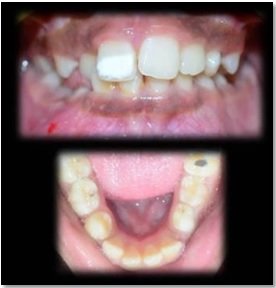
Figure.1 - Pre- operative image of patient
Patient was advised for OPG. OPG report reveled presence of multiple retained teeth in both arches and submerged ankylosed right lower deciduous molar.(Figure.2)
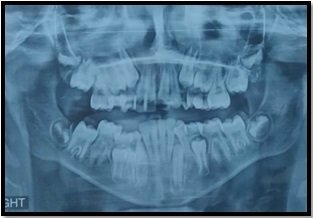
Figure.2 - Pre-OPG
Because of the patient's age, a lower lingual holding arch space maintainer was recommended to preserve arch length and maintain intra-arch space for eruption of the permanent mandibular premolar.Hence treatment planned for the patient was extraction of retained teeth followed by lingual arch space maintainer.
Followed by extraction of retained teeth a lower full arch digitalintraoral impression was made with a CerecOmnicam 2 scanner (DentsplySirona) (Figure.3).
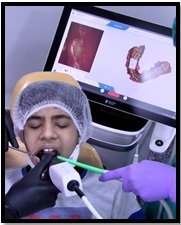
Figure.3 - Digital intra oral impression
The resulting file was electronically transferred, using a HIPAA compliant portal, to the dental laboratory so that a resin model could be 3-dimensionally printed. After the resin model was produced, the dental laboratory followed their normal protocol to fabricate a cast metal lower lingual holding arch and was delivered in only 5 days.(Figure.4)
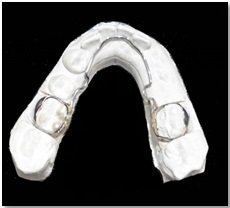
Figure.4 - Lingual arch space maintainer on model
When the patient returned for cementation, the appliance was tried in and, once placement was confirmed, cementedwith a resin-modified glass ionomer cement. Postoperative instructions were given and recalled for follow ups.(Figure.5a,b,c)
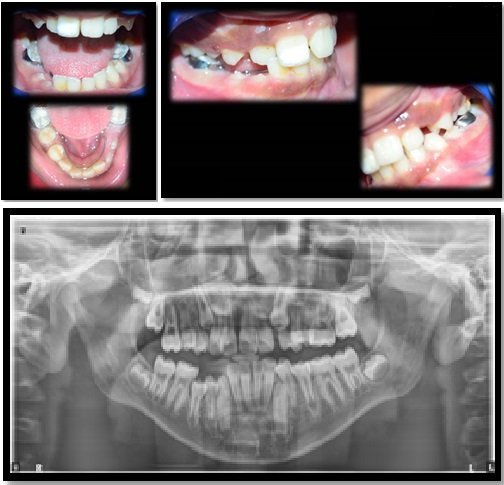
Figure.5a,b,c - Post operative image of patient
DISCUSSION
Digital impressions have the potential to increase efficiency, be more comfortable for the patient, and reduce long-term costs of the procedure. Digital impressions have been used routinely in other areas of dentistry, and expanding their use to pediatric dentistry could be beneficial for both patient and provider. A study by Vasudavan et al5 found that 77% of patients preferred intraoral scans over alginate impressions. Digital impressions were found to be more comfortable for patients, when evaluated by both patients and clinicians.6
Another benefit is that digital impression scans can be obtained in segments, which is useful with noncompliant patients. Intraoral scans can also be performed by auxiliary team members if state laws allow, freeing clinicians for other tasks. For dental offices in geographical areas that do not have dental laboratories nearby, digital impression files can be quickly transferred to a laboratory anywhere in the country, which reduces cost, limits damage of impressions/models because of shipping and handling, and reduces turnaround time for the case.
Despite all the benefits of digital impressions that contribute to increased patient comfort and compliance and reduced cost of the procedure, acquiring the equipment can be expensive and requires training of the dental team so that the equipment can be used predictably and cost effectively. Clinicians should also evaluate the size of the scanner head, when comparing intraoral scanners from different manufacturers, and its effect on scanning time, patient comfort, and ease of intraoral maneuvering especially in patients with shallow vestibules, limited mouth opening, and presence of missing or unerupted teeth.6
CONCLUSION
Acquiring a digital intraoral impression does require a level of cooperation from the patient similar to cooperation needed for an examination. The use of intraoral scanners for standard space maintainer fabrication should be considered by dentists.
REFERENCES
- Brothwell DJ. Guidelines on the use of space maintainers following premature loss of primary teeth. J Can Dent Assoc. 1997;63(10):753-766.
- Nicholls JI. The measurement of distortion: theoretical considerations. J Prosthet Dent. 1977;37(5):578-586.
- Powers JM, Wataha JC. Dental Materials: Properties and Manipulation, 10th edn. St. Louis, MO: Elsevier; 2013.
- Dalstra M, Melsen B. From alginate impressions to digital virtual models: accuracy and reproducibility. J Orthod. 2009;36(1):36-41.
- Vasudavan S, Sullivan SR, Sonis AL. Comparison of intraoral 3D scanning and conventional impressions for fabrication of orthodontic retainers. J ClinOrthod. 2010;44(8):495-497.
- Yilmaz H, Aydin MN. Digital versus conventional impression method in children: comfort, preference and time. Int J Paediatr Dent. 2019;29(6):728-735.
Disclaimer from Guident
The views and opinions expressed in articles published in Guident are solely those of the authors and do not necessarily reflect the views of the editors, the editorial board or the publisher, Ivory India. Guident does not endorse any product, technique or treatment described. Clinical content is intended for qualified dental and medical professionals and is not a substitute for individual clinical judgement. Guident, its editors and the publisher accept no liability for any consequence arising from the use of information published in the journal.
How to cite this article
Dr. Gaurav Gupta, Dr. D. K. Gupta, Dr. Neelja Gupta Wisdom Dental Clinics. Fabrication of Space Maintainer Using Digital Impressions: A Case Report. Guident. 2020 Oct;13(11). Available from: https://guident.net/articles/pedodontics/fabrication-of-space-maintainer-using-digital-impressions-a-case-report.html