Developmental Dentistry Extending Care to Adults with Special Health Care Needs
Department of Pedodontics and Preventive Dentistry, K. D. Dental College & Hospital Mathura, U.P. India
INTRODUCTION
Developmental Medicine & Dentistry can be defined as the expertise and competencies required for medical and dental evaluation and treatment of those health conditions frequently encountered in adults with Childhood Onset Brain Dysfunction.
C.O.B.D : Childhood Onset Brain Dysfunction refers to brain dysfunction of genetic or acquired etiology that manifests clinically before the age of twenty-one years. Adult patients with Childhood Onset Brain Dysfunction may be identified by the following “developmental disability” diagnostic labels: mental retardation, cerebral palsy, epilepsy, and autism.
HISTORICAL BACKGROUND
Developmental medicine and developmental dentistry is the result of three interacting factors:
- The trend developing towards deinstitutionalization of individuals with mental retardation and developmental disabilities (MR/DD)
- The increasing life span of this population and the resultant rise in health care access problems
- The scientific evidence for the importance of oral-systemic health interactions.
DEINSTITUTIONALIZATION
In the older days all the patients with disabilities were kept in institutions and had in-house medical and dental facilities. Therefore the medical/dental schools has a very little concern in training the aspiring graduates. Two landmark events ie Olmstead vs LC (1999) & Wilson and Curtis (1999)-] paved the path of community integration. Deinstitutionalization continued, but there were few community practitioners ready to provide care for these patients.
DEMOGRAPHIC TRENDS
The dramatic increase in the life expectancies of individuals with MR/DD has compounded the effect of deinstitutionalization. With major advances in medical care, people with developmental disabilities are enjoying longer, healthier lives. This desired outcome has also caused a fundamental demographic shift from a primarily pediatric population to an adult one.
ADOLESCENT TRANSITION ISSUES
As more children survived into adulthood and remained with their families or in other community settings, mounting concerns developed over the transition of these adolescents into adult health care systems. This presented as a biggest barrier to take care of their patients was lack of training As physicians and dentists continuously evolved as non players. The gap was filled in by various non medical and non dental entities. The medical model has been scorned by many disability advocates. These barriers can simply be overcome when clinicians takes the responsibility to educate himself or herself.
ACCESS AND POLICY BARRIERS
Together, deinstitutionalization and the aging of this population have created an access crisis for adults with MR/DD. In addition to the lack of trained medical and dental practitioners to see these patients, there are problems with the insurance system with respect to dental coverage. These extra demands may discourage clinicians who have no training or experience. Additionally there may be patient related factors creating barriers such as limited mobility, physical limitation such as spasticity, behavioral difficulties, dental fear and anxiety and limited ability of manuvering resulting in oral health concerns.
ORAL SYSTEMIC INTERACTIONS
Although there have been numerous reports of oral-systemic interactions but some non specific ones have received major attention such as C-reactive proteins, one common problem in adult special care patient is periodontal disease and those specially with intellectual disabilities due to difficulty in maintaining oral hygiene, having problems secondary to medications such as anticonvulsants associated gingival hyperplasia. Bacterial endocarditis, aspiration pneumonia are another such examples of oral systemic interactions. Clearly, “dental” conditions can affect systemic health, and “medical” conditions can affect oral health.
MEDICAL - DENTAL COLLABORATION
As the life span of these individuals have increased due to advancement in medical sciences, the incidence of chronic diseases and the oral systemic interactions is also on the rise. to recognize this early and timely diagnosis we need is inter professional collaboration ie physicians should give importance to oral health as it reflects general health and the dentist should be quick to recognize medical conditions eg. an early destruction of periodontium could be indicative of juvenile diabetes. The existing physicians and dentist should have cross disciplinary training programs to catch the disease pattern early.
FIVE ESSENTIAL CONCEPTS
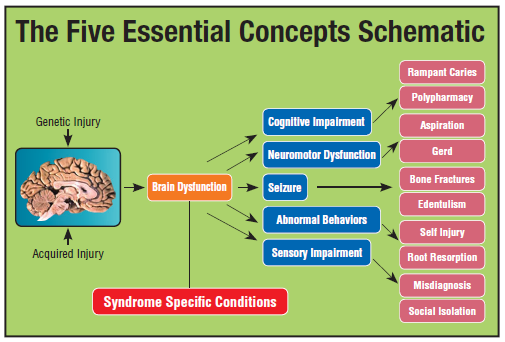
The first step in breaking the barrier is to educate and uplifting the inhibitions by the means of education and information. This is best explained by five essential concepts given by Dr Philip May and put forward by Dr. Henry Hood.
All these conditions like Intellectual Disability, Autism, Neuromotor Impairment Down syndrome, Developmental Disabilities, Prader Willi ,Seizure Disorder, Mental Retardation, Cerebral Palsy interrelate as they have a common origin ie neurodevelopmental. A medical disorder brought about by an injury to the neurological system during the period of a person’s life in which they are experiencing rapid neurological development - from the point of conception to early adulthood – age 21 / 22.
Neurodevelopmental disorders can be genetic or acquired.
Genetic causes:
Metabolic (PKU)
Chromosomal (Trisomy 21)
Structural (Tuberous Sclerosis).
Acquired causes:
Prenatal (Fetal Alcohol Syndrome)
Perinatal (Hypoxic Brain Injury)
Postnatal (Lead Toxicity).
The major functions of the brain are:
Memory & learning
Control of motor function
Control and routing of sensory output
Emotional regulation.
FIRST ESSENTIAL CONCEPT: The major functions of the brain require that specific interrelated brain structures to work together in a coordinated fashion. When these relationships are not properly developed, the brain dysfunction occurs.
SECOND ESSENTIAL CONCEPT: All the issues related to disabilities ie of clinical origin or otherwise that may be experienced by an individual with the neuro-developmental disorder can be traced directly back to brain dysfunction.
THIRD ESSENTIAL CONCEPT: All neuro-developmental disorder is associated with one or more primary complications, these include:
Intellectual disability (Cognitive impairment)
Neuromotor Dysfunction
Seizure
Behavioral Disturbances
Sensory Impairment./p>
FOURTH ESSENTIAL CONCEPT: The patient with neurodevelopmental disorder may also demonstrate secondary health consequences such as Avulsion of maxillary teeth due to seizure related fall or Boxer's fracture due to impulse dyscontrol. Multiple Consequences: Injury secondary to Cognitive / Behavioral Issues in FAS. The dysfunction in learning, and the social isolation experienced by a child with autism (a behavioral complication associated with multiple neurodevelopmental disorders) are really secondary secondary health consequences.
FIFTH ESSENTIAL CONCEPT: All neurodevelopmental disorder are often associated with syndrome specific conditions which are not directly the result of brain injury.
Pic A: Pre-Operative OPG
SUMMARY
In treating patients with developmental disorders, clinicians find themselves in unique challenges, in order to overcome these challenges, professionals need a more holistic view of patient and patient care which can be achieved through greater interdisciplinary understanding and communication.
Disclaimer from Guident
The views and opinions expressed in articles published in Guident are solely those of the authors and do not necessarily reflect the views of the editors, the editorial board or the publisher, Ivory India. Guident does not endorse any product, technique or treatment described. Clinical content is intended for qualified dental and medical professionals and is not a substitute for individual clinical judgement. Guident, its editors and the publisher accept no liability for any consequence arising from the use of information published in the journal.
How to cite this article
Dr. Priya Verma. Developmental Dentistry Extending Care to Adults with Special Health Care Needs. Guident. 2019 Dec;13(1). Available from: https://guident.net/articles/pedodontics/developmental-dentistry-extending-care-to-adults-with-special-health-care-needs.html