A Study to Compare Acceptance of Dental Prosthesis Among Volunteered and Motivated Geriatric Institutionalized Patients
Department of Prosthodontics, Yenepoya Dental College, Mangalore, India
ABSTRACT
Background:Acceptance of newly fabricated complete dentures has always been a challenging task for the prosthodontist and the general clinician alike. Apart from the negative emotions of normal ageing, the loss of teeth adds to the emotional imbalance of the elderly.
Method:Institutionalized patients were evaluated according to prosthetic need and the status of the prosthesis. Patients with existing prosthesis were informed about the condition of the prosthesisas acceptable or unacceptable. Patients requiring new prostheses were divided into two groups. One which willingly volunteered for the new prosthesis and the other group, which did not volunteer but had to be motivated. Informed consent was obtained and prostheses were fabricated according to conventional technique following moth preparation. Denture insertions were done and the patients were recalled after twenty four hour, one week and one month intervals.Results: 102 patients were treated and all the stages of the study were completed on them. A total of 71 patients had to be motivated and 31 patients willingly volunteered for fabrication of new prosthesis. Data obtained was analyzed. Initial level of adherence was higher in patients who had volunteered when compared with motivated patients. With effective motivational techniques gradual increase in both the groups were seen.
Conclusion:Recall visits and checkups in conjunction with effective motivation towards denture adherence in geriatric patients are paramount to the success of the treatment.
Keywords:Denture Acceptance, Old age home, Removable Dentures, Geriatric Patients
INTRODUCTION
Acceptance of newly fabricated complete dentures has always been a challenging task for the prosthodontist and the general clinician alike. In most cases a professional assessment of the quality of the dentures is not in sync with the patient’s subjective judgment. Diehl et al1 in a study concluded that subject characteristics including age, gender, race, income level, education, marital status, and maxillary and mandibular anatomy were not significantly associated with denture success. However strong co-relation was found in psychosocial variables, such as pretreatment expectations, satisfaction with the dental care received, and mental health for a successful outcome.
As healthcare facilities become easier to reach there is a decrease in mortality rate and a rapid increase in elderly population. Douglass et al2 suggests that this population will continue to increase over the next 20 years. The elderly population experiences social isolation due to breakage of various bonds like work relationship, loss of relatives and friends,and movement of children away from them for jobs. The situation worsens when the aged suffer from chronic diseases; lose their physical capabilities and face financial insecurity. Apart from the negative emotions of normal ageing, the loss of teeth adds to the emotional imbalance of the elderly.3-8
Similar results were shown by Davis et al9 who investigated the reactions to tooth loss in a partially dentate group. Partially dentate people who experienced difficulties in accepting their tooth loss were more likely to feel less confident, restrict their food choice, enjoy food less, avoid laughing in public and avoid forming close relationships with people other than those who had no difficulties in accepting tooth loss.
The purpose of the study was to evaluate the acceptance level of complete and partial dentures among institutionalized geriatric patients. The patients were divided in two broad categories; one who volunteered for denture therapy and the second group included patients who did not volunteer but were motivated for the treatment.
MATERIAL AND METHODS
A cross sectional study was conducted among 102 subjects aged 50 years and above in January 2014 to determine the prosthetic status, the prosthetic need and to plan rehabilitation among the institutionalized elderly residing in Mangalore city, Karnataka state, India. The subjects with removable prostheses were evaluated for the condition of the prosthesis and the unfavorable prostheses were replaced .Those subjects who were edentulous and did not want rehabilitation were motivated.
Approval for the study was obtained from the Institutional review board. The investigators visited the center and met the authorities in charge of the center .The aim of the study was explained,confidentiality of the participants was assured and approval for the study was obtained. Subjects were informed of the nature of the investigation and their consent was obtained.
A pre-designed and structured proforma was used for data collection It consisted of three parts, the first part recorded data on socio-demo graphic factors (age and gender), the second part contained the relevant section of the World Health Organization (WHO)10 oral health assessment form to record the prosthetic status and prosthetic need(denture wearing and need for dentures) of the elderly population and in the third part the investigators interviewed the subjects to gauge their satisfaction with the prosthesis (discomfort, wearing the prosthesis or not).
Subjects with unfavorable prosthesis who volunteered, were rehabilitated with new prosthesis, and edentulous patients who volunteered were rehabilitated with prosthesis. Those who were edentulous and did not volunteer were motivated.
During the clinical examination and prosthodontic procedures, infection control was followed as per the guidelines. The pre-prosthodontic treatments such as tooth extraction and restoration were performed. Dentures were fabricated by conventional methods. Post insertion checkup was done and adjustments were performed until the patients communicated no subjective symptoms. Follow up appointments were scheduled after 24 hours, one week and one month following denture insertion.
RESULT
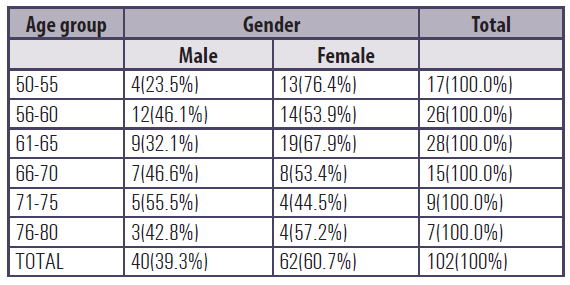
The study involved 102 subjects with the mean age of 62.4 yrs. The distribution of study population according to their age group and gender is given in Table 1. Evaluation of prosthetic status and Prosthetic need was done. Results showed that 72 patients (70.6%) had no prosthesis, 18 patients (17.6%) had complete removable dentures and 12 patients (11.8%) had Partial removable dentures. When the Prosthetic need was evaluated 20 patients (19.6%) did not require any prosthesis, 38 patients (37.3%) required complete removable denture, 34 patients (33.3%) required partial removable dentures and 10 patients (9.8%) required fixed partial dentures.
Table 1: Distribution of study subject according to their age group and gender
Distribution of motivated and volunteered patients according to the type of prosthesis in given in Table 2. However to maintain simplicity, complete dentures and removable partial dentures were considers as one i.e., dental prosthesis. Data collected with respect to patient who were motivated for treatment were given more emphasis in the present study, than who had volunteered.
Table 2: Distribution of motivated and volunteered patients according to the type of prosthesis

Acceptance of the prosthesis among the motivated and volunteered subjects during follow up appointments i.e., 24 hours, 1 week and 1 month following denture insertion was recorded. Number of patients who reported with “discomfort”and “no discomfort” in the both the groups, during the follow up appointments was compared. Discomfort of the prosthesis was based on subjective feedback given by the patient at the beginning of the appointment.
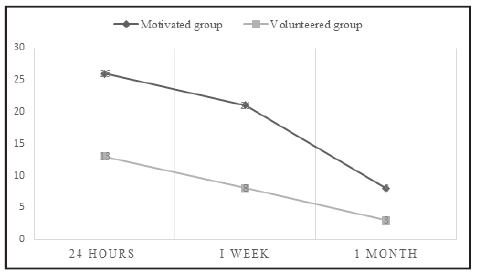
According to the data obtained, a gradual increase in the acceptance of the prosthesis was seen. Initial acceptance level was higher among patients who volunteered for the treatment than those who were motivated, which was anticipated. In the subsequent visits the acceptance level increased in the both the groups. However the level of acceptance among volunteered patients was higher than that of motivated patients after the first week checkup and denture adjustments, as shown in Graph 1
Graph 1 Distribution of acceptance of prosthesis among motivated and volunteered groups

The level of discomfort was also shown to fall in both the groups during the study period. However a considerable fall was seen following the first week checkup and denture adjustments. The number of patients with discomfort in the volunteered group had decreased, comparatively though not as observable as the motivated group, which reported much fewer complaints after the first week, as shown in Graph 2
Graph 2 Distribution of discomfort to prosthesis among motivated and volunteered groups
DISCUSSION
The World Health Organization11 has provided a classification of impairment, disability and handicap. Impairment is described as the loss of an anatomic body part; disability is defined as being prevented from partaking in everyday activities such as chewing and speaking; handicap describes broader social effects, such as minimized contact with other people. When interacting with our patients during the study, we realized that majority of them found the loss of teeth as an impairment, a disability and a handicap. These factors render patients with a high neuroticism score, which as described by Eysenck12 in a person with it “being an anxious, worrying individual, moody and frequently depressed, overtly emotional, reacting too strongly to all sorts of stimuli”. As a general observation, initial acceptance of the dental prosthesis is always low, with patients often complaining about fit, comfort and chewing ability. However in the course of time, patient come to adjust to the prosthesis psychologically and physiologically, which is in agreement with a study by Shetty MS13
House14 classified patients depending on their mental attitude as philosophical, exacting, indifferent and hysterical. According to House an indifferent type of patient is one who presents a questionable or unfavorable prognosis. This patient evidences little, if any concern; is apathetic, uninterested and lacks motivation. The indifferent patient pays no attention to instructions, will not cooperate and is prone to blame the dentist for poor dental health. A dental education program prior to treatment is recommended for such patients.
In the present study,acceptance of dental prosthesis among motivated and volunteered geriatric patients was evaluated. The study group selected, constituted inmates of a local old aged home. The group was selected to assess if acceptance of dental prosthesis was directly related to willingness for the treatment, or whether the situation is more dynamic in nature.
In a setup where fellow inmates had already adjusted to their new dentures we wanted to assess if they could help in conditioning the other inmates towards acceptance. Those subjects who were edentulous and did not want treatment were motivated by showing videos of denture wearers and their experience with dentures .The investigators gave motivational talks on a positive approach toward of life, and created awareness among the inmates about oral health and rehabilitation. The denture wearers were made to interact with their edentulous inmates and asked to share their experiences.
The study results indicated that, positive motivation and keenness to address all the subjective symptoms of the patient had positive effects on the level of acceptance regardless of the physiological status. Conventional motivational techniques in combination with newer innovative techniques, and continuous positive feedback by the investigators, care takers and fellow in mates were adopted to ensure adherence to dental prosthesis.
CONCLUSION
Treatment of geriatric patients is complicated due to psychological factors and poor adaptive responses. The abandoned elderly need constant motivation and hence, recall visits and checkups in conjunction with effective motivation is paramount to the success of the treatment.
REFERENCES
- Diehl RL, Foerster U, Sposetti VJ, Dolan TA. Factors associated with successful denture therapy. J Prosthodont 1996 Jun; 5(2):84-90.
- Douglass CW, Shih A, Ostry L. Will there be a need for complete dentures in the United States in 2020? J Prosthet Dent 2002; 87:5-8.
- Locker. Health outcomes of oral disorders. International Journal of Epidemiology 1995, vol. 24, supplement 1, pp. S85–S89.
- Reisine S, Fertig J, Weber J, and Leder S. Impact of dental conditions on patients’ quality of life. Community Dentistry and Oral Epidemiology 1989 vol. 17, no. 1, pp. 7–10.
- Slade G D, Spencer J, Locker D, Hunt R J, Strauss R, and Beck J. Variations in the social impact of oral conditions among older adults in South Australia, Ontario, and North Carolina. Journal of Dental Research 1996 vol. 75, no. 7, pp. 1439–1450.
- Bergendal B. The relative importance of tooth loss and denture wearing in Swedish adults. Community Dental Health 1989 vol. 6, no. 2, pp. 103–111.
- Allen P F and McMillan A S. The impact of tooth loss in a denture wearing population: an assessment using the Oral Health Impact Profile. Community Dental Health 1999 vol. 16, no. 3, pp. 176–180.
- Allen P F and McMillan A S. A patient-based assessment of implant-stabilized and conventional complete dentures. Journal of Prosthetic Dentistry 2001 vol. 85, no. 2, pp. 141–147.
- Davis D M, Fiske J, Scott B, Radford D R. The emotional effects of tooth loss in a group of partially dentate people: a quantitative study Eur J Prosthodont Restor Dent. 2001 Jun; 9(2):53-7.
- World Health organization. Oral health survey – Basic methods. World health Organization, Geneva, Switzerland 4th edition 1997
- World Health Organization. International classification of impairments, disabilities and handicaps. Geneva. 1980
- Eysenck H J. Manual of the Eysenck personality scales. London: Stodder and Houghton; 1991. p. 4–5.
- Shetty MS , Panchamal GS , ShenoyKK. Denture acceptance among newly rehabilitated elderly population in old age homes in South India. Contemporary Clinical dentistry.2015,6 : 90-93
- Koper A. Why dentures fail. DCNA 1964, 8:721-734.
Disclaimer from Guident
The views and opinions expressed in articles published in Guident are solely those of the authors and do not necessarily reflect the views of the editors, the editorial board or the publisher, Ivory India. Guident does not endorse any product, technique or treatment described. Clinical content is intended for qualified dental and medical professionals and is not a substitute for individual clinical judgement. Guident, its editors and the publisher accept no liability for any consequence arising from the use of information published in the journal.
How to cite this article
Dr. Mallika S Shetty, Dr. Karkala S Suhaim, Dr. Sanath Shetty. A Study to Compare Acceptance of Dental Prosthesis Among Volunteered and Motivated Geriatric Institutionalized Patients. Guident. 2019 Dec;13(1). Available from: https://guident.net/articles/research/a-study-to-compare-acceptance-of-dental-prosthesis-among-volunteered-and-motivated-geriatric.html