NEW TECHNOLOGIES FOR DENTAL CARE, In this first article of three, Dr Julian Holmes explores possibly the most important advance in caries management since the development of filling materials.
IAOHD, International Association of Ozone in Healthcare and Dentistry
INTRODUCTION
Over the years, general dental practitioners have been and continue to be bombarded with information promoting new and improved innovations to enhance clinical and marketing skills. There are now vast ranges of products available to improve patient communication and education by demonstrating oral health conditions and highlighting problem areas. These devices assist in treatment acceptance by enabling instant display of x-rays and maintaining photographic records. Modern dentistry offers everything from high-technology imaging systems to simple dyes for detecting plaque and caries.
MIRROR, PROBE AND X-RAYS ARE INACCURATE
In many dental practices worldwide, caries detection still relies on visual recognition using a mirror, probe, and x-ray analysis. Studies have shown that these traditional methods can be inaccurate. Computerized analysis of digital radiographs, dyes, and tests assessing individual susceptibility to decay offer improved accuracy.
THE ‘NICHE ENVIRONMENT THEORY’
Understanding caries development is crucial for appreciating new technologies. The ‘niche environment theory’ explains the progression from initial bacterial colonization to acid-producing microorganisms within a specialized environment. As bacteria accumulate, particularly in fissures, they produce acid metabolites leading to enamel demineralization.
This process is balanced by remineralization from the natural oral environment. However, as acid-producing bacteria increase, the environment becomes more acidic, attracting further bacterial growth and eventually leading to cavity formation. This process may take several years. Studies indicate that early decay can be reversed through improved oral hygiene and mineral-based treatments.
FAILURE TO FIND A CURE FOR DENTAL DECAY
Despite extensive research by dental professionals and pharmaceutical companies, a simple cure for dental caries remains elusive. Products such as varnishes and tablets have shown limited success. One reason may be the variation in microbial species during different stages of caries development. While fluoride has reduced decay incidence, recent trends show increased prevalence, possibly linked to lifestyle factors such as bottled water consumption.
The profession would welcome technologies that simplify caries detection and eliminate microorganisms, allowing natural remineralization without invasive procedures or anesthesia.
EMERGING TECHNOLOGIES
Several new technologies are now available globally:
- DIAGNOdent (KaVo) – laser caries detection
- HealOzone – ozone-based treatment system
- CMU3 (GCE) – advanced diagnostic tool
- CariScan – highly accurate diagnostic system
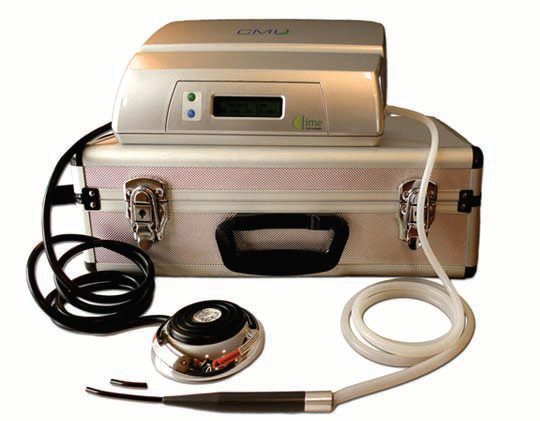
CMU3 from GCE
Ozone technology has been researched since the late 1990s, particularly at Belfast University under Professor Edward Lynch. Research findings have demonstrated highly promising outcomes.
OZONE KILLS >99% OF MICROORGANISMS
Ozone (O3) is a naturally occurring gas that protects the Earth from ultraviolet radiation. It is responsible for the fresh smell after thunderstorms or in mountainous environments.
Ozone has been used in medicine for over 100 years, particularly in Russia and Cuba. Research indicates its effectiveness in eliminating bacteria, viruses, and fungi. It is also widely used for purifying water supplies and improving air quality in hospitals.
Due to its ability to penetrate decayed tissue, ozone effectively disinfects lesions, creating conditions favorable for remineralization. However, ozone must be carefully controlled, as high concentrations can cause respiratory issues.
CURRENT RESEARCH FINDINGS
Research by Professor Edward Lynch and his team has shown that:
- 10 seconds of ozone treatment eliminates over 99% of microorganisms
- Over 70% of lesions reversed or improved
- No lesions deteriorated
- Control groups showed 80% progression
Fissure caries studies have shown even better outcomes. Clinical observations indicate that most treated lesions remineralize within 3–4 months, with no progression noted.
Patients prefer ozone treatment as it is painless and avoids injections, drilling, and discomfort. In cases where ozone is ineffective, conventional restorative methods can still be applied.
FUTURE POTENTIAL OF OZONE TECHNOLOGY
Ozone technology shows potential for various dental applications, including:
- Decontamination of dental unit water lines
- Treatment of periodontal disease
- Pre-surgical disinfection
- Endodontic root canal cleaning
- Tooth whitening applications
Ongoing studies include research by Dr Hubert Chang on endodontic applications and further investigations into whitening systems.
FURTHER INFORMATION
Additional information can be found at:
www.the-o-zone.cc
www.iaohd.org
The International Association for Ozone in Healthcare and Dentistry (IAOHD) promotes ozone use across healthcare sectors. Conferences bring together global experts to share research and advancements.
CONCLUSION
Ozone technology represents a significant advancement in non-invasive dental care. It offers a promising approach to caries management by eliminating microorganisms and supporting natural healing processes. With continued research and development, it has the potential to transform modern dentistry.
DISCLAIMER
Please note that current research data may not fully support all clinical uses of ozone in dental and medical treatment. The views expressed in this article are those of Dr Julian Holmes.
Disclaimer from Guident
The views and opinions expressed in articles published in Guident are solely those of the authors and do not necessarily reflect the views of the editors, the editorial board or the publisher, Ivory India. Guident does not endorse any product, technique or treatment described. Clinical content is intended for qualified dental and medical professionals and is not a substitute for individual clinical judgement. Guident, its editors and the publisher accept no liability for any consequence arising from the use of information published in the journal.
How to cite this article
Dr. Julian Holmes. NEW TECHNOLOGIES FOR DENTAL CARE, In this first article of three, Dr Julian Holmes explores possibly the most important advance in caries management since the development of filling materials. Guident. 2013 Mar;6(5). Available from: https://guident.net/articles/general/new-technologies-for-dental-care-in-this-first-article-of-three-dr-julian-holmes-explores-possibly-the-most.html