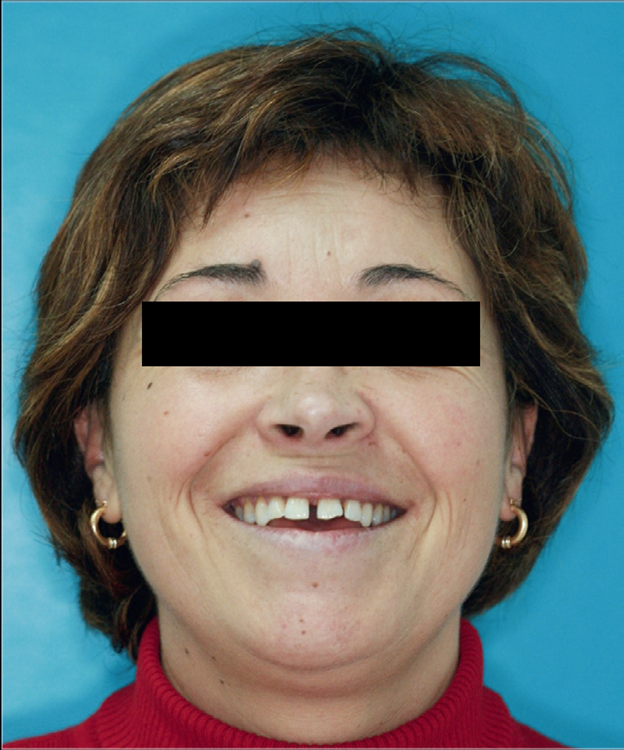
Laminates: A Transiti on to an Attractive Smile
Department of Prosthodontics K. D. Dental College & Hospital, Mathura, India
ABSTRACT
Introduction of laminates as an effective esthetic alternative has overtaken all the conventional options. Due to their esthetic appeal, biocompatibility and adherence to the physiology of minimal-invasive dentistry, porcelain laminate veneers have now become a restoration of choice.
INTRODUCTION
Confidence is important aspect of one’s personality and confident smile makes the picture complete. From a purely cosmetic standpoint, the value of the appearance of one’s teeth has taken on a greater importance in today’s society and people are giving an increasing importance to a healthy and attractive smile.
Ceramic laminates are a good alternative to full crowns as they preserve the tooth structure. It provides extremely good aesthetic results yet are conservative in nature and alternative to more extensive restorative procedures.
According to G.P.T.-8, Porcelain laminate veneers are a thin bonded ceramic restoration that restores the facial surfaces and part of the proximal surfaces of the teeth requiring esthetic restorations.
Laminates developed with the advent of ‘talkies’ when make-up executives desired improving the photographic appearance of the actor’s. Porcelain laminate veneers (PLV) were introduced into dentistry around 1938 by Dr. Charles Pincus, a Beverly Hills practitioner. They were the temporary thin veneers which were not bonded onto the teeth and were glued temporarily into place with denture powder.It was not worn in the mouth continuously and the stars could not eat with their facings and wore them for performing only. Thus was born the "Hollywood Smile”.
With the introduction of acid etch technique by Buonocore (1955) and silica resin direct filling materialby Bowen (1958), interest was generated in porcelain laminate veneers. Coupled with silanization of veneers the results with PLV have become more predictable. Survival rates have ranged from 92%at 5 years to 64 % at 10 years (Peumans et al, 2004).
All the clinical cases presented below were diagnosed with fluorosis and smile makeover for the same was done using porcelain laminate veneers.
CASE REPORT (1,2, &3)
Three patients reported to the OPD of Department of Prosthodontics, K.D. Dental College & Hospital Mathura, with a chief complaint of discoloured and unaesthetic anterior teeth. The patients were unhappy with the appearance of their teeth.
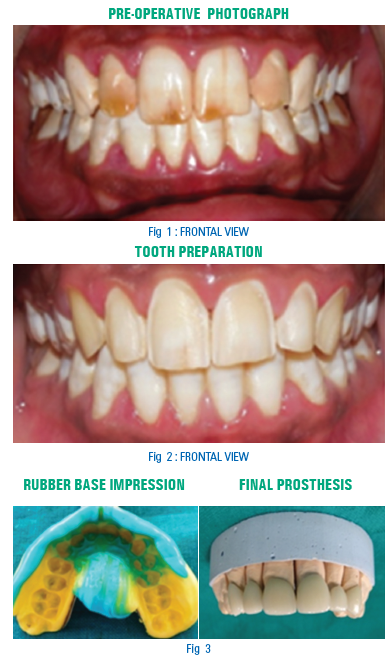
On examination staining was found in maxillary and mandibular teeth which was diagnosed as fluorosis.(fig-1)
After thorough examination, oral prophylaxis was done then diagnostic impressions were made with irreversible hydrocolloid. Diagnostic wax up was done so as to educate the patient regarding the treatment i.e., Porcelain Laminate Veneer. Treatment plan was carried out for maxillary anterior teeth only as the mandibular anteriors were less visible during the smile.
The maxillary teeth were prepared to receive porcelain laminate veneers.(fig-2) Shade selection was done prior as well as after the preparation. Final impressions were made with addition silicone by single step double mix technique. (fig-3)
Provisional restorations were not required as minimal tooth reduction was done. The laminates were etched with 4% Hydrofluoric acid for 120 seconds followed by silane application.(fig-4)
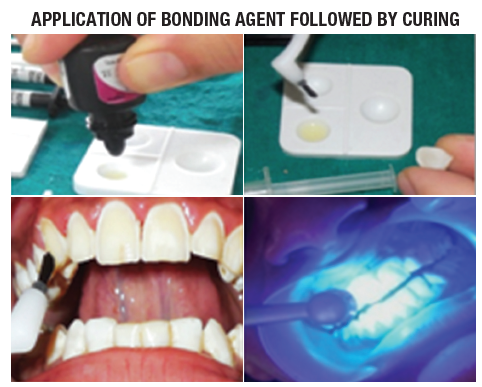
The prepared teeth were etched using 37% Phosphoric Acid for 15 seconds followed by application of bonding agent.(fig-5) Laminates were cemented using dual cure resin cement. Care was taken to remove excess cement before curing. (fig-6)
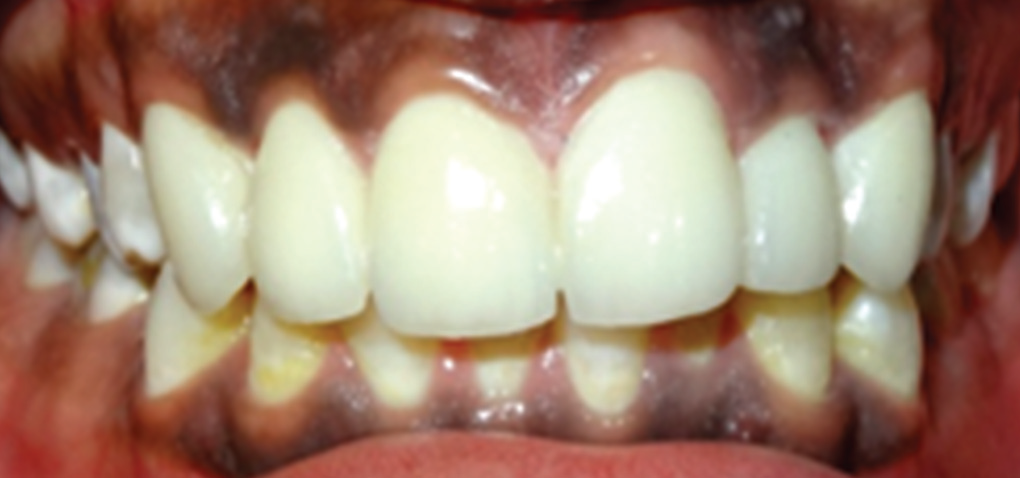
On completion of the cementation procedure, the occlusion was checked in centric and eccentric positions for interferences. The occlusal interferences were removed and polished.
CASE REPORT- 1



CASE REPORT - 2

Before
After

CASE REPORT - 3

Before
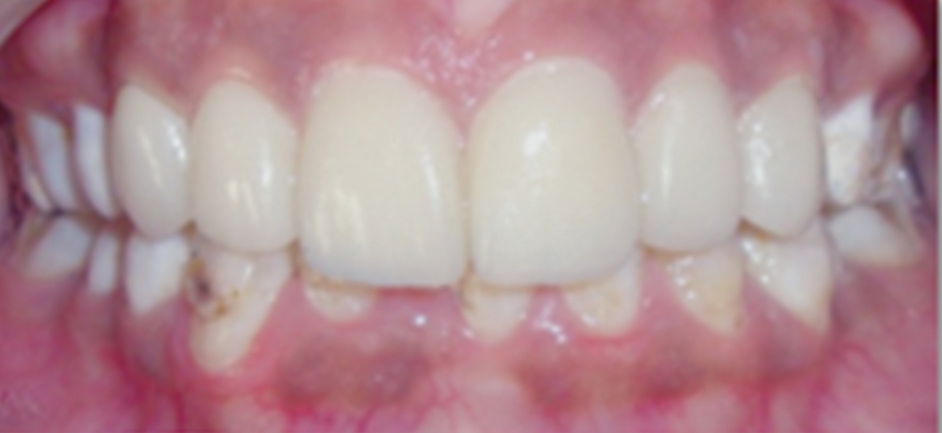
After
CONCLUSION
It has been around two decades since the phenomenon of fusing porcelain directly to the tooth was first described. It offers many wonderful advantages for carefully planned and properly selected cases. Porcelain laminate veneers is the most conservative restoration, which preserves a significant proportion of the natural enamel.
Proper case selection and treatment planing must be carried out to make porcelain laminates a successful treatment modality for minimally invasive esthetic dentistry.
REFERENCES
- Freedman G.A., McLaughlin G.L. Color atlas of porcelain laminate veneers.
- Magne Pascal, Belser Urs. Bonded porcelain restoration in anterior dentition. A biomimetic approach.
- T. Shillinburg. Fundamentals of Fixed Prosthodontics, II edition.
- Rosenstiel, Land, Fujimoto. Contemperory Fixed Prosthodontics, III edition.
- Malone W.F.P, Roth D.I. Tylman’s Theory and Practice of fixed Prosthodontics. VIII Edition.
- Gerald McLaughlin. Direct bonded retainers, The advanced alternative.
- George F Kantorowicz et al. Inlyas, crowns & bridges, A clinical handbook, 5th edition.
- Bernard G N Smith. Planning and making crown and bridges.
- Edward A. McLaren. Porcelain Veneer Preparations: To Prep or Not to Prep. Inside Dentistry, May 2006.
- A W G Walls, J G Steele & R W Wassell. Porcelain laminate veneers.
- Galip Gürel. Predictable and precise tooth preparation techniques for porcelain laminate veneers in complex cases. International dentistry SA vol. 9, no. 1.
- Brasseler USA, Laminate veneer preparation and finishing, Brasseler USA Laminate Veneer System.
- A Review On Ceramic Laminate Veneers
- Mathew C A1, Sebeena Mathew2, Karthik K S3, JIADS VOL -1 Issue 4 October - December,2010
Disclaimer from Guident
The views and opinions expressed in articles published in Guident are solely those of the authors and do not necessarily reflect the views of the editors, the editorial board or the publisher, Ivory India. Guident does not endorse any product, technique or treatment described. Clinical content is intended for qualified dental and medical professionals and is not a substitute for individual clinical judgement. Guident, its editors and the publisher accept no liability for any consequence arising from the use of information published in the journal.
How to cite this article
Dr. Manesh Lahori, Dr. Manjari Agrawal, Dr. D. S. Chakraborty. Laminates: A Transiti on to an Attractive Smile. Guident. 2013 Aug;6(10). Available from: https://guident.net/articles/prosthodontics/laminates-a-transiti-on-to-an-attractive-smile.html