Innovative Stability Solutions in Tooth-Supported Overdentures: A Case Report on Custom Locator Attachments and Short Copings
Department of Prosthodontics and Crown & Bridge, Seema Dental College & Hospital, Rishikesh, Uttarakhand, India
ABSTRACT
Overdentures are commonly used in elderly patients who retain two or more teeth in their dental arch, crucial for maintaining the alveolar ridge, providing sensory feedback, and enhancing denture stability. Unlike traditional complete dentures, which rely on copings or attachments, overdentures benefit significantly from natural teeth, improving overall stability and retention. This case report describes the prosthetic rehabilitation of a partially dentulous mandibular arch using a tooth-supported overdenture with extra-coronal attachments in one arch and short copings in the other, aiming to restore normal dental structure and function.
Key words-Overdenture, extra coronal attachment, preservation, stability.
INTRODUCTION
Preventive prosthodontics highlights interventions aimed at delaying or preventing potential complications, with overdentures being central to this strategy.1
Overdentures are recommended for patients with limited retainable teeth in a dental arch. They are particularly suitable for cases with malaligned ridges, single denture needs, and difficult conditions such as unfavorable tongue positions, problematic muscle attachments, and high palatal vaults. These challenges affect prosthesis stability and retention, making overdentures a favourable treatment choice.2
However, overdentures are unsuitable for patients with compromised oral hygiene, systemic conditions, or insufficient interarch space. Thorough evaluation of these factors is essential to determine the appropriateness of overdentures for each patient.3
Undoubtedly, an overdenture is a superior alternative to a removable complete denture prosthesis, which has inherent limitations. Overdentures epitomize one of the most practical approaches in preventive dentistry. In a four-year study by Renner et al., 50% of the roots used as overdenture abutments remained stable and immobile, highlighting the effectiveness and longevity of overdentures as a viable preventive measure in dental care.4
CASE REPORT
An 80-year-old male patient presented with masticatory difficulties and intermittent, dull pain in the upper jaw. Examination revealed a faulty fixed prosthesis in the maxillary arch, and radiographs indicated a poor prognosis for teeth 16 and 26, leading to a recommendation for extraction (Fig. 1). Treatment options included a complete denture, an implant-supported prosthesis, or a tooth-supported overdenture. The patient opted to preserve his remaining teeth, so a mandibular tooth-supported overdenture with extra coronal attachments was planned. The treatment plan involved extracting the compromised teeth, creating a tooth-supported overdenture with short copings for the maxillary arch, and fabricating a custom mandibular tooth-supported overdenture with extra coronal attachments.
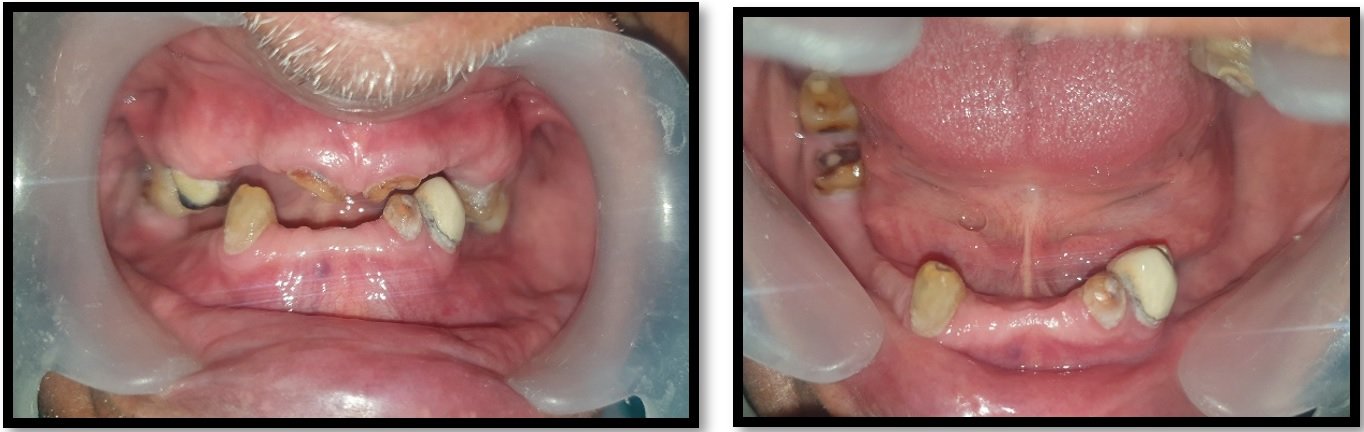
Fig. 1: Intraoral preoperative view of maxillary and mandibular arches.
TREATMENT PROCEDURE
Teeth 16, 26, and 46 were scheduled for extraction due to poor prognosis after clinical and radiographic assessments. Diagnostic impressions were taken and casts fabricated for planning. Following extraction, the patient underwent border molding, secondary impressions, and bite registration with Alu wax, leading to fabrication and insertion of a removable prosthesis with interim partial denture and post-insertion instructions.
Following interim prosthesis placement, vertical dimension and inter-arch space were assessed, confirming adequacy. A maxillary overdenture with short copings was planned for endodontically treated abutment teeth (11, 14, 21, 24, 25), while abutments 33 and 43 were evaluated for copings and custom ball attachments. Patient-consented planning included a mandibular overdenture with locator attachments, preceded by alginate impressions and special tray fabrication on the primary cast.
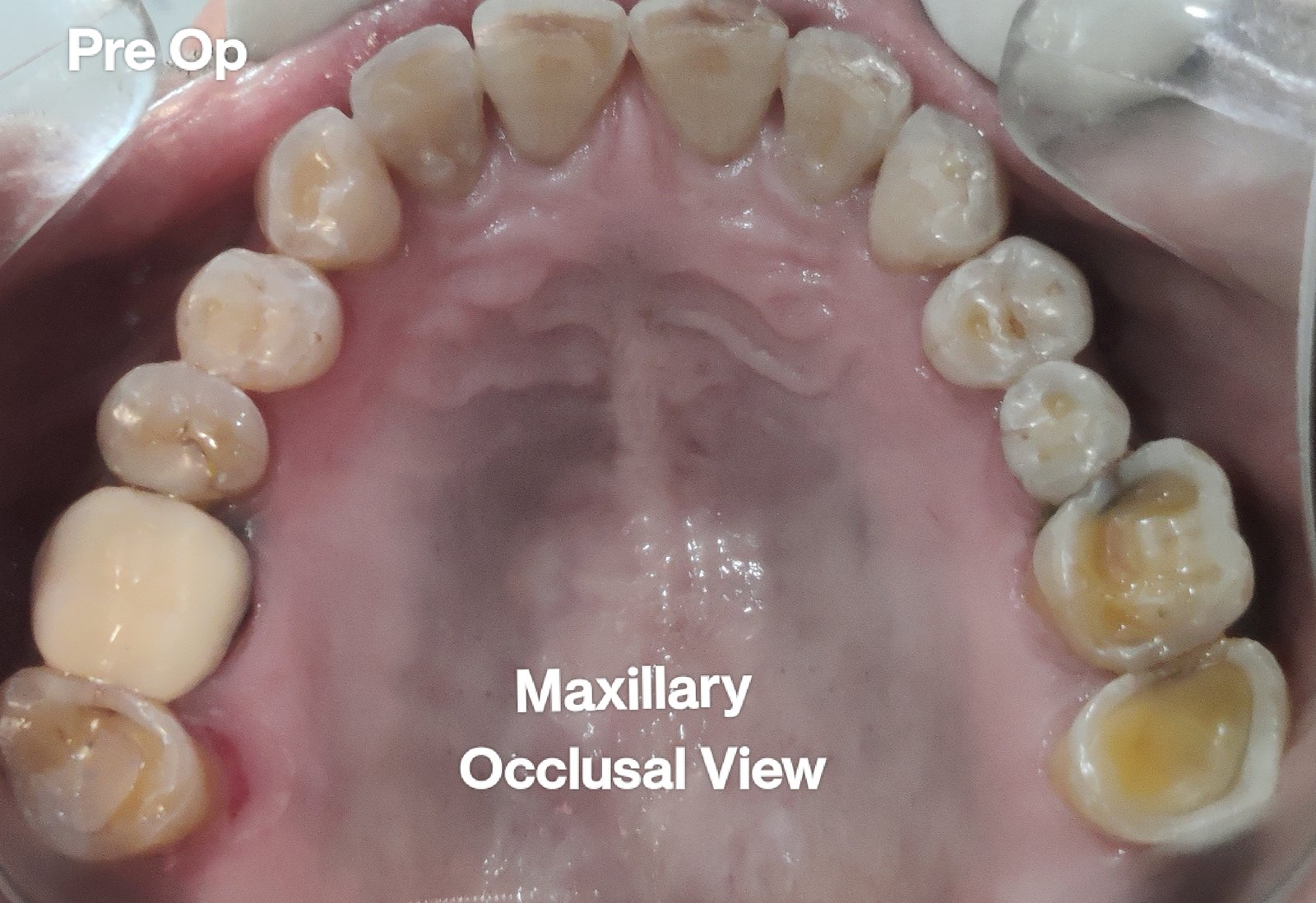
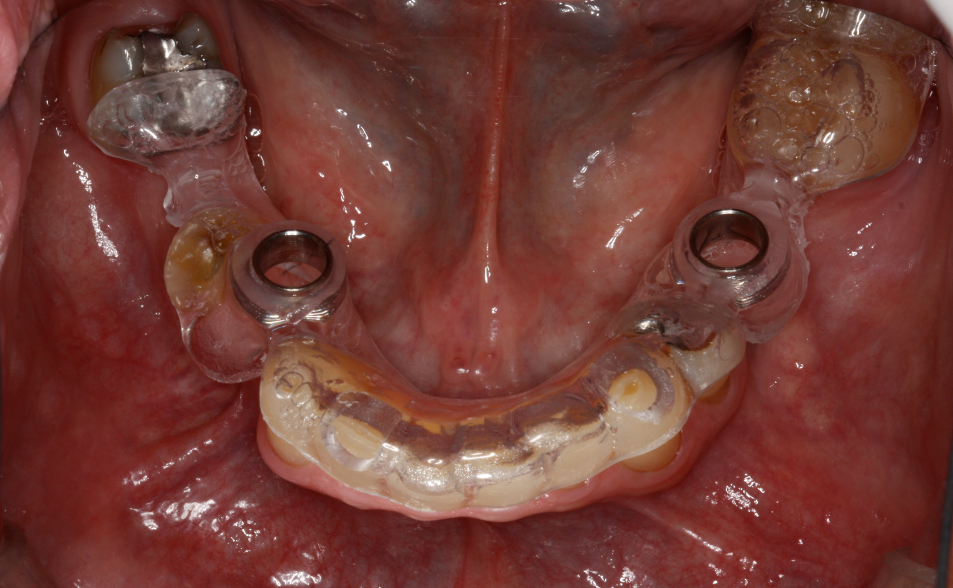
Maxillary abutment teeth (11, 14, 21, 24, 25) were prepared to receive short metal copings, while mandibular teeth 33 and 43 were readied for custom-made extra radicular stud attachments. Aquasil™ putty and rubber base materials were used for impressions, leading to the fabrication of copings and attachments via the lost wax technique. These components were cemented intraorally with glass ionomer cement for optimal fit and seating (Fig. 2). After the cementation of copings and attachment, using conventional techniques border moulding was done and secondary impression was made with light viscosity rubber base material (Aquasil TM, DECA Regular Set, Dentsply) (Fig.3).
Record rims were custom-made to establish the maxillary-mandibular relationship. This record was transferred to a semi-adjustable articulator for teeth arrangement and subsequent try-in (Fig. 4). Following a satisfactory try-in, the denture was waxed and processed using heat cure acrylic. Bilateral marks were made on the intaglio surface to accommodate custom ball attachments in the canine areas, incorporating orthodontic separators. These separators were embedded with auto-polymerizing acrylic resin to secure them to the denture. After trimming excess acrylic and polishing vent holes, cyanoacrylate resin was applied for better adhesion. The final denture (Fig. 6a & b) was delivered with post-insertion instructions, followed by regular follow-ups.
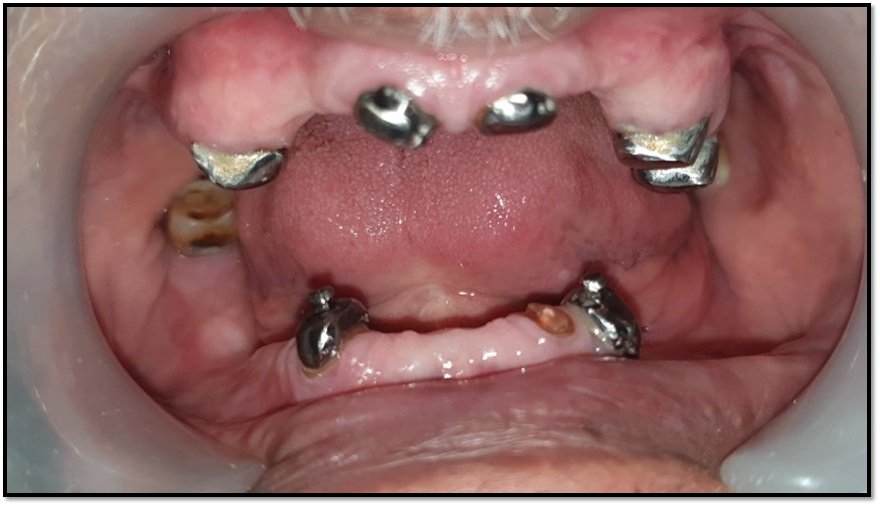
Fig. 2: View after cementation of custom-made ball attachment and short copings

Fig. 3: Final impressions
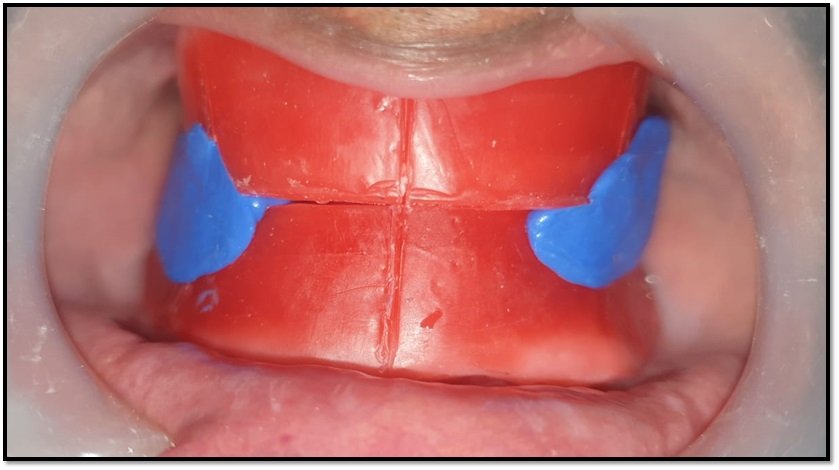
Fig. 4: Jaw Relation Record
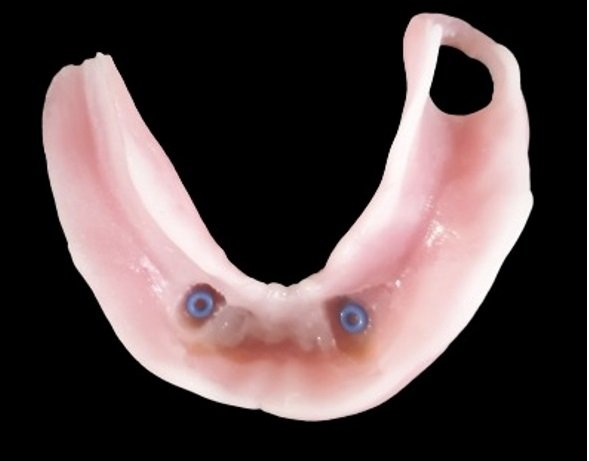
Fig. 5: Pickup of orthodontic separator as housing using self-cure acrylic

Fig. 6.a: Final Maxillary Denture

Fig. 6.b: Final Denture Insertion
DISCUSSION
Attachments in removable partial or complete denture prostheses, segmented fixed prostheses, and implant-supported prostheses vary widely and are not universally suitable. Hence, careful selection based on individual case requirements is paramount. Thorough analysis of study models and radiographs enables clinicians to make informed decisions, influencing attachment selection. This approach provides a viable option for patients retaining natural teeth who prefer to avoid surgical procedures associated with implant placement.6
An overdenture offers benefits such as minimizing bone shrinkage, alleviating pressure on the alveolar ridge, and preserving proprioception. Rissin et al.'s 1978 study compared masticatory performance among individuals with natural dentition, complete dentures, and overdentures, revealing that overdenture wearers exhibited a chewing efficiency one-third higher than those with complete dentures.
Attachments for overdentures are categorized as studs, linking the prosthesis to individual teeth, and bars, connecting it to splinted abutment teeth. These attachments are further classified as rigid or resilient, with resilient types preferred due to their ability to distribute occlusal forces away from compromised abutments, such as edentulous ridges and remaining roots.8,9
CONCLUSION
The significance of a tooth-supported overdenture in treatment lies in its adherence to fundamental principles of preventive prosthodontics. It is essential to continuously uphold and integrate these core concepts into clinical practice to ensure comprehensive patient care and treatment success.
REFERENCES
- Brewer AA, Morrow RM. Overdentures Made Easy. 2nd ed. St. Louis: The C. V. Mosby Co.1980.
- Preiskel HW. Overdentures Made Easy: A guide to Implant and root supported prostheses. London, UK: Quintessence Publishing Co. 1996.
- Rahn A, Heartwell C. Textbook of Complete Dentures. 5th ed. Philadelphia: WB Saunders Co. 1993.
- Renner RP, Gomes BC, Shakun ML, Baer PN, Davis RK, Camp P. Four-year longitudinal study of the periodontal health status of overdenture patients. J Prosthet Dent 1984.51:593-8.
- Miller PA. Complete dentures supported by natural teeth. Tex Dent J 1965.83:4-8.
- Thayer HH. Overdentures and the periodontium. Dent Clin North Am 1980.24:369-77.
- Preiskel HW. Precision Attachments in Prosthodontics: Overdentures and Telescopic Prostheses. Vol 2. 2nd ed. Chicago, IL: Quintessence Publishing Co. 1985.
- Morrow RM, Feldmann EE, Rudd KD, Trovillion HM. Tooth-supported complete dentures: An approach to preventive prosthodontics. J Prosthet Dent 1969.21:513-22.
- Almuhaiza M. Fracture resistance of three different post and core systems on endodontically treated teeth: an in vitro study. Journal of International Oral Health. 2016:1.8(6):679.
Disclaimer from Guident
The views and opinions expressed in articles published in Guident are solely those of the authors and do not necessarily reflect the views of the editors, the editorial board or the publisher, Ivory India. Guident does not endorse any product, technique or treatment described. Clinical content is intended for qualified dental and medical professionals and is not a substitute for individual clinical judgement. Guident, its editors and the publisher accept no liability for any consequence arising from the use of information published in the journal.
How to cite this article
Dr. Varun Kumar, Dr. Kedar Deole. Innovative Stability Solutions in Tooth-Supported Overdentures: A Case Report on Custom Locator Attachments and Short Copings. Guident. 2024 Jul;17(8). Available from: https://guident.net/articles/prosthodontics/innovative-stability-solutions-in-tooth-supported-overdentures-a-case-report-on-custom-locator-attachments.html