Immediate Dentures - a Boon for the Edentulous Patient
Department of Prosthodontics A.B.Shetty Memorial Institute of Dental Sciences, Nitte University, Deralakatte, Mangalore, India
ABSTRACT
The loss of all the natural teeth socially and psychologically handicaps an individual. The transition from the dentulous to the edentulous and then to wearing complete dentures is a difficult phase for many patients. The immediate denture provides a relief for those who need to undergo total extraction. It acts as a stent and aides in quick recovery while subjecting the ridges to functional loading as well, thereby reducing its chances of resorption. This simple procedure helps a patient to continue with routine life soon after removal of all teeth.
KEYWORDS: Immediate denture, interim denture, edentulous rehabilitation
INTRODUCTION
In the fast paced world of today, the ability to communicate, smile and conduct oneself, without a moment’s pause, is of paramount importance. The loss of a few teeth does not actually hinder day to day activities but the actual prospect of losing all the remaining teeth and opting for a complete denture is a harrowing experience for most of the patients.
The indication for extraction may be periodontal breakdown of the remaining teeth or gross carious involvement. Despite of this, almost all patients will strongly resist the prospect of complete extraction of their teeth. So as to reach a compromise between both worlds, immediate dentures emerge as an option- the fabrication and placement of a denture while the patient retains his few remaining teeth and the insertion of this denture on the day of extraction of these teeth.
An immediate denture is a complete or partial removable prosthesis that restores form, function and esthetics for a limited period of time after which it is replaced by a definitive prosthesis.1 Thus immediate denture emerged as a balm to soothe the pain of tooth loss and helped the patient to tide over their challenging time of edentuluosness.2
PROS AND CONS OF IMMEDIATE DENTURE THERAPY
Under normal circumstances, after total extraction, the waiting period for complete healing is 4-6 months. Following which, several appointments is required for the fabrication of the complete denture. Hence, the edentulous period is prolonged. The absence of teeth can be an extremely humiliating experience to a sensitive person. Socially useful and important functions are impaired, such as speech, smiling, laughing, singing, the appearance of one’s mouth, and mastication, which the amenities of life compel one to perform in the presence of others.3The waiting period is shortened by the immediate dentures.
These immediate dentures also act as a surgical stent aiding in the quick healing unimpeded by contact with contaminating substances thus ensuring a faster recovery and enabling him/her to return to their social life and work environment without further delay.4 Also, the patient does not have to face the harrowing experience of walking out, after the appointment without any teeth. Hence, this is psychologically better for the patient.
From a prosthetic point of view, the placement of dentures soon after extraction ensures the facial form and musculature remain in good condition and the tongue does not increase in size due to edentulousness. There’s no room for deleterious chewing patterns to set in. It also ensures that the residual alveolar ridge is subject to functional forces consistently, thereby reducing the rate of resorption.4 To our benefit, a person who has his own teeth until recently, retains some amount of proprioception and has good neuromuscular control and thus, it is easier to obtain a clear centric relation.
The downside to this technique is the anterior esthetics may be slightly compromised as it is not always possible to have a session of anterior try in. The chances of compromised retention also exist because of remodelling of the bone around the extraction socket over a period of time. The cost factor for multiple appointments may also prove to be expensive for the patient.
CASE SELECTION
Under normal circumstances, a patient with a few remaining teeth which are indicated for extraction, can be given an immediate denture. However, if the patient has a few periodontally sound teeth in the anterior and premolar region, he should be given the option of an overdenture, as this would retain the proprioceptive capacity of the teeth and preserve the alveolar ridge.
CASE REPORT
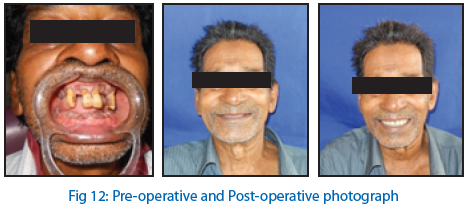
A male patient, aged 65yrs, reported with the complaint of few remaining teeth which had unacceptable esthetics and function and requested its removal and replacement with prosthesis.
DIAGNOSIS AND TREATMENT PLANNING
A thorough medical and dental history was recorded along with the radiographic examination of the relevant Intra Oral Periapical radiographs and Orthopantamographs was done.
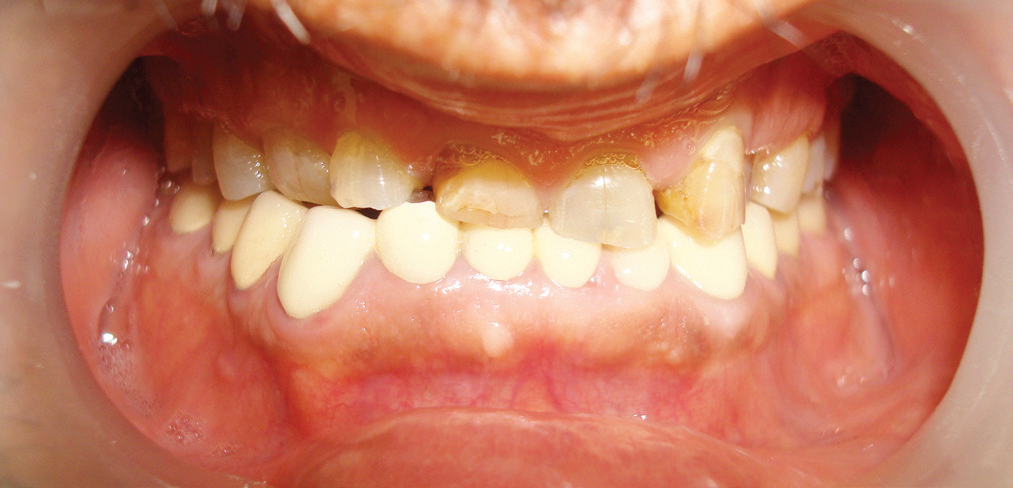
A complete intra oral examination including soft and hard tissues was done and status of the residual ridge noted. The remaining teeth included the maxillary canine and central incisor in the first quadrant and the central incisor and first premolar in the second quadrant. (Fig 1) All the teeth exhibited gingival recession and supraeruption. The teeth were firm
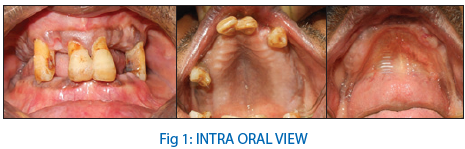
and had no signs of periodontal inflammation or periodontal pockets. No bony spicules, impacted teeth or residual cysts were noted.
PRE OPERATIVE PROCEDURES
In immediate denture, it is preferable to opt for a two stage surgical extraction of teeth. The first stage includes extraction of all the remaining posterior teeth (except first premolars), as this facilitates a healed posterior edentulous area which enables better recording of impressions and maxillo-mandibular jaw relations.5 This was not required in the current case since there were no opposing teeth and the posterior region was already edentulous and healed.
STEPS IN FABRICATION OF IMMEDIATE DENTURE
1. PRIMARY IMPRESSIONS:
CLINICAL STEP: A stock tray is selected and beaded with wax to conform to the ridges and a primary impression is made with irreversible hydrocolloid impression material. The primary cast thus obtained, is used to fabricate a special tray.
LABORATORY STEP: Spacer area is created by adapting baseplate wax in the areas of relief and a double layer thickness of spacer wax in the region of the teeth. Tissue stops
are provided both on the occlusal surface of teeth and on the crest of the alveolar ridge. (Fig 2)The custom tray is fabricated using autopolymerising resin.
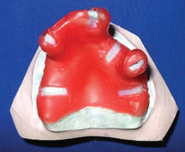
Fig 2: Wax spacer with hard and soft tissue stops
2. BORDER MOULDING AND SECONDARY IMPRESSIONS
CLINICAL STEP: The fit of the custom tray is checked and a low fusing compound is used to record the functional movement of all the borders. The posterior palatal seal is marked with the indelible pencil. Then light body elastomeric material is used to record the minute details of the tissues and has strength in the thinnest sections. (Fig 3) The custom tray is perforated with small holes all over to enhance the flow and to achieve better retention.6
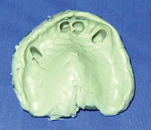
Fig 3: Secondary Impression with elastomeric impression material.
A point to be considered here is that the mobility of the remaining teeth should be judged and block out can be done with soft wax and coated with petrolatum if necessary to prevent inadvertent extraction of the teeth.
CAMPAGNA IMPRESSION TECHNIQUE7: A custom tray is fabricated only for the edentulous areas and border moulding done with green stick compound. The secondary impression is made with zinc oxide euginol paste. This is removed and evaluated and placed back into the mouth after application of an alginate adhesive on the external surface. A stock tray is selected, beaded with wax and placed into the mouth to record the areas of the teeth with irreversible hydrocolloid material in a mucostatic manner. The stock tray is removed along with the custom tray to obtain a final impression.
LABORATORY STEP: The secondary impression is poured with vacuum mixed dental stone to obtain the master cast.
ALTERNATIVE TECHNIQUE: At times, because of the supra eruption of the teeth or narrow diameter or malposition of the remaining teeth, the cast often breaks within the impression. Hence, it becomes cumbersome to attain a good cast with all the teeth intact.
There is a simple technique to obtain a complete cast. After the secondary impression is made, the regions of the teeth ONLY are poured with pattern resin (GC, Japan) drop wise. Before the resin sets, a die pin is inserted into the area of the teeth, one for each tooth respectively. The part of the die pin that remains outside the resin is coated with petrolatum, and the impression is poured with vacuum mixed stone. Once it sets, the cast is removed along with the resin teeth. (Fig 4)
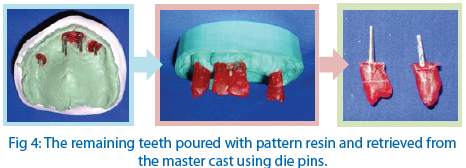
ADVANTAGE: The advantage this technique offers is that the teeth on the die pin can be removed and replaced back on the master cast whenever required. This is an advantage during fabrication of occlusal rims and arrangement of teeth.
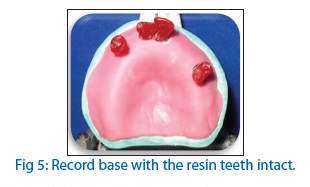
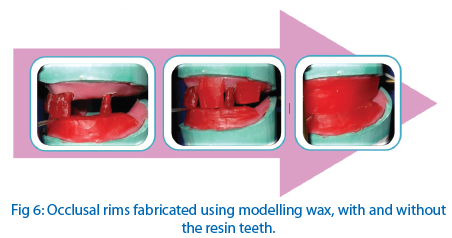
The record bases were fabricated out of autopolymerising resin. (Fig 5) The occlusal rims are fabricated by using modelling wax. The rims are shaped according
to the position of the existing teeth and then filled in. (Fig 6)
3. JAW RELATIONS, FACEBOW TRANSFER AND RECORDS
CLINICAL STEPS: The occlusal rims are placed in patient’s mouth and labial fullness, visibility, fullness of the cheeks, the mentolabial sulcus and the nasolabial fold is checked. It might be difficult to assess the vertical dimension because of the presence and interference of teeth. The best way to check is by phonetics. After the rims are sealed in centric relation position, the cast is mounted on the mean value articulator for this case. An alternative technique is to make a facebow transfer and a protrusive record in order to adjust the condylar inclination in of a semi adjustable articulator to achieve balanced occlusion.
LABORATORY STEPS: The casts are transferred to semi adjustable articulators via facebow. Using protrusive records, the condylar inclination and the bennett angle is calculated and set on the articulator.
POSTERIOR TEETH ARRANGEMENT
The shade, shape and size of the teeth are based on the patient’s remaining teeth. The posterior teeth are arranged on the crest of the ridge and balancing and working side contacts are obtained.
4. POSTERIOR TRY-IN:
CLINICAL STEP: The posterior teeth arranged in the occlusal rims are placed and centric relation and vertical dimension verified. Patient is asked to speak to determine phonetics and balancing contacts are checked if possible.
LABORATORY STEP
ANTERIOR TEETH ARRANGEMENT
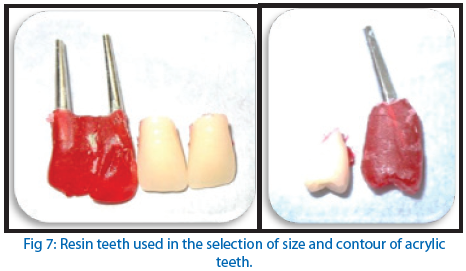
While arranging the anterior teeth, the resin teeth from the cast are removed one at a time until all teeth are replaced by artificial teeth.(Fig 7) The resin teeth on die pins can be removed or replaced into the cast at will to determine the position of the natural teeth.
5.ANTERIOR TRY-IN
CLININCAL STEPS: Since the remaining natural teeth are present, it is difficult to accommodate an anterior try –in. However, a resin template could be fabricated over the finished anterior teeth arrangement and filled with composite and light cured over the patient’s existing teeth to allow the patient to have an idea about the anterior esthetic . The part of the natural teeth outside the template can be reduce with an airotor. However, normally an anterior try in is not carried out.
LABORATORY STEPS: The dentures are flasked and processed as per usual norm. If possible, it is preferable to pack the dentures with clear heat cure acrylic as this would enable the specialist to determine areas of the ridge under pressure.
6. FIT AND INSERTION OF THE IMMEDIATE DENTURE
The patient first undergoes extraction procedures in an atraumatic manner along with filing of bony spicules or sharp areas of the ridge if needed. (Fig 8) The immediate dentures are trimmed, cleaned, polished and stored in antibacterial solution. (Fig 9) The extraction site is carefully inspected and blood or saliva in the region is gently cleaned with sterilised cotton. The immediate denture is carefully inserted into the patient’s mouth.8

Blanching or impingement of tissues, if any, is checked and relieved. The centric relation is checked and high points in occlusion are corrected. The site of extraction is relieved to prevent undue compression of the tissues. If retention is poor, tissue conditioners can be used, barring the extraction site.
POST INSERTION INSTRUCTIONS
- The patient should wear the dentures for 3 days and nights continuously. If removed, then reinsertion becomes difficult because of swelling of the tisses at the site of extraction.
- The patient should eat semi solid / soft food / diet for the first week.
- causes negative pressure)
- The patient should not brush in that area. Simple rinsing with mouth wash should suffice.
- The medications prescribed after extraction should be taken at the correct frequency.
RECALL AND REVIEW APPOINTMENTS
AFTER 24 HOURS
- Gently remove the denture and ask the patient to rinse with a pleasant tasting mouthwash.
- Overextensions along the borders are checked and relieved.
- Minimal manipulation at this stage.
AFTER 48 HOURS
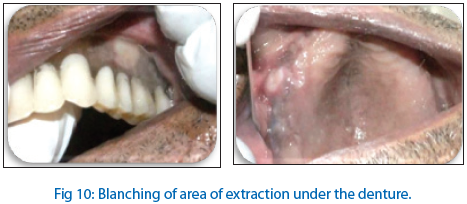
- The denture is relieved in areas of excessive pressure or blanching.(Fig 10)
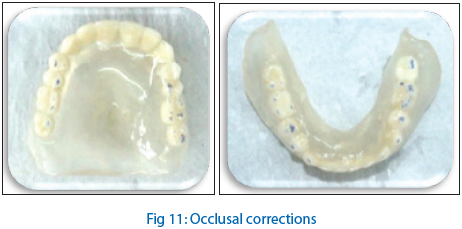
- The occlusion is checked with an articulating paper and corrections are made if necessary.
- If tissue conditioners were placed at the time of insertion, they are removed and reapplied if needed.9
AFTER 7 DAYS
- The sutures are removed.
- The centric relation is re-evaluated.(Fig 11)
- Post insertion instructions are reinforced.
AFTER 3-6 WEEKS
- The relining is periodically replaced.
- If the centric relation is not correct, then clinical remounting can be done at this time.
- Adjustments of the vertical dimension can be made upto 2 mm.10
ATER 6 MONTHS
- The dentures are re-evaluated and the healing site is assessed. The definitive prosthesis can be made.
DISCUSSION
In daily practice we come across all kinds of edentulous states. When both maxillary and mandibular arches are indicated for immediate denture, it is preferable to restore one arch at a time
Sometimes, during impression stage, the posterior palatal seal cannot be assessed accurately because of presence of teeth. Relining and careful reconditioning is a mandatory during the healing process. The vertical dimension is also sometimes difficult to assess as long standing teeth show a combination of recession and supraeruption.
The cost is also a factor for most patients as these procedures involves the fabrication of two sets of dentures- the interim denture and the definitive denture.
Yet if we can overcome these minor hurdles, the benefits of this procedure are bountiful. It emboldens the patient to take the courageous step towards edentulousness without fearing social ostracism and enables them to continue with their daily routines without much difference.
CONCLUSION
The immediate denture is an answer to those who fear the edentulous state in their lives following extraction. While it may not be perfect, it allows the transition from dentulous to edentulous state more comfortable. Regular follow up and maintenance spells success for this type of edentulous rehabilitation.
REFERENCES
- Glossary of prosthodontic terms 8th edition Journal of Prosthetic Dentistry 2005; Vol 94(1); 10–92
- Anderson, John N., and Roy Storer. Immediate and replacement dentures. Blackwell Scientific, 1973.
- DeVan, M. M. The transition from natural to artificial teeth. The Journal of Prosthetic Dentistry, 1961, 11(4), 677-688.
- Winkler, Sheldon. Essentials of complete denture prosthodontics. 2nd edition, Saunders, 1979.
- Linenberg, W. B. Surgical preparation of the mouth for immediate dentures. The Journal of Prosthetic Dentistry,1963, 13(1), 95-101.
- Zarb, G. A., Bolender, C. L., Eckert, S. E., Jacob, R., Fenton, A., & Mericske-Stern, R. Prosthodontic treatment for edentulous patients. Complete dentures and implant-supported prostheses. 12th. ed. St. Louis: Mosby.2004
- Campagna, S. J. An impression technique for immediate dentures. The Journal of prosthetic dentistry, 1968, 20(3), 196-203.
- Payne, S. H. A transitional denture. The Journal of Prosthetic Dentistry,1964, 14(2), 221-230.
- Heartwell Jr, C. M., & Salisbury, F. W. Immediate complete dentures: an evaluation. The Journal of prosthetic dentistry,1965, 15(4), 615-624.
- Demer, W. J. Minimizing problems in placement of immediate dentures. The Journal of prosthetic dentistry,1972,27(3), 275-284.
Disclaimer from Guident
The views and opinions expressed in articles published in Guident are solely those of the authors and do not necessarily reflect the views of the editors, the editorial board or the publisher, Ivory India. Guident does not endorse any product, technique or treatment described. Clinical content is intended for qualified dental and medical professionals and is not a substitute for individual clinical judgement. Guident, its editors and the publisher accept no liability for any consequence arising from the use of information published in the journal.
How to cite this article
Dr. Krishna Prasad, Dr. Chethan Hegde, Dr. Archana Ashok S.. Immediate Dentures - a Boon for the Edentulous Patient. Guident. 2014 Sep;7(10). Available from: https://guident.net/articles/prosthodontics/immediate-dentures-a-boon-for-the-edentulous-patient.html