Future of Prosthodontics Together with Artificial Intelligence and Robotics
Department of Prosthodontics, Crown, Bridge and Implantology, AME’s Dental college and Hospital, Raichur
ABSTRACT
There have been significant changes in the various healing arts during the past few decades, as there have been in fields of dentistry. Artificial intelligence and robotics are next-generation technologies that have made it possible to investigate and advance the various fields of prosthetic dentistry. The present era's data-driven disruptive technology is artificial intelligence (AI). From dentistry to space research, AI is revolutionising every industry. Compared to traditional diagnosis, treatment planning, patient documentation, and management, biomedicine offers a number of benefits. AI is being used in every industry to make life easier for patients and medical professionals. The review of the application of AI in prosthodontics was done in the current work. The use of robots, which help to reduce manual labour and improve accuracy and precision of procedures, is gaining popularity in a number of fields of prosthetic dentistry. Robots are thought to be the most wonderful invention ever made by humans. At first, the use of robots in prosthetic dentistry was primarily restricted to the creation of complete dentures and the assistance of dental implant surgeries. However, with the development of engineering and technology, their applications in prosthetic dentistry have expanded. This article aims to provide an overview of the various applications of AI and robots and their development to date in the complex field of prosthetic dentistry.
Key words: Artificial intelligence, robotics, augumented reality, virtual reality, single manipulator robot, multimanipulator robot, dentomunch robot.
INTRODUCTION
Artificial intelligence is increasingly being used in dentistry and healthcare. Due to the emergence of various software programmes utilised with various medical equipment in recent years, traditional dentistry has gradually evolved into digital dentistry.1 As more and more people attempt to make a diagnosis using technology that enables them to work more quickly and precisely, lowering expenses and the amount of medical errors, artificial intelligence (AI) has gained traction in public healthcare.2 The search for innovation and development to provide high quality patient care will continue to grow in the future. John McCarthy first used the term artificial intelligence (AI) to describe machines that mimicked human knowledge and behaviour in 1989.3
Through the creation and enhancement of hardware, sequences of algorithms have enhanced this capability. Clinicians frequently wonder whether artificial intelligence will be able to take over the role of the clinician in disease diagnosis. This subject has sparked a lot of interest in the technical literature, especially in the application of AI to several medical disciplines.4
Prosthodontics has continuously changed and has proven that it can adapt to changing demands. The teaching, research, and practise of prosthetic dentistry are impacted by the introduction of innovative concepts, technology, and materials. One such development was the introduction of robots in prosthetic dentistry.5 Following advancements in industrial robot technology in the 1990s, the use of robots in a variety of industries, including medicine and dentistry, has gradually increased. The first-ever international symposium on medical robotics and computer-assisted surgery took place in 1994 in Pittsburgh, Pennsylvania, USA.6
The use of robots in the field of prosthetic dentistry may serve to increase staff efficiency and may help to spare people from performing some repetitive, dull, and risky tasks. Because of this, robotic technology is receiving a lot of attention, and its applications are steadily growing every day.7
AI IN PROSTHODONTICS
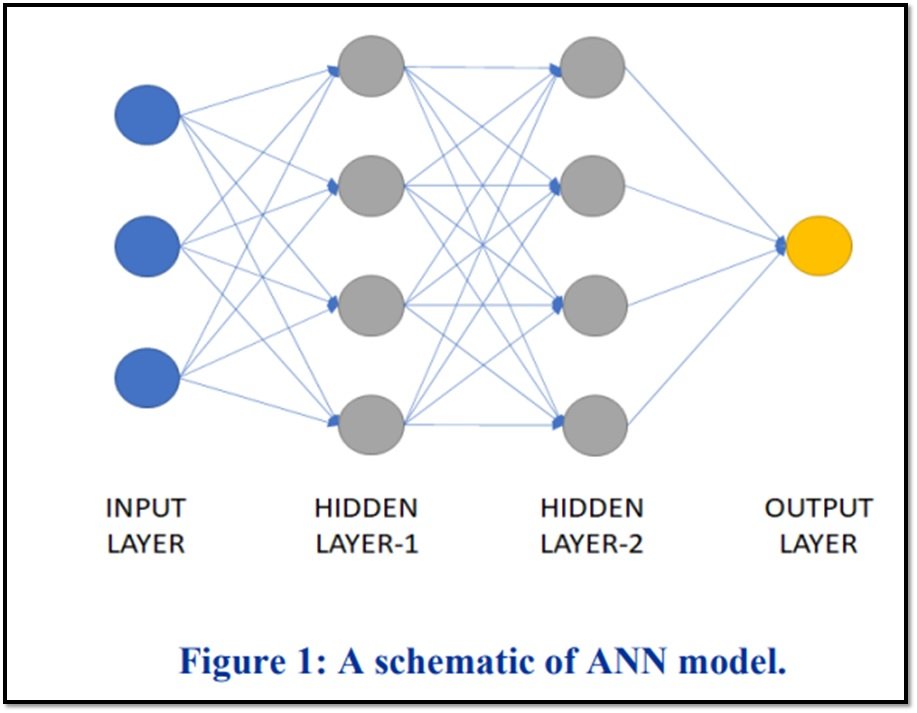
AI is a branch of current technology that uses computer algorithms to mimic human intelligence and actions. It is a type of mathematical model that is based on data. The model can make predictions since it has been trained on previously collected data. The amount of digitalized data is currently growing daily and aids in training AI models to produce more accurate outcomes. The neural network in the human body is comparable to an AI model. The term ANN, which stands for artificial neural network, is also used to refer to the model. A typical AI model has three layers. Figure 1 depicts an example ANN model. The input layer, or top layer, is where the model's parameters come from.
The following layer, which consists of neurons, is known as the hidden layer. Output layer is the third layer. The model receives training data during the training phase. The model can construct a mathematical relationship between the input and output parameters with the use of this data. For more accurate findings, this trained model is further refined on the testing dataset. The model is ready for practical predictions once it has been fully optimised.8
To reduce these errors, Henriette Lerner et al. presented an AI model. This AI model was intended to facilitate the creation of Using monolithic zirconia crowns, a fixed implant prosthesis. The application of the AI model to help find the abutment's subgingival margins. Additionally, this model aided in sharpening the dentist's focus on maintaining interproximal and occlusal contacts and preparing the teeth. This simplicity was intended to cut down on mistakes and time.9
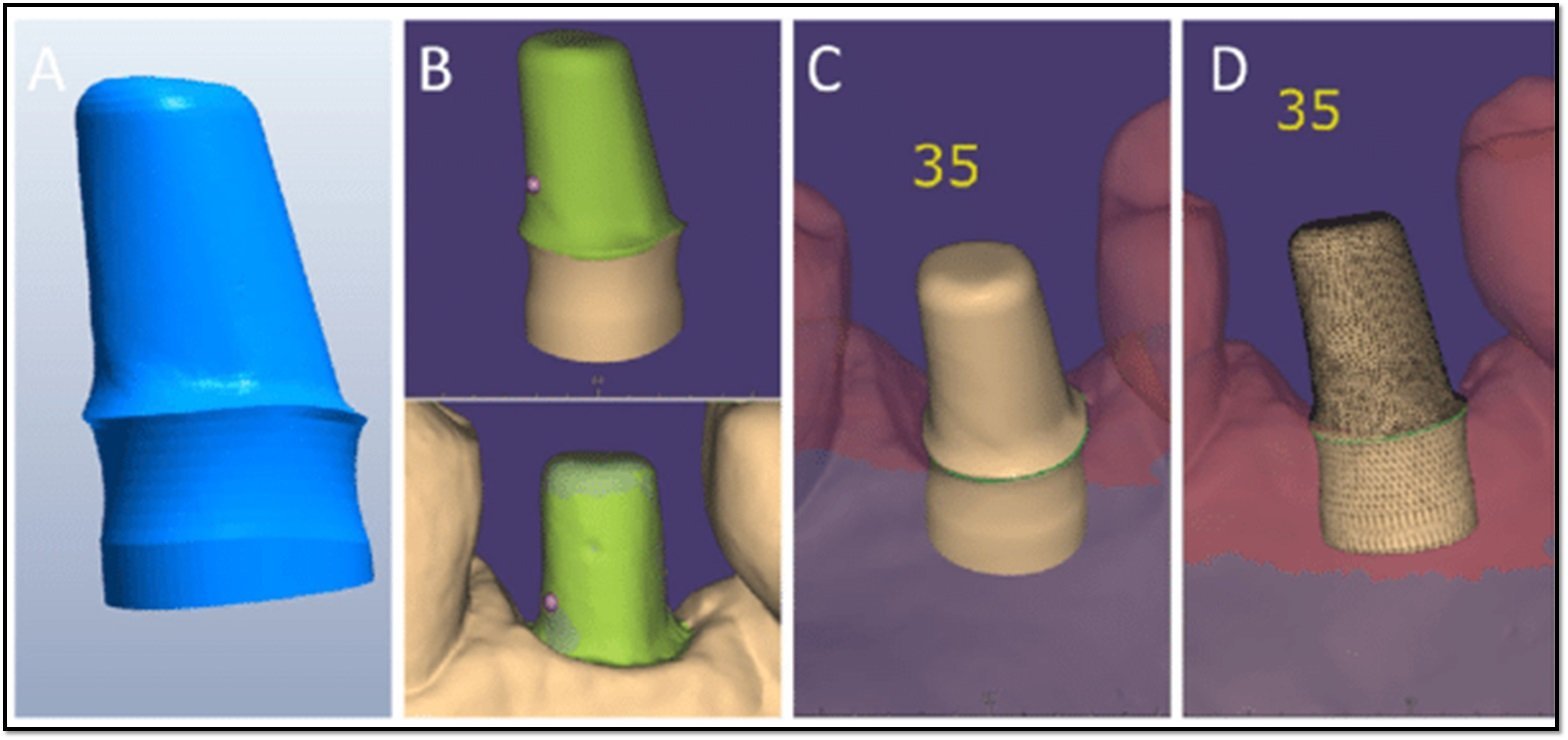
Artificial Intelligence (AI) application in fixed implant prosthodontics. (A) The original .STL file of the CAD design of the individual abutment, which was previously saved in a dedicated folder, is recalled by the system. (B) The original CAD design of the abutment is superimposed on the mesh captured intraorally. (C) Automatic margin line detection. (D) Details of the original CAD model, in which the abutment margins, although subgingival, are clearly represented and visible.9
AUGUMENTED REALITY
Recent developments have replaced the necessity with simulated training achieved through artificial intelligence (AI), virtual reality (VR), and augmented reality (AR).10 While AR is a subset of VR and creates a simulated environment, it enhances sensory experience and duplicates the real world in the virtual space. With the help of augmented reality, real and virtual objects can coexist in a single, lifelike setting. It is capable of reciprocally registering actual and virtual items. In real time, it operates interactively. An operator's perspective of the real environment is combined with an image created by a computer to create augmented reality (AR). Many of the procedures involved in treating prosthetics have been made simpler by the development of augmented reality, which easily matches patient expectations.11
AR has a vital role in CAD-CAM restorations, implantology, and aesthetic planning in prosthodontics. It supports restoration design and mills restorations with exceptional precision that provide improved function and aesthetics. Additionally, the ideas are used to create various craniofacial prostheses that will soon become a reality.11
Using AR, treatment predictions can be made more accurately. In implantology and maxillofacial surgery, the navigation systems help to get superior results. Students receive excellent training thanks to the simulators. As well as saving time, AR helps with exact diagnosis and procedure calibration. Costs can be decreased in the future with widespread use and affordable alternatives. Technology has limitations, making it difficult to convert from non-clinical criteria to few characteristics of comprehension. These constraints will be lessened with more study and advancements. The tests are carried out to use photo emission tomography, infrared spectroscopy, indocyanine green dyes to assess tissue vascularity and sentinel nots. Utilizing robots and haptic force feedback enhances the use of technology of Augumented Reality.12

ROBOTICS IN PROSTHODONTICS
The use of robots in the field of prosthetic dentistry may make it easier to increase staff productivity and may assist in keeping people from performing some repetitive, monotonous, and risky tasks. Because of this, robotic technology is receiving a lot of attention, and its applications are steadily growing every day.12
Types of robots in prosthetic dentistry: The various types of robots in prosthetic dentistry are described below.
Teeth arrangement robots for complete dentures and partial dentures: These can be divided into 2 types:
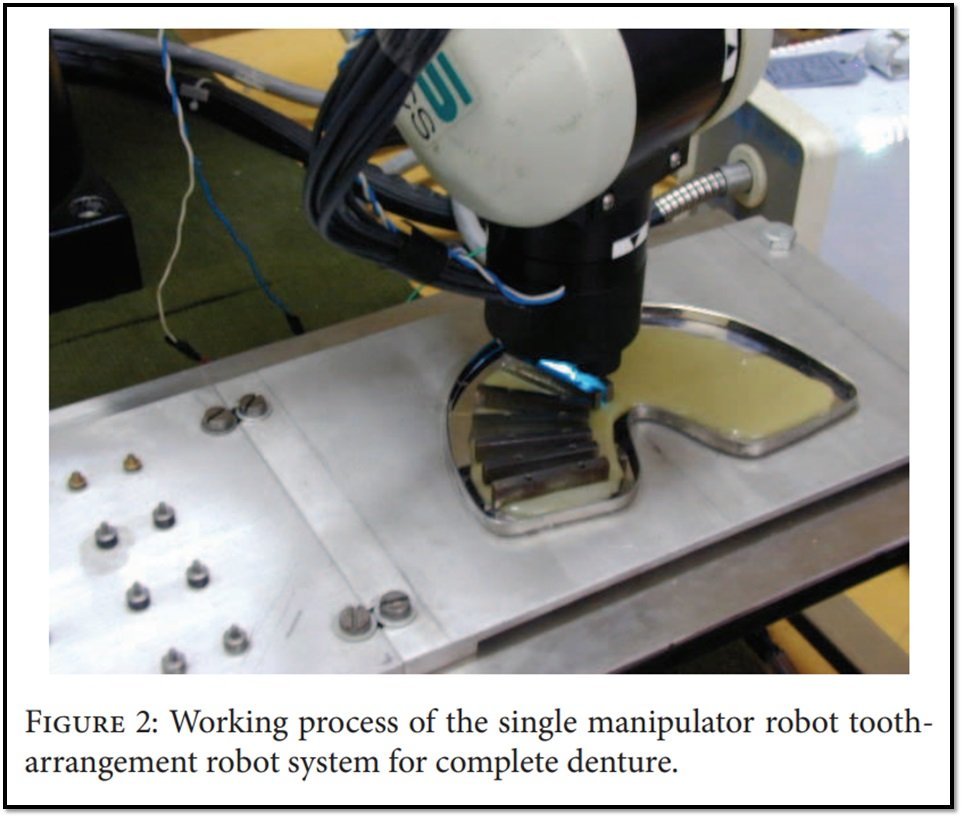
- Single manipulator tooth arrangement robot for complete dentures: Eg. CRS robotics with 6 DOF system.
Robot system with a single manipulator The first CRS robot was created in Canada. The single manipulator tooth arrangement robot system is made up of a 6DOF CRS robot, a tooth arrangement central control system, an electromagnetic gripper, a computer, robot control software for tooth arrangement, motion planning and control, a denture base, a light source device, and light-sensitive glue. The VC++ and OpenGL programming languages are used to create three-dimensional virtual teeth arrangement software.13

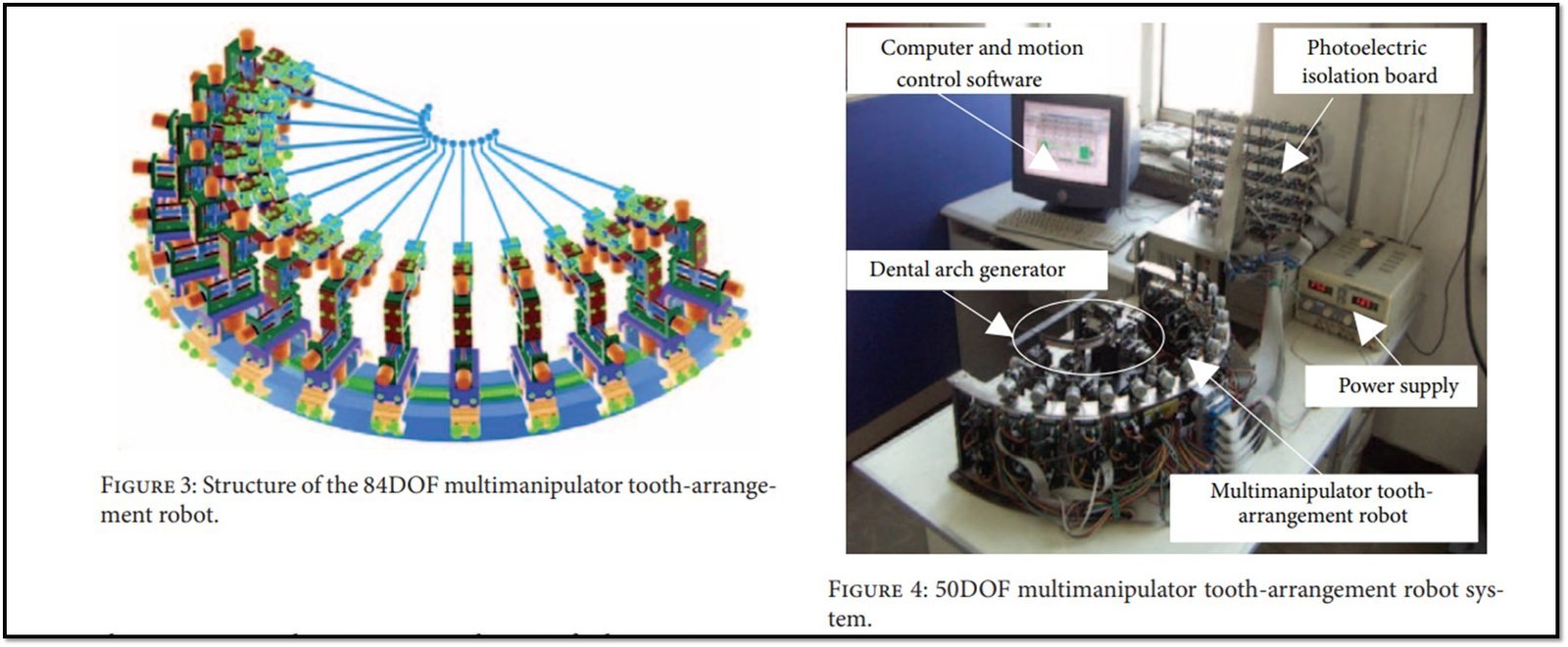
- Multimanipulator tooth arrangement robot for complete dentures: Eg. 50 DOF teeth arrangement robot, 84 DOF teeth arrangement robots.
The 14 independent manipulators, a dental arch generator, and a slipway mechanism make up the 50DOF multi manipulator tooth arrangement robot system. The dental arch curve generator creates a dental arch curve that is used to create a dental arch curve that matches the one from a patient's mouth using a 5-point [one fixed-point and four movingpoints] control system. In order to fulfil the need for every tooth to rotate, each of the 14 manipulators can travel along their own path. These manipulators give the controls with three degrees of freedom (DOF) [two rotations and one movement] to manipulate each tooth's position in the Z, lingual, and near-farmedium directions. Each tooth is supported by a tootharrangement assistant. It takes this robot device roughly 30 minutes to process a full denture.14
ROBOT ASSISTED DENTAL IMPLANT SURGERY
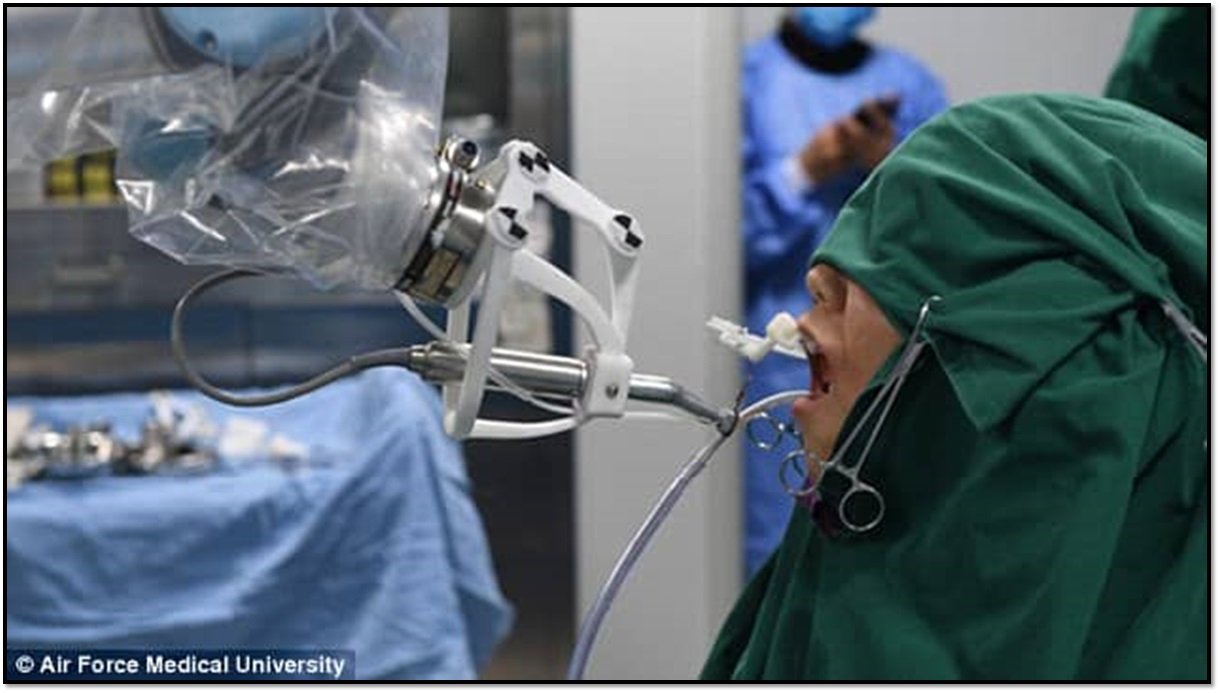
With compelling data supporting its value in increasing and augmenting surgical capabilities, robotic assistance has become widespread in many medical and surgical specialties. It should be noted that the robotic guidance arm does not move until the surgeon exerts force on it. Unlike with a static guide, the surgeon can change the planned implant position whenever they choose because to the digital nature of the plan and guidance. The surgeon has complete control over starting and stopping drilling, and he or she may change the plan at any time or do an entirely freehand procedure. The first FDA-cleared robotic device for dental surgery, Yomi (Neocis, Inc.), is commercially available.15
Similar to previous digitally driven operations, Yomi-Enabled Surgery ("YES") plans the procedure virtually on the patient's CBCT scan based on restorative aims. Yomi, in comparison, also provides cutting-edge support in the form of haptics, or robotic guidance.16 Through Yomi's robotic guidance arm, haptic guidance offers the surgeon with directional and proportionate feedback forces that help him or her stay on the virtual plan. Notably, the surgeon must exert force before the robotic guide arm moves. The digital nature of the plan and guidance, in contrast to a static guide, allows the surgeon to change the intended implant position whenever necessary. Drilling is entirely under the surgeon's complete control, and the plan may be changed at any time or can be a freehand operation as well.17
DENTAL MASTICATORY ROBOTS
Robots that can fulfil at least some specific human masticatory functions are referred to as "masticatory robots."functions. There are numerous tools and equipment for measuring human masticatory movements. But these tools and technologies fall short of simulating the whole range of intricate actions and movements needed in the masticatory process. This paved the door for the realistic and controllable robotic recreation of jaw movements for a variety of applications, including speech therapy, dentistry training, and jaw simulation.18
Robot Simulator Dento Munch is an illustration of a dental masticatory robot. A 6 DOF robotic dental testing simulator is what it is.It consists of the compliance module and artificial jaws. The jaws were reverse engineered to resemble a human mandible and maxilla with artificial teeth. They can be used to simulate material wear on dental components, such as individual teeth, crowns, bridges.19

CONCLUSION
Despite the potential uses of AI in dentistry that have been demonstrated in numerous research, these systems are still far from being able to take the place of dental experts. Instead, the usage of AI should be seen as a supplementary tool to support specialists and dentists. To ensure that humans can continue to oversee treatment and make wise judgments in dentistry, it is imperative to make sure AI is integrated in a safe and controlled way.
The use of robotics in the field of prosthetic dentistry is no longer science fiction, but it is just in its initial stages. Quality research is necessary to maximise the utilisation of this great innovation in this age of ever evolving ideas and technologies. When prosthetic treatments are administered using robotic systems, the accuracy and precision of the care given under the direction of knowledgeable doctors can be increased.
REFERENCES
- Machoy, M.E.; Szyszka-Sommerfeld, L.; Vegh, A.; Gedrange, T.; Wo?niak, K. The ways of using machine learning in dentistry. Adv. Clin. Exp. Med. 2020, 29, 375–384. https://doi.org/10.17219/acem/115083.
- Wong, S.H.; Al-Hasani, H.; Alam, Z.; Alam, A. Artificial intelligence in radiology: How will we be affected? Eur. Radiol. 2019, 29, 141–143. https://doi.org/10.1007/s00330-018-5644-3.
- McCarthy, J. Artificial Intelligence, Logic and Formalizing Common Sense. In Philosophical Logic and Artificial Intelligence; Thomason, R.H., Ed.; Springer: Dordrecht, The Netherlands, 1989. https://doi.org/10.1007/978-94-009-2448-2_6.
- Pareek, Mitali & Kaushik, Brahmansh. (2022). Artificial intelligence in prosthodontics: a scoping review on current applications and future possibilities. International Journal of Advances in Medicine. 9. 367. 10.18203/2349-3933.ijam20220444.
- Lerner H, Mouhyi J, Admakin O, Mangano F. Artificial intelligence in fixed implant prosthodontics: a retrospective study of 106 implantsupported monolithic zirconia crowns inserted in the posteriorjaws of 90 patients. BMC Oral Health. 2020;20(3).
- Howard, J. Artificial intelligence: Implications for the future of work. Am. J. Ind. Med. 2019, 62, 917–926. https://doi.org/10.1002/ajim.23037.
- Kumar CP, MA Amrutha, M.A S Mohammed. Trends in Prosthodontics: An Overview. J Adv Med Dent Scie Res 2016;4[2]:35-40.
- Jiang JG, Zhang YD, Wei CG, He TH, Liu Y. A review on robot in prosthodontics and orthodontics. Advances in Mechanical Engineering. 2015 Jan;7[1]:198748.
- Sreelekshmi S, Varghese K, Abraham JP, Jaysa JJ. Applications Of Robotics In Prosthodontics–A Review. Int J Innovat Res Adv Stud. 2017;4[5]:38-41.
- Takahashi T, Nozaki K, Gonda T, Ikebe K. A system for designing removable partial den-tures using artificial intelligence. Part 1. Classification of partially edentulous arches using a convolutional neural network. J Prosthodont Res. 2021;65(1):115- 8.
- Kumar CP, MA Amrutha, M.A S Mohammed. Trends in Prosthodontics: An Overview. J Adv Med Dent Scie Res 2016;4[2]:35-40.
- Bhambhani R, Bhattacharya J, Sen SK. Digitization and its futuristic approach in prosthodontics. J Indian Prosthodont Soc. 2013;13:165–74.
- Huang TK, Yang CH, Hsieh YH, Wang JC, Hung CC. Augmented reality (AR) and virtual reality (VR) applied in dentistry. Kaohsiung J Med Sci. 2018;34:243–8.
- Jiang JG, Zhang YD, Wei CG, He TH, Liu Y. A review on robot in prosthodontics and orthodontics. Advances in Mechanical Engineering. 2015 Jan;7[1]:198748.
- Sreelekshmi S, Varghese K, Abraham JP, Jaysa JJ. Applications Of Robotics In Prosthodontics–A Review. Int J Innovat Res Adv Stud. 2017;4[5]:38-41.
- Mahule, Aushili & Shaikh, Almas & Sagvekar, Avinash & Gade, Jaykumar & Gade, Vandana. (2021). Robots in Prosthodontics: A scientific fiction or reality?.
- Kavic MS. Robotics, technology, and the future of surgery. JSLS 2000;4:277-279.
- Hussain A, Malik A, Halim MU, Ali AM. The use of robotics in surgery:
areview.IntJClinPract2014;68:1376-1382. - Kochanski RB, Lombardi JM, Laratta JL, Lehman RA, O’Toole JE. Image-guided navigation and robotics in spine surgery. Neurosurgery 2019.
- Xu WL, Bronlund JE, Potgieter J, Foster KD, Röhrle O, Pullan AJ, Kieser JA. Review of the human masticatory system and masticatory robotics. Mechanism and Machine Theory. 2008 Nov 1;43[11]:1353-75. 10.
- Alemzadeh K, Raabe D. Prototyping artificial jaws for the robotic dental testing simulator. Proceedings of the Institution of Mechanical Engineers, Part H: Journal of Engineering in Medicine. 2008 Nov 1;222[8]:1209-20.
- Kumar P, Dixit P, Kalaivani V, Rajapandian K. Future advances in robotic dentistry. J Dent Health Oral Disord Ther. 2017;7[3]:00241.
- Wu Y, Wang F, Fan S, Chow JK. Robotics in dental implantology. Oral and Maxillofacial Surgery Clinics. 2019 Aug 1;31[3]:513-8.
- Naveen S. A novel approach for carrying out dental activities such as drilling and filling using automated robots. International Journal Of Electrical, Electronics And Data Communication. 2017.
- Rawtiya M, Verma K, Sethi P, Loomba K. Application of robotics in dentistry. Indian J Dent Adv. 2014 Oct 1;6[4]:1700-6.
- https://time.com/4952886/china-world-first-dental-surgery-robot-implant/
- Xu WL, Bronlund JE, Potgieter J, Foster KD, Röhrle O, Pullan AJ, Kieser JA. Review of the human masticatory system and masticatory robotics. Mechanism and Machine Theory. 2008 Nov 1;43[11]:1353-75.
- Alemzadeh K, Raabe D. Prototyping artificial jaws for the robotic dental testing simulator. Proceedings of the Institution of Mechanical Engineers, Part H: Journal of Engineering in Medicine. 2008 Nov 1;222[8]:1209-20.
- Ishii H, Koga H, Obokawa Y, Solis J, Takanishi A, Katsumata A. Development and experimental evaluation of oral rehabilitation robot that provides maxillofacial massage to patients with oral disorders. The International Journal of Robotics Research. 2009 Sep;28[9]:1228-39.
- Tanzawa T, Futaki K, Tani C, Hasegawa T, Yamamoto M, Miyazaki T, Maki K. Introduction of a robot patient into dental education. European Journal of Dental Education. 2012 Feb;16[1]:e195-9
- L. Sun, H. Hu, and M. Li, “A review on continuum robot,” Robot, vol. 32, no. 5, pp. 688–694, 2010.
- L. T. Yu, Z. Y. Wang, P. Yu, T. Wang, H. J. Song, and Z. J. Du, “A new kinematics method based on a dynamic visual window for a surgical robot,” Robotica, vol. 32, no. 4, pp. 571–589, 2014.
- L. Yu, H. Song, T. Wang, Z. Wang, L. Sun, and Z. Du, “A new asymmetrical mass distribution method on the analysis of universal “force-sensing” model for 3-DOF translational parallel manipulator,” Industrial Robot, vol. 41, no. 1, pp. 56–69, 2014.
- Z. J. Du, L. N. Sun, and L. X. Fu, “An overview of medical robots,” Robot, vol. 25, no. 2, pp. 182–187, 2003.
- . M. Wang, W. Li, D. Liu, J. M. Liu, L. Hu, and C. R. Yu, “Study of robot-assisted orthopedic operation,” Robot, vol. 25, no. 3, pp. 255–258, 2003.
- B. Shao, L. N. Sun, and Z. J. Du, “The state of art of the robot assisted minimally invasive surgery and analysis of key technology,” Journal of Natural Science of Heilongjiang University, vol. 22, no. 1, pp. 56–60, 2005.
- D. Li, W. Rong, L. Sun, W. Xiao, and Y. Zou, “Virtual force feedback-based 3D master/slave tele-nanomanipulation in SEM,” Journal of Nano Research, vol. 20, pp. 109–116, 2012.
- D. Li, W. Rong, L. Sun, B. You, Y. Zou, and W. Xiao, “Fuzzy control and connected region marking algorithm-based SEM nanomanipulation,” Mathematical Problems in Engineering, vol. 2012, Article ID 803912, 16 pages, 2012.
Disclaimer from Guident
The views and opinions expressed in articles published in Guident are solely those of the authors and do not necessarily reflect the views of the editors, the editorial board or the publisher, Ivory India. Guident does not endorse any product, technique or treatment described. Clinical content is intended for qualified dental and medical professionals and is not a substitute for individual clinical judgement. Guident, its editors and the publisher accept no liability for any consequence arising from the use of information published in the journal.
How to cite this article
Dr. T. Ritushree, Dr. Sunil Dhaded, Dr. Priyanka Konin. Future of Prosthodontics Together with Artificial Intelligence and Robotics. Guident. 2022 Dec;16(1). Available from: https://guident.net/articles/prosthodontics/future-of-prosthodontics-together-with-artificial-intelligence-and-robotics.html