Fabrication of Tooth Supported Overdenture with Customizing Ball Attachments-a Case Report
Department of Prosthodontics, Seema Dental College and Hospital, Rishikesh
Abstract
When patients with few remaining teeth comes for the replacement, most of the dentists face problems among various treatment modalities. Such dilemma can be resolved by following the simple approach of preservation of existing structures first. Tooth supported overdenture best justify this approach of replacement with preservation as helps to maintain proprioception by preserving the natural teeth and avoid the loss of alveolar bone due to extraction. This clinical report describes the prosthodontic rehabilitation of a patient with few remaining teeth in mandibular arch retained with customized ball attachments in tooth supported overdenture for added advantages like better retention, stability, support and psychological benefits of the patient.
Keywords: Overdenture; tooth supported denture; Customized ball attachment; post space preparation; overlay denture
Introduction
With the loss of teeth, not only function and aesthetics of the patient get compromised but also affect the patient psychologically. Presence of teeth gives a psychological impact on the person's mind of having natural teeth in his mouth, which adds to the personal confidence.1 According to GPT, an overdenture is defined as any removable dental prosthesis that covers and rests on one or more of the remaining natural teeth, on the roots of the natural teeth, and/or on the dental implants. This paper reports the fabrication of the custom- made ball attachments in the institutional laboratory by simple technique for tooth supported overdenture which was cost effective and more acceptable to the patient. Our main focus behind selecting this treatment modality was preservation of the remaining hard and soft tissues in oral cavity and at the same time cost effective treatment. Tooth supported overdenture treatment not only preserves the proprioceptive characteristic but also prevent the bone resorption after extraction and patient also feel confident psychologically. In comparison to removable prosthesis, tooth supported overdenture has an upper hand in terms of retention, stability, patient satisfaction and functional adaptability. So proper diagnosis of the hard and soft tissues plays a significant role in the prognosis of tooth supported overdenture.
Case History
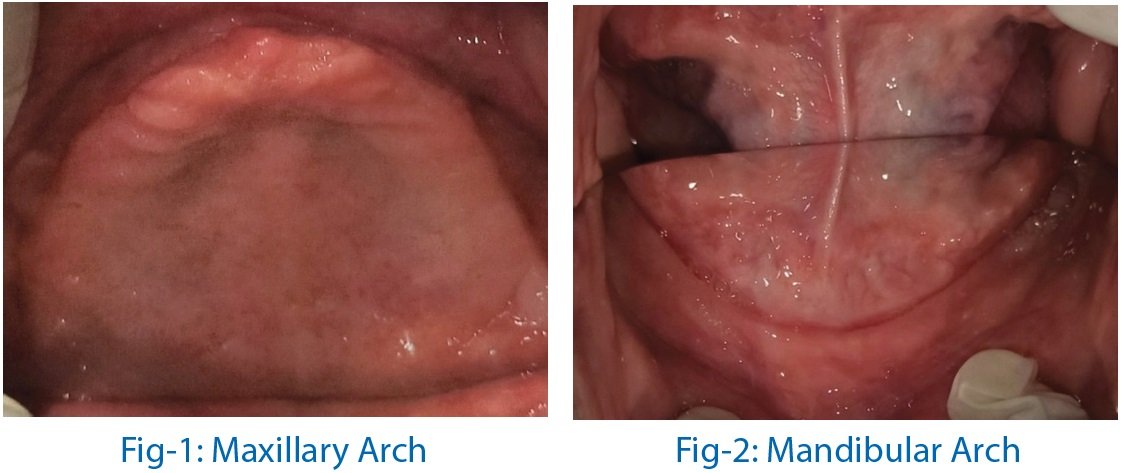
A 55 year old female reported in the department of prosthodontics, crown & bridge with the complain of missing teeth, difficulty in chewing and wanted the replacement for the same. The patient gave the history of loss of teeth since 3 year due to caries and gums problems and she was wearing removable denture with respect to maxillary and mandibular arch. On extraoral examination, the patient had convex profile and temporomandibular joint was normal. On intraoral examination teeth present were 34 and 44 in mandibular partially edentulous arch and in maxillary partially edentulous arch teeth present were 11,12,15,16,21,22 &23(Fig 1). Few weeks back endodontic treatment was carried out with respect to 34 and 44. Fixed prosthesis was seen with respect to 16. All treatment options were presented and discussed with the patient, including total extraction and conventional denture, implant-supported denture, tooth supported overdenture with lower arch and conventional or implant-supported denture with upper arch. After considering the financial aspects and amount of time the patient elected to tooth supported lower overdenture and conventional upper removable partial denture. After taking consent from the patient, oral prophylaxis and root planning were carried out, emphasizing oral hygiene instructions and maintenance.

Fig 1- Intraoral view of maxillary & mandibular arch
Prosthetic Management
Diagnostic impression of the maxillary and mandibular arches were made using irreversible hydrocolloid impression material(Densply Zelgan) and diagnostic casts were made with Type III gypsum product(Kalabhai dental stone). After assessing endodontic therapy, tooth preparation and post space preparation was done to the predetermined length of half to two third of root length with respect to 34 and 44(Fig 2). After that post space impression was made with the acrylic resin pattern for receiving customizing ball attachments to 34 and 44. For preparing the ball attachment, a small metallic bead(size-1.5mm) was indexed in Vinyl Polysiloxane(putty consistency). This index was used to fabricate the ball attachments by using the acrylic resin pattern and then it was attached to the post(Fig 3). The casting was carried out by using base metal alloy(Ni-Cr) and retrieved the attachments by air abrasion with aluminium oxide particles of size 50 microns(Fig 4).

Fig 2- Tooth preparation for post space wrt 34 & 44

Fig 3- Indexing of metallic bead in VPS(Putty) & poured with resin pattern which was attached onto impression of post space


Alginate impression for lower arch and upperarch was made and custom tray was fabricated. Border moulding was performed in a conventional manner and final impressions were made with ball attachments in their respective position by medium body impression material(Fig 5) for mandibular arch, respectively, and master cast was poured. The fitting of post attached with customized ball attachments checked radiographically and finally cemented with Glass ionomer cement(Fig 6).
The denture base was fabricated on master cast. Occlusion rims were also fabricated over the trial denture base. Horizontal and vertical maxillomandibular records were obtained with the record bases and the occlusion rims and these were transferred to a semiadjustable articulator by using a face bow. The artificial teeth were selected and arranged on the record bases for a try in and they were evaluated intraorally for phonetics, aesthetics, occlusal vertical dimension and centric relation(Fig 7). The dentures were processed, finished and polished. At the time of insertion, holes were made on intaglio surface of the denture in relation to customized ball attachments.
The O-rings (elastic orthodontic separators) of blue color was placed on to customized ball attachments (Fig 8), vaseline was applied on to the surface of attachments for easily removal later and then denture was relined with self-cure acrylic. Finally the prosthesis was polished and placed(Fig 8,9,10). Occlusion was assessed and placement instructions were given and the denture was delivered. Post placement check up was done after 24 hours, 1 week and 1 month. The patient was happy with the prosthesis and was able to speak and chew well. The patient was instructed to attend recall visits every 6 months.
Discussion
For this patient we opted for fabrication of tooth supported overdenture, overdentures have numerous advantages like they decrease the pressure on soft-tissue and transmit it to the underlying bone, that will increase the ridge integrity, stability and patient comfort. Overdentures have greater retention and stability compared with the complete dentures, which greatly enhance the mastication. If we talk about disadvantages of the overdenture treatment which include the need for inevitable treatment, which requires additional time and cost also increases. This requires the simplification of the techniques that can assure the cost-effective treatment modalities. Practitioners are looking for simplified treatments that can provide cost-effective alternatives to more complex implant prosthodontic procedures.2
In this present case report we used custom made attachments for overdenture which was time consuming but cost effective for the patient. Semi precision attachments are definitely more accurate but not acceptable to patient economically, due to which patient has no other option other than conventional removable dentures.3 But with this simple technique for fabrication of custom made attachments, we are not only preserving the natural structures but also by this technique retention, stability and acceptance of denture can be increased.4 Though comparatively, there are fewer studies on semi-precision, custom made stud attachments, the researchers like Berkson used a laboratory made semi-precision attachment in overdentures. According to him, to achieve a satisfactory level of retention and stabilization, we must try to save even the last remaining teeth in the mouth and use them as abutments for overdentures.5 Nemcovsky et al. in 1990, described a simple technique for fabricating stud overdenture retainers in the form of custom attachment castings with teflon retention discs. This system allows for selective placement of the retention sphere on the root surface and control of retention through the size of the retention sphere. This technique makes the chair side replacement of teflon discs possible.6,7
This shows that there is need of implementation of innovative techniques, which can provide the better choice of treatment to the patient. In this case report an attempt was made to give the patient a satisfactory treatment. The patient should be monitored periodically to check the condition and health of retained teeth and also instructed to keep prosthesis clean, to brush daily. The overdenture should also be left out of mouth in a cleaning solution overnight. Though the custom- made attachments lack in the precision, which is possible with the prefabricated ones, but important thing is to serve the purpose of achieving the satisfactory function. The acceptance level of the patients is similar to the costlier attachments or may-be it is more here as it is cheaper.
Conclusion
Approach of the dentist to restore the aesthetics and function of the patient is an important aspect in selection of treatment modality. Because such procedures are time consuming and expensive, even the clinicians avoid practicing such procedures, which might keep them away from its implementation and getting expertise in the special care treatment modalities. Approach of preservation is not only in favour of the patient however it additionally helps the dentist to think differently and encourage them to practice new innovative procedures. Clinicians should make an effort to utilize all the available resources to apply their knowledge and skill to keep them updated at the expense of patient satisfaction. There is a great need of innovation to make the sophisticated systems lot more economical.
References
- Burns DR. The mandibular complete overdenture. Dent Clin North Am 2004;48:603-23.
- Nemcovsky CE, Fitzig S, Gross M. Custom overdenture retainer. J Oral Rehabil 1990;17:343-50
- S. Bansal, M.A. Aras, V. Chitre. Tooth supported overdenture retained with custom attachments: a case report. J Indian Prosthodont Soc 2014;14:283-6.
- C. Schuch, A.P. de Moraes, R. Sarkis-Onofre, T. Pereira-Cenci, N. Boscato. An alternative method for the fabrication of a root-supported overdenture: a clinical report. J Prosthet Dent 2013;109: 1-4
- Berksun S. A laboratory made attachment application that can be used in overdentures. Ankara Univ Hekim Fak Derg 1989;16:505-9.
- Langer Y, Langer A. Root-retained overdentures: Part I: Biomechanical and clinical aspects. J Prosthet Dent 1991;66:784-9.
- Bolouri A, Zartman RR. Fabrication of custom clips for bar-and-clip attachments for implant-supported overdentures. J Prosthet Dent 2006;96:379-80.
Disclaimer from Guident
The views and opinions expressed in articles published in Guident are solely those of the authors and do not necessarily reflect the views of the editors, the editorial board or the publisher, Ivory India. Guident does not endorse any product, technique or treatment described. Clinical content is intended for qualified dental and medical professionals and is not a substitute for individual clinical judgement. Guident, its editors and the publisher accept no liability for any consequence arising from the use of information published in the journal.
How to cite this article
Dr. Himanshu Aeran, Dr. Varun Kumar, Dr. Upasna Sharma. Fabrication of Tooth Supported Overdenture with Customizing Ball Attachments-a Case Report. Guident. 2021 Feb;14(3). Available from: https://guident.net/articles/prosthodontics/fabrication-of-tooth-supported-overdenture-with-customizing-ball-attachments-a-case-report.html