A Modified Impression Technique for Flabby Ridges
Department of Prosthodontics H.P. Government Dental College & Hospital, Shimla, Himachal Pradesh, India.
ABSTRACT
Flabby ridge is a mobile or extremely resilient alveolar ridge. It occurs due to replacement of bone by fibrous tissue. Such ridges provide poor support, retention and stability to complete dentures, unless managed appropriately. With time, many impression techniques have been employed for flabby ridges. In this article, a modified impression technique is described to overcome the problems related to poor support for denture.
Keywords: flabby ridge, support, retention, impression
Corresponding Author: Dr. Reena Sirohi, Junior Resident, Department of Prosthodontics, H.P. Government Dental College & Hospital, Shimla, Himachal Pradesh
INTRODUCTION
Flabby ridge is a superficial area of mobile soft tissue, developed due to replacement of alveolar bone by hyperplastic soft tissue. Such mobile denture bearing area can be easily displaced by masticatory forces leading to loss of stability and retention.1 Mucocompressive impression techniques result in an unstable and unretentive denture, as flabby tissue recorded in a distorted state, while mucostatic techniques may not make best use of available tissue support.2 Thus, an impression technique is required which will compress the nonflabby tissues to obtain optimal support, and, at the same time, will not displace the flabby tissues. A multitude of impression techniques have been described for overcoming the problem of the flabby ridge.3
Liddlelow described a technique in which two different type of impression materials i.e. ‘plaster of Paris’ and zinc oxide eugenol were used over flabby and normal tissue respectively4 . Osborne used two separate impression trays and materials in his technique to record the ‘flabby’ and ‘normal’ tissues, and then related intra-orally5. Watson described ‘window’ impression technique in which a custom tray is made with an opening over the flabby tissues6.
The main aim of this article is to describe a modified impression technique for making impressions of denture bearing areas having flabby ridges.
CASE REPORT
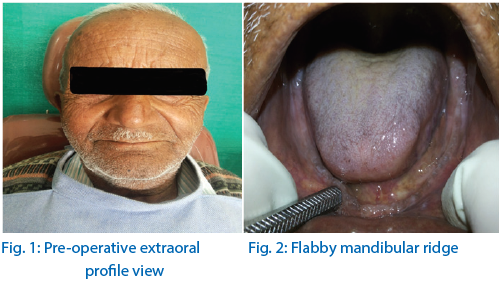
A 65 year old male patient reported to the Department of Prosthodontics of H.P. Government Dental College, Shimla with a chief complaint of difficulty in chewing food and wanted prosthetic rehabilitation for the same. History revealed that patient was completely edentulous for the past 5 years and was wearing a denture with problem of loose mandibular denture. Past medical history revealed no underlying systemic disorder. (fig.1)
Intraoral examination revealed severely resorbed mandibular ridge with extensive flabby tissue (fig.2). Labial, buccal mucosa, floor of mouth, hard and soft palate were normal. Available treatment options were discussed with the patient. He was not willing to accept any surgical procedure. Hence, a new denture was planned for the patient, with a modified impression technique.
TECHNIQUE
- Primary impression of mandibular denture bearing area was made with McCord’s technique7 [3 parts impression compound mixed with 7 parts greenstick compound] in a metal stock tray and poured in dental plaster. (fig.3)

Fig. 3: Primary impression.

Fig. 4: Green stick record in custom tray
- Wax spacer was given in flabby crestal area and special tray was fabricated with autopolymerizing acrylic resin.
- Green stick was used to record the denture bearing area using a correctly extended special tray.(fig.4)
- Secondary impression was made with zinc oxide eugenol.
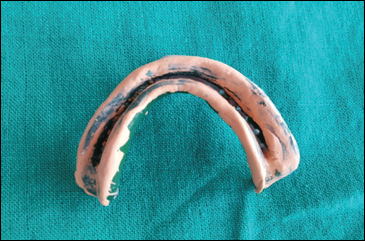
Fig. 5: Perforated tray in crestal area

Fig. 6: Flabby area recorded in light bodied silicone
- A heated instrument was then used to remove the greenstick related to fibrous crestal tissue and tray was perforated in the region.(fig.5)
- Light bodied silicone impression material was then syringed into the space and gently inserted into the patient’s mouth.(fig.6)
- The excess material extruded through the perforations and fibrous ridge assume a resting position
DISCUSSION
Impression of the edentulous arch is the most important factor in achieving retention, stability and support. A variety of techniques have been suggested to circumvent the difficulty of making a denture to rest on a flabby ridge. A particular problem is encountered if a flabby ridge is present within an otherwise ‘normal’ denture bearing area. If the flabby tissue is compressed during conventional impression making, it will later tend to recoil and dislodge the resulting overlying denture.3
The use of selective pressure or minimally displacive impression techniques should help to overcome some of these limitations. The use of perforations reduces the hydraulic pressure and minimize the displacement of the bearing tissues. Use of light body silicone in crestal area eliminates the excessive displacement of the soft tissues at the secondary impression thus a physiologic and anatomic registration of the attached and the unattached tissue of the denture bearing areas are attained.8 This article describe the impression technique to minimally displace the flabby tissue and reproduction of maximum details.
SUMMARY AND CONCLUSION
The procedure described above is a new and modified impression technique for flabby ridges. In this technique flabby area (crest of ridge) is recorded in its anatomic form and stress bearing area is recorded in functional form. Hence, maximizing the support from remaining alveolar bone.
REFERENCES
- Crawford RDI, Walmsley AD. A review of prosthodontic management of fibrous ridges. Br Dent J 2005;199(11) :715-19.
- Allen F. Management of the flabby ridge in complete denture construction. Dent Update 2005;32:524-28.
- Lynch CD, Allen PF. Management of the flabby ridge: using contemporary materials to solve an old problem. . Br Dent J 2006;200:258-61.
- Liddelow K P. The prosthetic treatment of the elderly. Br Dent J 1964; 117: 307-315.
- Osborne J. Two impression methods for mobile fibrous ridges. Br Dent J 1964; 117: 392-394.
- Watson R M. Impression technique for maxillary fibrous ridge. Br Dent J 1970; 128: 552.
- McCord JF, Tyson KW. A conservative prosthodontic option for the treatment of edentulous patients with atrophic (flat) mandibular ridges. Br Dent J 1997;182:469-72.
- Jayaprakash MB et al. Management of flabby ridge cases: a challenge in clinical practice. Int J Adv Health Sci 2014; 1(5): 32-37.
Disclaimer from Guident
The views and opinions expressed in articles published in Guident are solely those of the authors and do not necessarily reflect the views of the editors, the editorial board or the publisher, Ivory India. Guident does not endorse any product, technique or treatment described. Clinical content is intended for qualified dental and medical professionals and is not a substitute for individual clinical judgement. Guident, its editors and the publisher accept no liability for any consequence arising from the use of information published in the journal.
How to cite this article
Dr. Reena Sirohi, Dr. Renu Gupta. A Modified Impression Technique for Flabby Ridges. Guident. 2017 Jul;10(8). Available from: https://guident.net/articles/prosthodontics/a-modified-impression-technique-for-flabby-ridges.html