A Case Report on Mandibular Telescopic Overlay Denture: A Preventive Prosthodontic Approach
Viyas Dental College & Hospital, Jodhpur, Rajhasthan, India
ABSTRACT
The philosophy of Preventive Prosthodontics pertaining to overdenture therapy has long term advantage, by preserving the proprioception and thereby residual alveolar ridge. It is a versatile and successful means of achieving long‑term restoration of a partially edentulous jaw. Telescopic dentures consist of primary coping to be cemented to abutment and a secondary coping which is attached to the cast partial superstructure. These copings are advantageous for to eliminate undesirable undercut, protect the abutment from dental caries and also provide retention and stabilization of the secondary coping. An impression made for casting the primary coping following abutment preparation. After evaluation of parallelism these copings were cemented on the abutments. A final impression was made and wax pattern fabricated for cast partial framework. After checking its fit and tryin of the occlusion, esthetics it was processed and veneer was applied to the secondary copings. Telescopic overlay denture may be considered as preventive prosthodontic option, combining good retentive and better occlusal awareness, biting force, neuromuscular control and immense psychological support for patients.
KEYWORDS: Telescopic denture, overlay denture, preventive prosthodontics
ACKNOWLEDGEMENT
We would take immense pleasure to acknowledge Dr. Vivek Thomas sir,prof & hod, dept. of Prosthodontics, who always encouraged, supported and believed in us. Would also heartfully thank Dr. Vishwas Chaugule sir, prof & hod, dept. of Pedodontics without whose continuous guidance this article could not have been completed. would also thank from deep beneath my heart Dr. Manesh Lahori sir; prof & hod, dept. of Prosthodontics for his gratitude and belief in us and provide a platform.
INTRODUCTION
Preventive prosthodontics emphasizes the importance of any procedure that can delay or eliminate future problems. Tooth-supported overdenture offers a lot of advantages like better retention, stability, proprioception, support, maintenance of alveolar bone and psychological aspect of retaining teeth. There are two physiologic benifits related to overdenture therapy: the first concerns the continued preservation of alveolar bone around the retained teeth1 while the second relates to the continuing presence of periodontal sensory mechanisms2 that guide and monitor gnathodynamic functions.
According to GPT 8, a telescopic denture is also called as an overdenture, which is defined as any removable dental prosthesis that covers and rests on one or more of the remaining natural teeth, on the roots of the natural teeth, and/or on the dental implants. It is also called as overlay denture, overlay prosthesis, and superimposed prosthesis. Although first described by Starr in 1886, telescopic copings were initially introduced as retainers for removable partial dentures (RPD) at the beginning of the 20th century.3 Because of its resemblance to the collapsible optical telescope, this system of double crowns, which can be fitted into each other, became known as the telescopic denture.4
The advantages of overlay dentures include better occlusal awareness, biting force, neuromuscular control and immense psychological support for patients. It is often possible to provide a functional, retentive and esthetic treatment outcome through a variety of modalities.5
This clinical report describes a treatment modality emphasizing on preventive prosthodontic approach towards management of a patient with few remaining natural teeth by using telescopic overlay denture in mandibular arch.
CASE REPORT
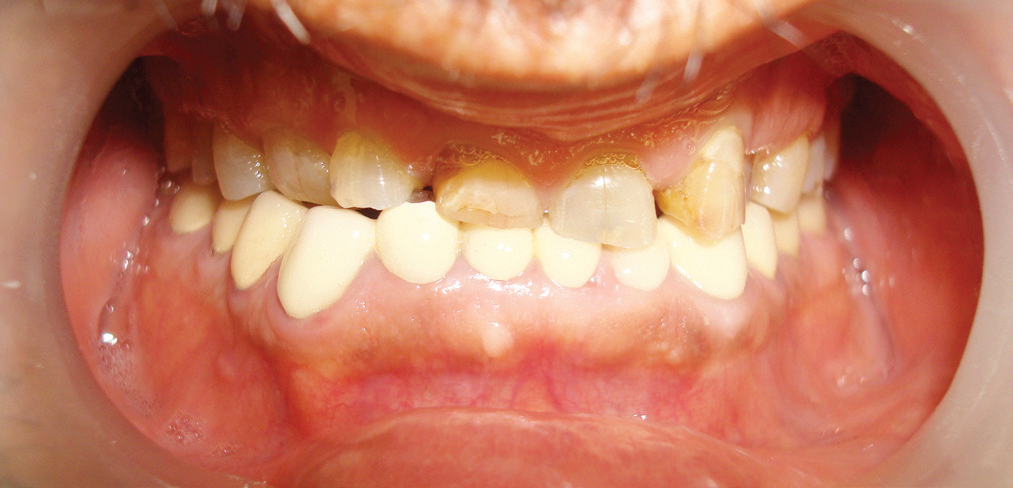
A 65 year old male patient reported to the department of Prosthodontics, Vyas Dental College and Hospital, Jodhpur with a chief complaint of difficulty in mastication due to partial mandibular edentulism. He desired replacement of missing teeth so that function can be restored. Clinical and radiographic examination revealed partially edentulous mandibular arch. Teeth present were 34, 38, 44, 45, 48 and 42 as root stump (Figure 1). The teeth were periodontally sound, with no mobility. The edentulous span had favorable ridge with firmly attached keratinized mucosa.

Figure 1: Pre-operative intraoral view
Diagnostic casts were prepared via alginate impressions (Zelgan, Dentsply, Mumbai, India). The casts were articulated in semi adjustable articulator (Hanau™ Wide-VueArcon Articulator, Whipmix Corporation) using centric relation record and a face-bow transfer (Quick mount Facebow) to evaluate inter arch space and the vertical dimension of occlusion. There was sufficient interarch space for the copings, the denture base and the teeth arrangement. It was decided to fabricate a mandibular telescopic overlay denture.
After taking consent from patient, he was sent for oral prophylaxis and endodontic therapy of the remaining teeth. After assessing endodontic therapy, tooth preparation was done to receive telescopic crowns by placing chamfer finish line subgingivally. Since all the teeth were tilted with undesirable undercuts which was then planned to eliminate using crowns after surveying. After the preparation of the abutments, the impression was made by using a polyvinyl siloxane elastomeric impression material (putty and light body) (Reprosil, Dentsply Caulk, Milford, USA) by a double step putty wash technique (Figure 2). The impression was poured into a die material (Kalrock, Kalabhai, Mumbai, India) to obtain the cast, on which the primary copings were fabricated after surveying the copings for eliminating the undesirable undercuts (Figure 3). The fit of the primary coping were evaluated in the patient’s mouth, after which they were cemented on the abutments with glass ionomer cement (Type I; GC Fuji) (Figure 4).

Figure 2: Impression for fabrication of primary copings

Figure 3: Surveying the primary copings

Figure 4: Intraoral view of the cemented primary copings
An over impression was made using the medium viscosity addition silicone impression material and the second master model was made. This model would be used for fabrication of the cast partial superstructure. Bite registration (ImprintTM Bite, 3M ESPE, Germany) was repeated and the models were mounted on a semi‑adjustable articulator using the same face bow record. In the laboratory, the copings on the second master model were milled. The second master model was duplicated (Polyflex duplicating material, Denstply Austenal, USA) and the refractory model was prepared. The cast partial framework was waxed up (MAARC Pattern/Inlay, Shiva products, Mumbai, India), which was then cast using a base metal alloy (cobalt‑chrome) (Wironium, BEGO USA) with the secondary coping overlay of the primary coping. After evaluating the fit of the framework in the mouth (Figure 5), a wax rim (Rolex, Ashoo Sons, NewDelhi, India) was prepared on the framework and acrylic teeth (Premadent, Dr. Jagdish lal sethi, Delhi) were set with the same shade as that of maxillary fixed dental prosthesis. After verification of esthetics, function, phonetics and occlusion the mandibular denture was processed using heat-cure acrylic resin (Trevalon-HI, Dentsply, Germany). Retention of the denture was finally provided by the friction between the parallel surfaces of the primary and secondary copings (Figure 6). The completed prostheses were re-evaluated for function, esthetics, and phonetics. A veneering material (Artglass; Heraeus Kulzer) was applied and then light-polymerized on the facial aspect of the mandibular framework after matching the shade with acrylic teeth. Occlusion was evaluated and adjusted (Figure 7). Postoperative instructions on how to insert the prostheses and also was provided with instruction on adequate oral hygiene maintenance. After minor adjustments during post insertion visits, the patient was recalled for 6 months follow-up. Minor post-insertion adjustments were performed.

Figure 5: Intraoral evaluation of cast partial superstructure with
secondary copings

Figure 6: Intaglio surface of the processed overlay denture

Figure 7: Post-operative intraoral view
DISCUSSION
Proper diagnosis and strategic treatment planning play a crucial role in management of complex cases. Residual ridge resorption (RRR) following removal of teeth has been well observed and documented in literature.6 While the bone loss following the removal of teeth is stated to be rapid, progressive, irreversible and inevitable, it is equally well observed that bone is maintained around standing teeth and implants.7,8Over denture therapy constitutes essentially a preventive prosthodontics concept as it endeavors to preserve the few remaining teeth and the supporting structures.1,2 In this situation, a total of 5 abutments for telescopic copings were used to support the overdenture, thus creating a quadrilateral configuration. It has been reported that at least two abutment teeth should be splinted when attachment prostheses are used to make the stress patterns more favorable. This option was thought to have a better prognosis for the remaining teeth as well as to have a more retentive prosthesis.9 The recommended alloys for fabrication of copings are the high noble (ADA Type IV). Ag‑Au‑Pd alloys have better precision and better retention, but are technique sensitive and costly. Base metal alloys (Cr‑Co) can also be used because they have low thermal conductivity, thus the patient does not experience unpleasant thermal sensation caused by excessive tooth preparation 10 and is economical.
The advantages of telescopic overlay dentures are that it creates a common path of insertion, easy to perform routine oral hygiene, rigid splinting action, proprioceptive responses, distribution of stresses to the abutment teeth and it is psychologically well-tolerated by patients. The disadvantages include increased cost, complex laboratory procedures, increased number of dental appointments, difficulty in achieving esthetics11-13 and finally, veneer material fracture, debonding, discoloration, and wear are the possible complications.14
CONCLUSION
Telescopic overlay denture may be considered as preventive prosthodontic option, combining good retentive and stabilizing properties with a splinting action. Apart from the splinting of the abutment teeth with the telescopic system, the gingival tissues are easily accessible around the entire marginal circumference of the abutment, thus permitting easy home care and oral hygiene. However, correctly implemented plaque control is fundamental in the prevention of recurrence of gingivitis. Also, the rate of the residual ridge resorption decreases because of the transfer of compressive forces into the tensile forces by the periodontal ligament and better stress distribution.
REFERENCES
1. Prince IB. Conservation of the supporting mechanism. J Prosthet Dent 1965; 15:327.
2. Yalisove IL. Crown and sleeve coping retainers for removable partial prosthesis. J Prosthet Dent 1966; 16:1069-1085.
3. Gungor MA, Artunç C, Sonugelen M. Parameters affecting retentive force of conus crowns. J Oral Rehabil 2004; 31:271–7.
4. Wenz HJ, Lehmann KM. A telescopic crown concept for the restoration of the partially edentulous arch: The Marburg double crown system. Int J Prosthodont 1998; 11:541–50.
5. David R. Burns. The mandibular complete overdenture. Dent Clin North Am 2004;48:603-23.
6. Toolson LB, Smith DE. A two year longitudinal study of overdenture patients, Part 1: Incidence and control of caries on overdenture abutments. J Prosthet Dent 1978; 40: 486-91.
7. Tallgren A. The continuing reduction of the residual alveolar rides in complete denture wearers: a mixed longitudnal study covering 25 years. J Prosthet Dent 1972; 27: 120-32.
8. Vin Y, Pan S, Feng H. Three dimensional finite element analysis and comparison of stress distribution in overdentures supported with bar attachments and telescopic crowns. Chin J Dent Res 1992; 2: 21-30.
9. Saito M, Miura Y, Notani K, Kawasaki T. Stress distribution of abutments and base displacement with precision attachment and telescopic crown-retained removable partial dentures. J Oral Rehabil 2003; 30: 482‑7.
10. Weber H, Frank G. Spark erosion procedure: A method for extensive combined fixed and removable prosthodontic care. J Prosthet Dent 1993; 69: 222‑7.
11. Langer A. Telescopic retainers for removable partial dentures. J Prosthet Dent 1981; 45: 37 43.
12. Langer A. Tooth supported telescopic restorations. J Prosthet Dent 1981; 45: 515–20.
13. Minagi S, Natsuaki N, Nishigawa G, Sato T. New telescopic crown design for removable partial dentures. J Prosthet Dent 1999; 81: 684–8.
14. Graser GN, Rogoff GS. Overdentures for acquired and congenital anomalies: 2. Partial overdentures. Int J Prosthodont 1990; 3: 361-7.
Disclaimer from Guident
The views and opinions expressed in articles published in Guident are solely those of the authors and do not necessarily reflect the views of the editors, the editorial board or the publisher, Ivory India. Guident does not endorse any product, technique or treatment described. Clinical content is intended for qualified dental and medical professionals and is not a substitute for individual clinical judgement. Guident, its editors and the publisher accept no liability for any consequence arising from the use of information published in the journal.
How to cite this article
Dr.NirbanMitra, Dr. Naima Ahmed, Dr. Anand Rajapur Department of Prosthodontics. A Case Report on Mandibular Telescopic Overlay Denture: A Preventive Prosthodontic Approach. Guident. 2016 Jul;9(8). Available from: https://guident.net/articles/prosthodontics/a-case-report-on-mandibular-telescopic-overlay-denture-a-preventive-prosthodontic-approach.html