3D Printing: An Upcoming Technology in Prosthodontics
Department of Prosthodontics Pt. B.D Sharma University of Health Sciences, Rohtak, Haryana, India
Abstract
Advancement in dentistry stays parallel to advancement in digital technology. Rapid prototyping is one of the techniques based on digital technology that has proved to overcome the disadvantages of contemporary clinical and laboratory procedures in Prosthodontics. The word rapid prototyping denotes the technique in which a particular physical model is created with either addition or subtraction technology or combination of both with prior designing by the help of computer. 3D printing is based upon additive technology of rapid prototyping. Use of this technology has lead to better treatment outcomes in Prosthodontics. This brief communication aims to focus on 3D printing methods and its application in Prosthodontics.
Keywords: Additive technology, Dental Prosthesis Design/methods, 3D Printing, Rapid prototyping.
INTRODUCTION
Modern Prosthodontics utilizes recent techniques which save time as well as give precision and accuracy for particular rehabilitation treatment. One such technology is digitalization which includes 3D printing and it closely fulfills the requirements of modern Prosthodontics. The skills of dentist and technician also influence the fabrication of particular prosthesis. Part specific tooling and complete human intervention is not required in the fabrication of prosthesis by rapid prototyping. As there is no complete human intervention, labor cost is reduced and better, faster restorations are achieved. Considering the advantages of rapid prototyping technology over traditional process, RP technology can be regarded as promising alternative to conventional dental prosthesis fabrication.[5]
Rapid prototyping includes a group of techniques used to fabricate a scale model of a physical part or assembly using three-dimensional computer aided design (CAD) data.[1] Rapid prototyping technologies may be broadly classified into additive and subtractive. Subtractive technology requires milling which results in more material wastage. 3D printing as the name suggests is based on additive technology and also called as additive manufacturing.
American Society for Testing and Materials (ASTM) defined additive manufacturing as the process of joining materials to make objects from 3D model data usually layer upon layer.[2] 3D printing can be a substitute for milling and helps to save material, energy and time along with the advantages of subtractive technology. This brief communication discusses the 3D printing methods and its application in field of Prosthodontics.
The earliest use of rapid prototyping was in the field of engineering for the production of solid models which was based on a computer file. Later it also got popular in medical and dental field. Charles Hull in 1983 had printed the first 3D object using stereolithography. This technique was patented by him in 1986. In 1991, stereolithography technique was used to produce the first human anatomical model and used in a maxillofacial surgery at a clinic in Vienna.
The basic process of 3D printing technology is shown in Fig 1.
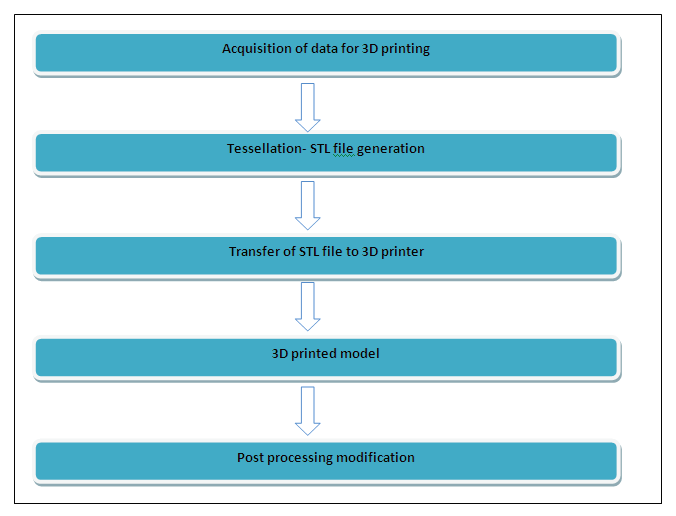
Fig. 1 Basic process of 3D printing.
1.Various technologies of Rapid Prototyping
The frequent techniques that are adopted in dental practice according to material accretion are:
- Stereo lithography
- Inkjet printing
- Fused Deposition Modeling (FDM)
- Laser powder forming (selective laser sintering, Selective laser melting)
1.1 Stereo lithography
Stereolithography is one of the first commercially available and the most commonly used rapid prototyping technique. “SLA apparatus” was developed by Hull in 1988 and was the first 3D printer.
This system consists of laser (ultraviolet) bath containing photosensitive resin and a platform. Resin is sequentially cured with exposure of UV light to form layers and these layers bond together to form complete solid object or model. However, initial model of stereolithography was less cost efficient, labour intensive and time consuming. It led to the development of new “continuous liquid interface production” which is better and is cost efficient.
1.2 Inkjet printing
This system consist of powder, liquid adhesive, supply chamber and fabrication chamber. Powder is sequentially dispersed from supply chamber. Roller then compresses the powder in the fabrication chamber. During this process liquid adhesive is deposited to form layer. Once layer is formed, piston that supported the powder bed is lowered so that next layer can form over the previous layer. This process continues until the complete prototype is formed.
1.3 Fused Deposition Modeling (FDM)
In this technique thermoplastic material is used. Temperature controlled head liquefies the resin fibre and directs the material with precision to form a layer. FDM extrusion nozzle head is computer controlled and model is formed layer by layer as the material solidifies within 0.1 second. Entire system is contained within a chamber. It can produce models, surgical guides and templates.
1.4 Selective laser sintering
This system consists of laser, powder delivery system, roller, scanning system. In this system model is fabricated by computer guided laser. Powder is delivered from delivery chamber over the build cylinder and sintered to form layer. The layer is lowered and laser beam is traced over this layer and subsequently the model is fabricated by joining all these layers.[6]Various advantages and disadvantages of different RP techniques are elaborated in Table 1.[7]

Table.1 Different techniques of 3D printing technology with overall comparison with each other.
2. Prosthodontic applications of 3D printing technology
Various in-vitro and clinical studies concluded that 3D printing technology is beneficial in treatment planning and has provided an alternative to conventional method for fabrication of prosthesis. Various materials used are resin, metal, wax. Zirconia is still in experimental phase.[5] 3D printing is used for fabrication of wax patterns, provisional crowns, all-ceramic crowns and casts for prostheses.[5]
2.1. Wax pattern fabrication
By using rapid prototyping technology automatic wax-up construction is possible[8]. It involves three steps -1)scanning the master model 2) designing the wax pattern with particular designing software 3) fabrication of wax-up by using fused deposition modeling(FDM). It has high fabrication rate, good quality control of wax coping thickness, minimum spruing time and reduces the trimming and finishing time for metal copings.
One such system which utilizes this technology is Waxpro system which simultaneously scans, design and fabricate the wax pattern. After that, with the lost wax technique further process of casting and prosthesis fabrication is completed.[5]
2.2. Direct dental metal prosthesis fabrication
Conventional fabrication of high precision metal part takes longer time but with 3D printing this process takes place quickly. Selective laser melting and sintering is suitable for this laboratory procedure. This technique is capable of customizing the complex geometry without many manual pre and post processing steps.[8] This technique simplifies the conventional process and speeds up the turnover time of production of metal prosthesis. The metal framework of metal ceramic restoration possesses comparable fit to the metal coping fabricated by conventional method.[9] However, there are less number of clinical studies to support it.[5]
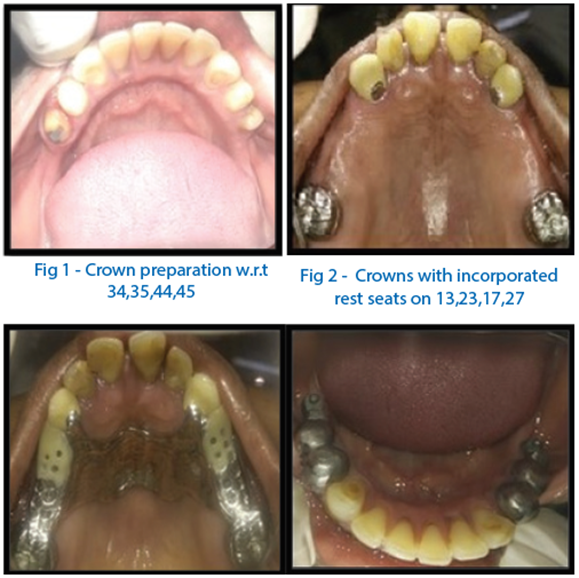
2.3. Removable partial denture frameworks
The fabrication of frameworks for removable partial denture is done by Co-Cr alloy by using selective laser melting technique. Bibb et al presented a report for fabrication of framework with SLM technique and showed that framework possessed comparable quality of fit and object accuracy.[8]
2.4. All-ceramic restoration fabrication
Direct inkjet technique based on slurry microextrusion principle is used for the fabrication of green-Zirconia and all ceramic dental restorations. It provides high precision, minimum material intake and cost competence but this method still requires further research to be used clinically.[8]
2.5. Mold for complete dentures
In complete denture fabrication, 3D records are taken by scanning the edentulous models and rims in centric relation for parametric positioning of artificial teeth. Using this data physical flask (models) are fabricated.[8] There is limited data available regarding the use of 3D printing technology in complete denture.[5]
2.6. Maxillofacial prosthodontics
Rapid prototyping technology is used in Maxillofacial Prosthodontics with the advantages of producing complex shapes with complete internal details and undercut areas.
RP are being used for-
- Manufacturing of surgical stents
- Fabrication of obturators
- Manufacturing of lead shields for radiotherapy treatment
- Fabrications of burn stents
- Duplication of existing maxillary/mandibular prosthesis
- Production of nasal, auricular prosthesis
Conventional impression procedures can be avoided in inaccessible and sensitive areas like in burn cases with the use of 3D printing.[8] Unkovskiy et al published a clinical report which summarized that nasal prosthesis fabricated by directly printed silicone method had better accuracy and acceptable esthetics.[10]
2.7. Implantology
Rapid prototyping technology in implantology is mainly used for treatment planning. It is mostly done by using 3D imaging. Surgical guides can also be fabricated by 3D printing. These guides possesse adequate accuracy with linear deviation of 2mm at apex and 1.1 mm at hex and angular deviation of 2°.[11]
Porous titanium dental implants can be fabricated with the use 3D printing. Implants are fabricated with the help of laser beam which fuses the metal particles and generates the implant. There are no post processing steps required in this method.[12]
2.8. Provisional restoration
One of the prosthetic applications of 3D printing technology is fabrication of provisional restoration. Recent in-vitro studies suggest that mechanical properties and wear resistance of 3D printed resin material is in a comparable range to that of milled or conventionally fabricated resin materials for intraoral use.[13-14] However, there is a lack of information regarding the clinical performance of 3D printed provisional restoration.
CONCLUSION
Rapid prototyping is a highly accurate and time saving technology being currently used in Prosthetic dentistry. It is becoming portable and more persuasive. These systems are used in rehabilitation of patients with head and neck defects, pre-surgical planning, implant placement, fabrication of facial prosthesis etc. However it requires complicated machinery, high expertise and high cost for the equipments.
REFERENCES
- Nayar S, Bhuminathan S, Bhat W. Rapid prototyping and stereolithography in dentistry. J Pharm Bioallied Sci. 2015;7(5):218-9.
- Dikova T, Dzhendov D, Simov M, Katreva-Bozukova I, Angelova S, Pavlova D et al. Modern trends in the development of the technologies for production of dental constructions. J IMAB. 2015;21(4):974-81.
- Ishida Y, Miyasaka T. Dimensional accuracy of dental casting patterns created by 3D printers. Dent Mater J. 2016;35(2):250–6.
- Katreva I, Dikova T, Tonchev T. 3D Printing – an alternative of conventional crown fabrication: a case report. J IMAB. 2018;24(2):2048–54.
- Sun J, Zhang F.-Q. The Application of Rapid Prototyping in Prosthodontics. J Prosthodont.2012;21(8):641–44.
- Azari, A, Nikzad, S. The evolution of rapid prototyping in dentistry: a review. Rapid Prototyping Journal. 2009;15(3):216–25.
- Ligon S.C, Liska R, Stampfl J, Gurr M, Mülhaupt, R. Polymers for 3D Printing and Customized Additive Manufacturing. Chemical Reviews. 2017; 117(15):10212–90.
- Quadri S, Kapoor B, Singh G, Tewari R. Rapid prototyping: An innovative technique in dentistry. J Oral Res Rev 2017;9(2):96-102.
- Alharbi N, Alharbi S, Cuijpers V. M. J. I, Osman, R. B, Wismeijer D. Three-dimensional evaluation of marginal and internal fit of 3D-printed interim restorations fabricated on different finish line designs. J Prosthodont Res. 2018;62(2);218–26.
- Unkovskiy, A., Spintzyk, S., Brom, J., Huettig, F., & Keutel, C. Direct 3D printing of silicone facial prostheses: A preliminary experience in digital workflow. J Prosthet Dent. 2018;120(2):303–308.
- Barazanchi, A., Li, K. C., Al-Amleh, B., Lyons, K., & Waddell, J. N. Additive Technology: Update on Current Materials and Applications in Dentistry. Journal of Prosthodontics. 2016;26(2):156–63.
- Tunchel S, Blay A, Kolerman R, Mijiritsky E, Shibli J. A. 3D Printing/Additive Manufacturing Single Titanium Dental Implants: A Prospective Multicenter Study with 3 Years of Follow-Up. Int J Dent. 2016;1–9.
- Tahayeri A, Morgan MC, Fugolin AP, Bompolaki D, Athirasala A, Pfeifer CS, et al. 3D printed versus conventionally cured provisional crown and bridge dental materials. Dent Mater. 2017;192-200.
- Park J-M, Ahn J-S, Cha H-S, Lee J-H. Wear Resistance of 3D Printing Resin Material Opposing Zirconia and Metal Antagonists. Materials. 2018;11(6):1043.
- Joda T, Zarone F, Ferrari M. The complete digital workflow in fixed prosthodontics: a systematic review. BMC Oral Health. 2017;17(1):1-9.
Disclaimer from Guident
The views and opinions expressed in articles published in Guident are solely those of the authors and do not necessarily reflect the views of the editors, the editorial board or the publisher, Ivory India. Guident does not endorse any product, technique or treatment described. Clinical content is intended for qualified dental and medical professionals and is not a substitute for individual clinical judgement. Guident, its editors and the publisher accept no liability for any consequence arising from the use of information published in the journal.
How to cite this article
Dr. Manu Rathee, Dr. Smriti Kaushik, Dr. Sanju Malik. 3D Printing: An Upcoming Technology in Prosthodontics. Guident. 2018 Nov;11(12). Available from: https://guident.net/articles/prosthodontics/3d-printing-an-upcoming-technology-in-prosthodontics.html