Utilizing Tetracycline Fibers in Complement to Periodontal Flap Surgery in Chronic Generalised Gingivitis with Localised Periodontitis Patient-a Case Report
Department of Periodontology and Oral Implantology, K. D Dental College & Hospital Mathura
ABSTRACT
Periodontal plaque is composed of bacterial aggregates that are the primary cause of periodontal disease associated with one another and with surfaces and interfaces. A biofilm of highly resistant bacteria forms on the surfaces of matrix protected by exopolysaccharide.
Various treatments are available to remove this disease Soft and hard tissues are both inhabited by microorganisms.
Therefore, antimicrobial agents can be used to augment conventional treatments. The use of tetracyclines in treating periodontal disease has been widespread for many decades because they are effective & highly concentrated in the sulcular fluid.
There are two types of tetracyclines: semi-synthetic and broad spectrum. Chemotherapeutic agents which are bacteriostatic in action and thus have an effect on rapidly multiplying bacteria.
Tetracycline fiber was evaluated in combination with periodontal flap surgery in the present report.
Key words: Periodontitis, chlorhexidine, local drug delivery, tetracycline fibers.
INTRODUCTION
Periodontal disease belongs to a group of inflammatory disease with no clear cause, although it has a genetic component.
A host's defense mechanisms interact with one another an important determinant of onset is the etiology and progression of the disease. A well-documented problem exists. Evidence that bacteria and their products are found in dental plaque,it is plaque that is responsible for the majority of etiologies known as periodontitis. Nonsurgical procedures also have a primary goal. The purpose of surgical treatment regimen is to remove the underlying cause factors (i.e. plaques and calculi). It is not always possible to achieve good periodontal health with scaling and root planning. Due to poor management of the disease, the etiologic factor has been eliminated access to deep periodontal pockets. There may be some limitations associated with anatomical complexity, but Planing roots efficiently has many benefits. Periodontal surgery therefore retains an important role in treatment of periodontitis, with trends away from resective approaches to more conservative and regenerative techniques.1
Additionally, residual bacteria may populate scaled teeth in dentinal tubules and soft tissues. Therefore, local and systemic antimicrobial agents are often used in conjunction with non-surgical therapies. Through the circulation, drugs administered systemically are absorbed into the blood stream and spread throughout the body.
Unfortunately, systemic drug therapy has limitations due to side effects and the possibility of toxicity and acquired bacterial resistance. Another issue is patient compliance. In contrast, local administration of the drug allows the therapeutic agent to be delivered at the diseased periodontal site with increased therapeutic effect and minimal side effects.2
Subgingival irrigation and controlled release of drugs are commonly used methods to deliver drugs locally. As local delivery agents, antimicrobial agents like tetracycline, ofloxacin, clindamycin, chlorhexidine, etc. are most commonly used. Tetracycline as well its derivatives doxycycline and minocycline are the most commonly used antimicrobial agents in the treatment of periodontal infections.3 Tetracycline offers a broad‑spectrum antimicrobial activity and may be a useful adjunct to periodontal therapy. Tetracyclines are commonly used to treat periodontal diseases. Grampositive bacteria are generally considered more resistant to these types of tetracycline drugs. Most spirochetes, facultative and anaerobic bacteria respond well to these antibiotics.
Gingival crevicular fluid has been reported to contain high levels of drug concentrations, making them particularly suitable for periodontal applications. Various systems for insertion of tetracyclines into periodontal pockets have been introduced which include hollow fibers, ethylene vinyl acetate copolymer fibers, ethyl cellulose fibers, acrylic strips, collagen preparations, and hydroxypropylcellulose films. The new “Periodontal Plus ABTM” delivery system (Advanced Biotech Products, Chennai) contains 25 mg of fibrillar collagen along with 2 mg of tetracycline HCL [Figure 1,2]. The present study evaluates the effects of local delivery of Tetracycline fibers in periodontal pockets.
CASE REPORT
During the last 2-3 months, a 28-year-old female patient came in with bleeding gums, mild pain, and sensitivity on her left lower back tooth. On clinical examination, edematous red gingiva, bleeding on probing was present in the left lower quadrant, and probing pocket depth of 6 mm was present between the left & right lower first molar and second molar. The first and second molars were radiographically visible with mild bone loss. The treatment plan included scaling and root planing (non-surgical) followed by placement of Periodontal Plus AB at the time of curettage at the site between the right & left lower first and second molar.

Figure-1

Figure-2
The patient was assessed based on a thorough medical history and routine laboratory tests. There were no abnormalities found. The non-surgical procedure was explained to the patient and informed consent was obtained. The patient was instructed regarding oral hygiene measures to be followed at home before the procedure started. Modified Stillman's method of brushing the teeth twice daily should also be used with a soft toothbrush with conventional toothpaste. No medicated toothpaste or mouthwash was allowed during the study period. Parameters (Site-specific Plaque scoring using Quigley Hein and Elliot Plaque Index, Probing Pocket depth (Figure 3), Clinical attachment level, and Site-specific Bleeding on probing using index by Muhlemann H.R.) was recorded on day 0 at the time of scaling and root planning and subsequently at the end of six weeks, three months. A calibrated periodontal probe was used to measure pocket depth and Clinical Attachment.
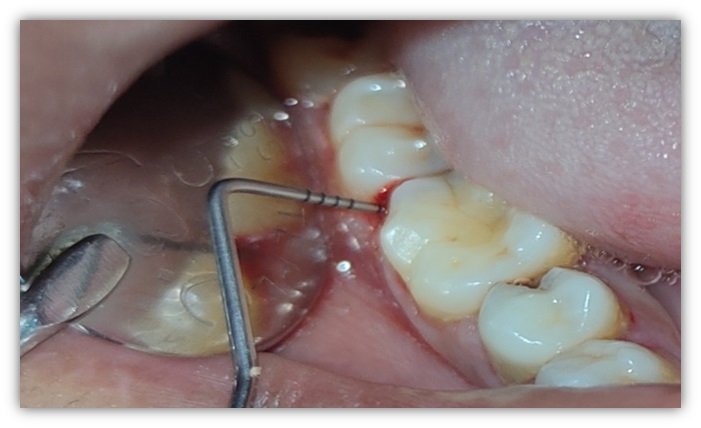
Figure-3
TREATMENT PROCEDURE
Scaling and root planning of the patient were done. After six weeks, parameters were assessed on day 0 before curettage. Instrumentation was used to thoroughly clean and plan the exposed root surfaces. During irrigation, a chlorhexidine solution was used (Figure 4).

Figure-4
Periodontal plus AB fibers were soaked in saline and placed at the diseased site (Figure5,6).

Figure-5
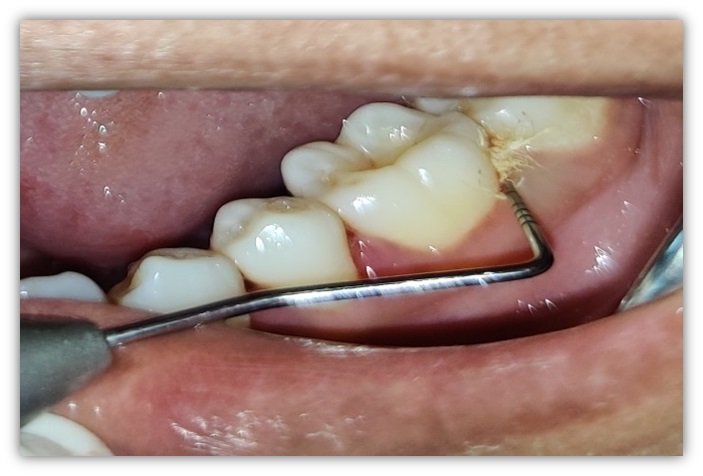
Figure-6
The curettage site was dried using gauze and Coe-pack was then applied (Figure 7,8).
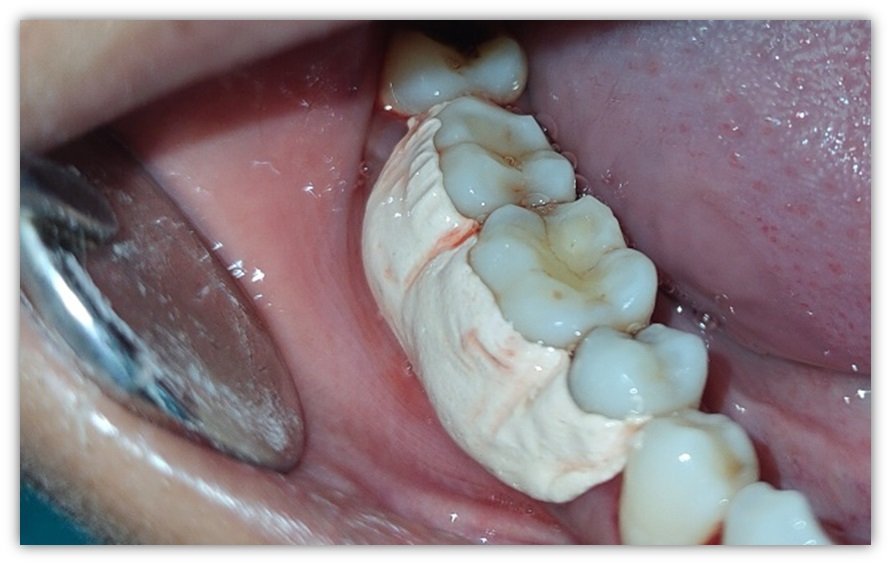
Figure-7
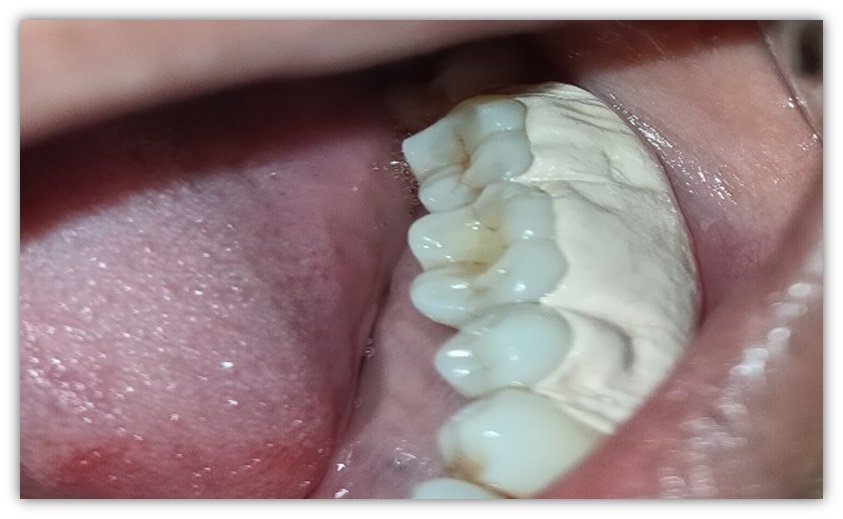
Figure-8
A prescription for Amoxycillin 500 mg thrice every day had been prescribed. The patient was prescribed 400mg of ibuprofen thrice daily, along with 1 capsule daily of vitamin B complex for 5 days. During the healing phase, the patient was instructed to follow all the routine oral postoperative hygiene instructions. She was instructed not to brush the curetted site for one week and to rinse the oral cavity with chlorhexidine (0.2%) mouthwash daily. After 7 days, the periodontal dressing was removed and the area was flushed with an antimicrobial solution. Plaque score, bleeding index, gingival index, and patient assessment of the periodontal dressing was recorded at 6 weeks and 3 months using indices already mentioned.
RESULTS
In the initial six weeks after surgery, after three months, the plaque score decreased from 1.6 to 1.15. At day 0 at the time of curettage, after six weeks, and after three months, the probing pocket depth decreased from 6mm to 3mm. At the time of curettage, at 6 weeks and after 3 months, the clinical attachment level had decreased from 8mm to 4mm. Bleeding score decreased from 0.85 to 0.6 then 0.35 at day 0 at the time of curettage, after 6 weeks and after 3 months respectively.
DISCUSSION
Periodontitis is a set of bacteria-induced localized infections affecting the gum line and supporting tissues of the teeth. Evidence suggests that facultative bacteria and anaerobic microbes are the primary causes of periodontitis.4 Reducing the mass of subgingival microbial plaques or reducing the periodontopathic microbes are essential for controlling periodontal disease. The administration of systemic drugs involves frequent dosing, which has adverse effects such as resistance development and superinfection.5,6 Local delivery devices consist of a drug reservoir and limiting elements that control the rate at which the drug is released. The goal is to maintain effective concentrations of therapeutic agents at the site of action for a longer period, despite drug loss from crevicular fluid clearance.3 Tetracycline is superior to other antibiotics as it is the only class of antibiotic that is capable of being retained in tooth cementum. They are the only antibiotics, which can achieve higher levels of gingival fluid concentrations than serum levels.7 Tetracycline has also been to inhibit collagenase activity, collagen degradation and bone resorption.8 Tetracyclines have proven to be effective against gram-positive and gram1 negative anaerobic microflora in chronic adult periodontitis. They exert their antimicrobial effect by inhibiting protein synthesis.3 Because the putative pathogens are located within gingival tissue or in deeper areas inaccessible to periodontal instrumentation, mechanical debridement alone may fail to eliminate the putative pathogens from the pocket completely and results in relapse. Thus, there is a need for periodontal flap surgery to treat chronic periodontitis for thorough debridement and disease control.2 In the present case report, local drug delivery agent i.e. tetracycline fibers were used along with periodontal flapless surgery. There was a reduction in probing pocket depth with a change in clinical attachment level.
CONCLUSION
This case report demonstrates that the application of tetracycline fibers along with flapless surgery is effective and beneficial to patients suffering from chronic periodontitis, with results demonstrating an improvement in clinical parameters.
REFERENCES
- Sachdeva A, Aggarwal V. Evaluation of commercially available biodegradable tetracycline fiber therapy in chronic periodontitis. JISP 2011;15(2):130-134.
- Dang AB, Chubey KK, Thakur RK, Mohan RM, Chowdhary Z, Tripathi R. Comparative evaluation of efficacy of three treatment modalities- tetracycline fibers, scaling and root planing, and combination therapy: a clinical study. JISP 2016;20(6): 608-613.
- Sadaf N, Anoop B, Dakshina B, Shweta B. evaluation of efficacy of tetracycline fiber in conjunction with scaling and root planing in patients with chronic periodontitis. Indian Soc Periodontol 2012; 16(3): 392-397.
- Helderman WH. Microbial etiology of Periodontal diseases. J Clin Periodontol.1981;8:261-80.
- Slots J, Evans RT, Lobbins PM, Genco RJ. Antimibicrobial susceptibility of Actinobacillus actinomycetemcomitans. Antimicrob Agents Chemother. 1980;18:9–12.
- Pitcher GR, Newman HN, Strahan JD. As referred in effects of subgingival irrigation on Periodontal Status. J Periodontol. 1987;58: 827–36.
- Rapley JW, Cobb CM, Kiloy WJ, Williams DI. Serum Levels of Tetracycline during treatment with tetracycline fibers. Periodontol. 1992;63:817–20.
- Golub LM, Ramamurthy N, McNamara TF, Gomes B, Wolff M, Casino A, et al. Tetracyclines inhibit tissue collagenase activity. J Periodontal Res. 1984;19:651–5.
Disclaimer from Guident
The views and opinions expressed in articles published in Guident are solely those of the authors and do not necessarily reflect the views of the editors, the editorial board or the publisher, Ivory India. Guident does not endorse any product, technique or treatment described. Clinical content is intended for qualified dental and medical professionals and is not a substitute for individual clinical judgement. Guident, its editors and the publisher accept no liability for any consequence arising from the use of information published in the journal.
How to cite this article
Dr. Gaurav Singh, Dr. Satendra Sharma, Dr. Saksham Kulshrestha. Utilizing Tetracycline Fibers in Complement to Periodontal Flap Surgery in Chronic Generalised Gingivitis with Localised Periodontitis Patient-a Case Report. Guident. 2021 Jun;14(7). Available from: https://guident.net/articles/periodontics/utilizing-tetracycline-fibers-in-complement-to-periodontal-flap-surgery-in-chronic-generalised-gingivitis-1154.html