Combined Periodontal and Implant Treatment in a Case of Generalized Aggressive Periodontitis
S.D.M College of Dental Science & Hospital, Sattur, Dharwad, India
ABSTRACT
Aggressive periodontitis is characterized by rapid progression and destruction of periodontal tissues, thus rendering a great challenge to clinicians with regard to treatment and prosthetic rehabilitation. Although, stabilizing the periodontal disease is difficult, it is mandatory before any prosthodontic treatment can be performed. Moreover, restorations need to be designed in a way that performance of oral hygiene procedures is not impaired and maintenance is feasible. Although the use of dental implants has become a common treatment modality, limited data is available on the use of dental implants in patients with aggressive periodontitis. This is a case of combined periodontal and implant treatment in a case of generalized aggressive periodontitis followed up for a period of 4 years thus conveying that long-term stability of implants as well as the natural teeth can be achieved if an adequate maintenance schedule phase is adhered to after the initial treatment.
Key Words: Aggressive periodontitis, periodontal flap surgery, dental implants, supportive periodontal therapy.
INTRODUCTION
Generalized Aggressive Periodontitis is characterized by rapid destruction of the periodontal tissues often associated with a high risk of disease relapse.1 A combination of a compromised remaining dentition and the risk of a relapse of the periodontal disease renders the supporting teeth at a hazard of later loss thus making the periodontal and implant treatment and prosthodontic rehabilitation of patients with aggressive periodontitis challenging.2 Although the use of dental implants has become a common treatment modality, limited data are available on the use of dental implants in patients with aggressive periodontitis. In such a case stabilizing the periodontal disease is not only difficult but mandatory before any prosthodontic treatment can be performed. Moreover, the restorations need to be designed in a way such that performance of oral hygiene procedures is not impaired and maintenance is feasible.2 This is a case of successful periodontal and dental implant treatment and maintenance therapy in a patient with generalized aggressive periodontitis which was followed up for a period of four years.
CASE REPORT
A 24 year old female patient reported to the outpatient department of periodontics SDM College of Dental Sciences and Hospital, Dharwad on 28th march 2011 with a chief complaint of missing teeth in the upper front region of the jaw since 5 years. The patient was examined by a single examiner. Past dental history revealed that the patient had undergone extraction of the upper anterior teeth (13 to 23) in 2006 due to severe mobility, pain, gingival bleeding and repeated periodontal abscess formation. A history of fall or road traffic accident which could cause tooth mobility was negative. The patient also revealed that she had undergone a full mouth periodontal flap surgery in November 2008 along with the replacement of the missing anteriors with a removable partial denture and presently visited the dentist for the replacement of the same with a fixed prosthesis. The medical history was unremarkable and family history pertaining to periodontal problems revealed that patient’s mother’s sister lost majority of her teeth at a young age due to severe mobility. Comprehensive clinical examination of the oral cavity revealed a pale pink gingiva in the maxillary arch and a reddish pink gingiva with mandibular anteriors. The contours were irregular with the lower anteriors and consistency was soft, while firm in the other areas of the gingiva. (Fig.1) Generalized pockets with a mean probing pocket depth of 8mm were present with all the premolars and molars. Grade 3 mobility (Miller’s mobility index) was seen with the lower anteriors, Grade 2 with all the premolars and molars; and Grade 1 mobility with 15 and 36. Dental examination revealed missing upper anteriors. Orthopantamogram examination revealed a generalized angular bone loss with all the premolars and molars along with impacted 18, 28, 38 and 48. (Fig 2) Considering Lang’s criteria (1999) a diagnosis of Generalized Aggressive Periodontitis was made and the treatment was initiated with phase I therapy which comprised of a thorough subgingival scaling and root planing. Patient was advised to take a course of antibiotics – Cap Amox 500mg twice daily for five days and Tab Metrogyl 400mg thrice daily for four days. On evaluation of the response to phase I therapy, it was noticed that deep periodontal pockets measuring around 8mm did persist with all the remaining natural posterior teeth which were treated by the original Widmann flap technique. (Fig. 3) Since the patient was not willing for extraction of teeth with lower anteriors, they were treated only through non-surgical line of treatment which comprised of thorough subgingival scaling, root planning and curettage. It was observed that there was reduction in mobility with the lower anteriors from Grade 3 mobility to Grade 1 mobility and thus splinting was not required. The mobility completely subsided on the teeth which were treated by flap surgery. Disimpaction was also performed with 18, 28, 38 and 48. Patient was informed about the option of dental implants or fixed partial prosthesis for the replacement of missing teeth with upper anteriors. Patient was under the supportive periodontal care and was evaluated for 8 months after which the patient was referred to the department of oral implantology for the replacement of missing teeth. (Fig.4 and Fig.5)
Preoperatively, CBCT (Cone Beam Computed Tomography) was used to assess the ridge in the maxillary anterior region which revealed a ridge with deficient height and width. This was also confirmed with a periodontal probe on flap reflection as shown in Fig.6. Considering the treatment plan from the implant point of view, mainly focussing the bite after replacement of the missing anteriors, the lower anteriors were extracted and thereafter the upper and lower anterior teeth were replaced with dental implants and ceramic final restoration as follows: Under local anesthesia, a full thickness flap was reflected with the upper anterior region to visualize the alveolar ridge. Since the ridge width and height was deficient, the mid-ridge-split was done from 13 to 23 and two vertical cuts were made distal to 13 and 23. Initial drilling of the sites was done with a 2.0 pilot drill to mark the implant positions. Sequential enlargement of the site was done with bone expanders and 3.75mm diameter, 13.0mm length implants were placed in 23 and 21 areas, and implant of similar diameter with 11.5mm length implants were placed in 11 and 13 areas at 35Ncm2 torque. (Fig.7) The split ridge on the buccal and palatal sides were grafted with novabone and proguide, the flaps were released and the primary closure was attained with 5-0 vicryl sutures.(Fig.08) Similarly sequential osteotomy was performed and 3.5mm diameter and 12mm length biohorizon implants were placed with 32 and 42. (Fig.9 & Fig.10) Thus, four dental implants were placed in the maxillary anterior region with immediate loading. The flaps were sutured with 5-0 vicryl sutures. Figure 11.shows the immediate post cementation photograph.
The patient was under supportive periodontal care with regular check-up and recall visits throughout the course of the treatment. During the maintenance phase, the patient was advised to implement modified bass method of tooth brushing technique along with the use of dental floss and interdental aids. Initially the patient was recalled every 3-months wherein complete dental, occlusal, mucosal, gingival and periodontal examination along with removal of supragingival deposits on the teeth were done. After 1 year, the patient was categorized under Class B of Merrin’s classification and was followed up for a period of 4 years.(Fig.12 and Fig.13) It was noted that in the maintenance phase there was no clinical signs of gingival inflammation, reduced sulcus probing and a gain in the attachment levels. Data regarding the periodontal status during the maintenance phase is shown in Chart 3, 4 and 5.

Fig. 1 – Preoperative photograph

Fig. 2 – Preoperative Orthopantamogram

Fig. 3 – Full thickness mucoperiosteal flap reflected with 3rd quadrant

Fig. 4 – Clinical photograph of 3-months recall and follow up
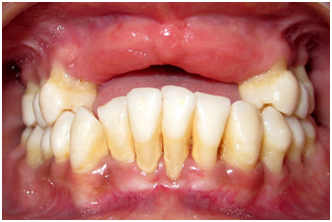
Fig. 5 - Clinical photograph of 8-months recall and follow up with a stable periodontium
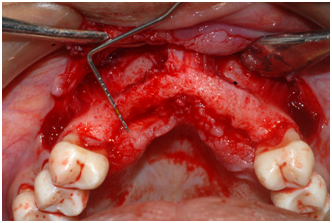
Fig.6 - Clinical photograph showing a deficient ridge
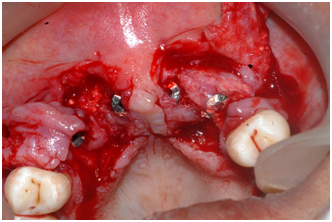
Fig. 7 – Dental Implants placed in the maxillary arch
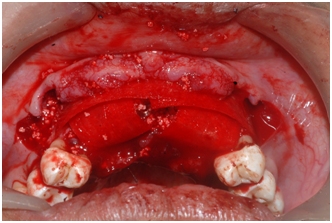
Fig.8 – Dental Implants placed with bone graft and membrane

Fig. 9 – Dental Implants in the mandibular arch

Fig.10- Orthopantamogram showing post implant restoration with maxillary and mandibular anteriors.
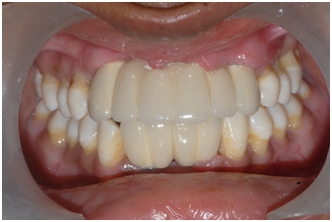
Fig. 11 – Clinical Photograph showing Immediate post-cementation.

Fig.12- 4 year follow up after a combined periodontal and implant treatment

Fig.13- Orthopantamogram of 4-year follow up periodontal and implant treatment.
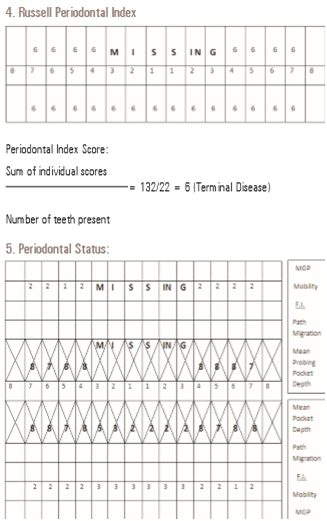
DATA SHOWING THE CHANGES IN THE PERIODONTAL PARAMETERS FROM BASELINE TO 4-YEARS OF RECALL VISITS.
Clinical Parameters at baseline (28/03/2011)
1. Plaque index (Silness & Loe):

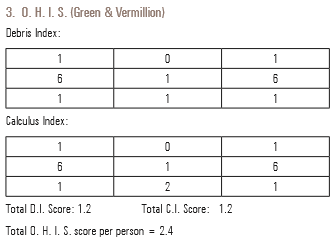
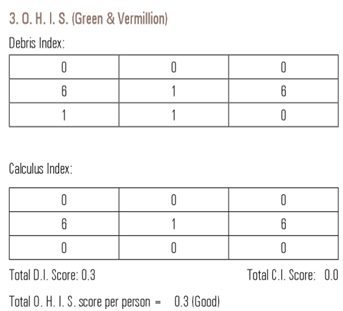
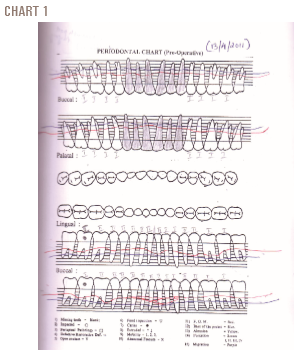
Clinical Parameters after phase 1 therapy(13/04/2011)
1.Plaque index (Silness & Loe)


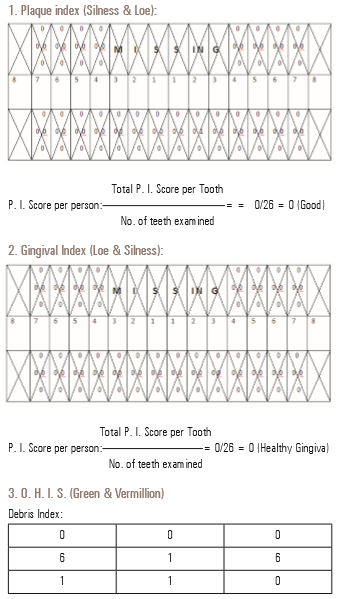
Clinical Parameters one month post surgery (27/06/2011)
1.Plaque index(Silness & Loe):


Clinical Parameters three months post surgery (27/08/2011):
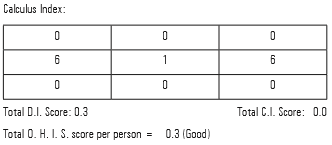


Clinical Parameters Eight months post surgery (03/02/2012):
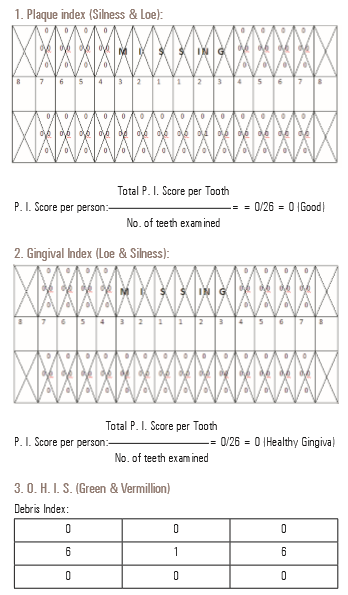


Clinical Parameters Four year follow-up (14/07/2016)


DISCUSSION:
The use of dental implants for the replacement of missing teeth has been increased by leaps and bounds ever since the concept of osseointegration has been identified and accepted.3 Nevertheless, currently limited data are available on the use of dental implants in patients with aggressive periodontitis. Aggressive periodontitis is characterized by rapid progression and destruction of periodontal tissues, which is often associated with the early onset of the disease, increased degree of therapy resistance and a high tendency towards relapse.1 Moreover, the remaining dentition is often too compromised to allow for sufficient retention of fixed or removable partial dentures, thus rendering the teeth questionable for the use as abutments. De Boever Al and De Boever JA (2006) correlated the level and type of periopathogens around dental implants to those found in the remaining dentition in patients with aggressive forms of periodontitis and demonstrated that this does not impair the osseointegration of dental implants.4 However, studies by Bullon and Fioroni (2004) have evaluated similar inflammatory mechanisms of peri-implantitis and aggressive periodontitis thus concluding that dental implants in patients with aggressive periodontitis are at a high risk of failure.5 Studies by Malmstrom (1990), Schroder (2001), Yalicn (2003), Mengel (2005) and Hoffmann (2007)2 have demonstrated successful use of dental implants over extended period in such patients if periodontal disease is controlled.6,7,8,9 Thus, periodontal maintenance plays a vital part of periodontal treatment especially in patients with Aggressive Periodontitis. In other words, supportive periodontal care is a continuous phenomenon in patients with Aggressive Periodontitis.10 Supportive periodontal care is based on the health status obtained following the successful active periodontal treatment, thus facilitating the maintenance of a stable clinical attachment for many years. Thus supportive periodontal care is defined as procedures that are performed at selected intervals to assist the periodontal patients in maintaining the oral health.11
In the present case, patient did undergo a periodontal flap surgery three years ago, but failed to report for periodic check up and maintenance after which a relapse was observed. Periodontal flap surgery was performed again, the patient was educated and well-motivated pertaining to the importance of maintenance phase. The dental implants were placed only after evaluating the patient’s oral hygiene for 8 months. The case was followed up for a period of four years and it was noticed that there was an improved change in periodontal parameters. (Chart No.2,3,4 and 5) During this period, it was noticed that the patient had realized the importance of oral health and was well-motivated. The procedures performed in this patient did not present any complication.
CONCLUSION
Successful placement of dental implants in patients with generalized aggressive periodontitis is possible and long-term stability of implants as well as the natural teeth can be achieved if an adequate maintenance schedule phase is adhered to after the initial treatment.
REFERENCES
- Armitage GC. Development of a classification system for periodontal diseases and conditions. Ann Periodontol 1999;4:1-6.
- Hoffmann O, Beaumont C and Zafiropoulos G.G. Combined Periodontal and Implant Treatment of a case of Aggressive Periodontitiis. J Oral Implantology 2007;13: 288-92.
- Nagpal S, Kamath S, Thakur S and Kulkarni S. Correlation between Occlusal Forces and Marginal Bone Levels Around Dental Implant-Retained Restorations: A Clinico-Radiological Study. J Oral Implantology 2012; 38: 261-69.
- De Boever AL and De Boever JA. Early colonization of non-submerged dental implants in patients with a history of advanced aggressive periodontitis. Clin Oral Implants Res.2006;17:8-17.
- Bullon P, Fioroni M, Goteri G, Rubini C and Battino M. Immunohistochemical analysis of soft tissues in implants with healthy and peri-implantitis condition and aggressive periodontitis. Clin Oral Implants Res. 2004;15:553-59.
- Malmstrom HS, Fritz ME, Timmis DP and Van Dyke TE. Osseointegrated implant treatment of a patient with rapidly progressive periodontitis. A case report. J Periodontol 1990;61: 300-304.
- Mengel R, Schroder T and Flores-de-Jacoby L. Osseointegrated implants in patients treated for generalized chronic periodontitis and generalized aggressive periodontitis: 3 and 5-year results of a prospective long-term study. J Periodontol 2001;72:977-989.
- Yalcin S et al. Treatment of aggressive periodontitis by osseointegrated dental implants. A case report. J Periodontol 2001; 72:411-416.
- Mengel R and Flores-de-Jacoby L. Implants in patients treated for generalized aggressive and chronic periodontitis: a 3-year prospective longitudinal study. J Periodontol 2005;76:534-543.
Disclaimer from Guident
The views and opinions expressed in articles published in Guident are solely those of the authors and do not necessarily reflect the views of the editors, the editorial board or the publisher, Ivory India. Guident does not endorse any product, technique or treatment described. Clinical content is intended for qualified dental and medical professionals and is not a substitute for individual clinical judgement. Guident, its editors and the publisher accept no liability for any consequence arising from the use of information published in the journal.
How to cite this article
Dr. Pragati R. Bhat Dr. Anirudh B. Acharya Dr.Sudhindra S.Kulkarni Department of Periodontics & Oral Implantology. Combined Periodontal and Implant Treatment in a Case of Generalized Aggressive Periodontitis. Guident. 2018 Mar;11(4). Available from: https://guident.net/articles/periodontics/combined-periodontal-and-implant-treatment-in-a-case-of-generalized-aggressive-periodontitis.html