Modified Groper,S Appliance
Department of Pediatric Dentistry SDM College of Dental Sciences & Hospital, Sattur, Dharwad, India
Abstract
Traumatic injuries are common in preschoolers since this is the age when the child indulges in various physical activities. Moreover, there is a lack of motor coordination at his age. Esthetics can be a concern among many parents and children in the current scenario. This article addresses the prosthetic rehabilitation in case of exarticulated primary anterior where in a modified Groper’s appliance was fabricated.
In such cases, when the parents desire a modified Groper’s appliance can be fabricated.
Key words: Avulsion, Child, Deciduous, Treatment, Groper’s Appliance.
INTRODUCTION
Aesthetics is a chief concern among many parents and children these days. Be it playing cricket, soccer, kabbadi or hide and seek, children tend to be reckless all the time. Traumatic injuries tend to increase when a child starts to crawl, stand or walk and are usually related to lack of motor coordination. Many a times this can lead to exarticulation of the anterior teeth. In such cases when the parents or children desire, appliances replacing the lost anterior teeth can be a treatment modality.
CASE REPORT
Two years old boy reported with his father to the Department of Pediatric Dentistry, SDM College of Dental Sciences, Dharwad, Karnataka. His father complained of missing upper right tooth in the anterior region which looked aesthetically unpleasing.
Previous history revealed trauma to the upper anterior region due to fall while playing. Treatment was deferred as incisors were in different stages of eruption and second molars were not completely erupted.
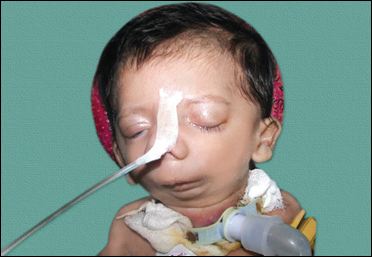
Replacement was planned at the age of three years. Patient was kept under evaluation till the second molars erupted and the space loss was minimal during this period. (Figure 1)
STEPS IN FABRICATION
Stainless steel banding was done on both the primary second molars followed by which primary alginate impressions were made. Casts were poured with Type II dental stone.
The wire component was fabricated with 19 gauge wire, adapted along the palatal contours and was soldered to bands on second primary molars. A small ‘U’ loop was extended in the edentulous area in the first appliance which was fabricated. The acrylization of the appliance was done with cold cure acrylic.The patient was recalled for try in before final finishing and polishing of the appliance was done. However, the fabricated appliance had fractured at the acrylic and wire interfaceafter two days.This was probably due to the lesser strength at the arylic wire interface and hence another technique of fabrication was followed.
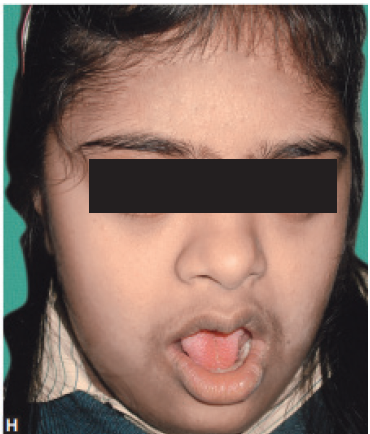
After banding, the impressions were made again. This time the wire component was made to extend into the edentulous area. Another vertical component of wire was soldered onto the horizontal wire component to increase the strength by providing stabilization in both horizontal and vertical direction (Figure 2). Acrylization was further completed by the same procedure as employed earlier and the patient was recalled for try-in. (Figure 3) Once the proper fit of the appliance was achieved, finishing and polishing was completed followed by cementation of the appliance with Type I luting glass ionomer cement.(Figure 4)

Figure 1 Preoperative view
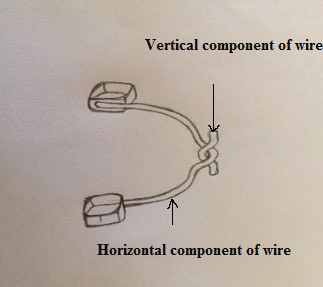
Figure 2 Schematic representation of appliance
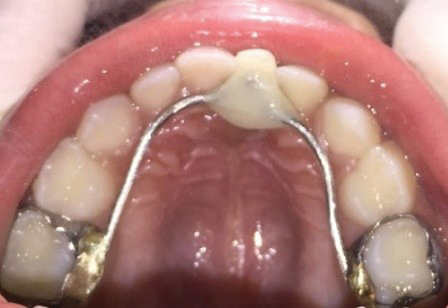
Figure 3 Maxillary occlusal view
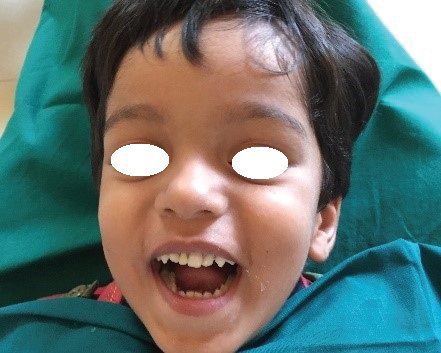
Figure 4 Postoperative view
DISCUSSION
Traumatic dental injuries are common in preschoolers since they are likely to fall when they learn to crawl, stand, walk and run during the development of motor skills.1 Tiny humans are subject to various orofacial conditions like trauma, early childhood caries, cleft lip and palate and craniofacial anomalies. Andreason states that exarticulation injuries to the anteriors is more commonly seen in the developing permanent anteriors due to the resilient surrounding bone and the loosely structured periodontal ligament. The same reason can be attributed in case of primary teeth.2 Children affected with the above mentioned conditions can have physical, social and psychological impacts on quality of life.3,4
Aesthetic rehabilitation of anterior teeth in a preschooler is one of the greatest challenge which a pediatric dentist has to face. Many parents seek aesthetic solution to the lost anteriors because of trauma or early childhood caries. However there is still a paucity of adequate data available on the appliance design considerations, modifications and parental counseling.5,6 ,7
The chief clinical considerations while planning for the prosthetic appliance are8
I. Desire of the parents /children- The most valid reason to deliver this appliance is the parents wish or when the children desire. Many preschoolers these days are extremely concerned about their appearance and so are their parents. This is the particular age when the child actually starts moving out of the homely environment and attends kindergarten or nursery and also indulges in different kinds of sports /outdoor activities. Present day technology like internet and smartphones has led the preschoolers more concerned about their appearance. This case also had a similar perception of aesthetics where the parents were concerned about the child’s appearance and had keen interest in replacement of the missing anterior tooth and visited us every three months.
II. Space Maintenance- space maintenance in the anterior segment is of minimal consideration since the space loss is negligible, no space maintainer being required if the loss had occurred after the eruption of primary canines. However in the present case some amount of space loss did occur.8
III. Speech- Speech compensation can develop if the teeth are missing. Difficulty in articulation of certain syllables like /s/ z/ and /th/ can occur.9 However, in the present case, patient did not have impaired speech.
Different treatment modalities have been employed for the replacement of lost teeth such as fibre reinforced composite,10 Natural Tooth Pontic Fiber Reinforced Prosthesis11 or a fixed acrylic partial denture with abutment preparation12and Groper’s Appliance where a bracket is soldered onto the U loop which has a satisfactory outcome. However, Groper’s appliance couldn’t be fabricated for the present case because of the insufficient space for bracket.8
This case report describes a failed appliance when only horizontal extension of the U loop was given after which a modified groper’s appliance was fabricated where in stabilization of the appliance in all the three planes is achieved by soldering another piece of stainless steel wire onto the U loop wire .
CONCLUSION
Loss of anterior teeth can result in a psychological trauma and can affect the emotional development of the child. To meet the parents’ demands and to address the functional and esthetic demands associated with missing anterior teeth, the above mentioned appliance can be fabricated. This simple to fabricate appliance provides a satisfactory outcome and is indeed a practical approach which provides stabilization in all the three planes.Ultimately, nothing beats an innocent smile of a child. ‘A smile of a child is packaged sunshine and rainbows’.
REFERENCES
- Aldrigui et al. Impact of traumatic dental injuries and malocclusions on quality of life of young children. Health Qual Life Outcomes 2011;9(9):78-84.
- Andreason JO. Traumatic injuries of the teeth.2nd ed.Copenhagen:Munksgaard;1981.
- McGrath C, Broder H, Wilson-Genderson M. Assessing the impact of oral health on the life quality of children: implications for research and practice. Community Dent Oral Epidemiol 2004;32:81–5.
- Locker D, Jokovic A, Stephens M, Kenny D, Tompson B, Guyatt G. Family impact of child oral and oro-facial conditions. Community Dent Oral Epidemiol 2002;30:438–48.
- Steffen JM, Miller JB, Johnson R. An esthetic method of anterior space maintenance. J Dent Child 1971;38(3):154-7.
- Klapper BJ, Strizak-Sherwin R. Esthetic anterior space maintenance. Ped Dent 1983; 5(2):121-123.
- Jasmin JR, Groper JN. Fabrication of a more durable fixed anterior esthetic appliance. J Dent Child 1984;51(2):124-7.
- Waggoner W, Kupietzky A.Anterior esthetic fixed appliances for the preschooler: considerations and a technique for placement.Pediatr Dent 2001;23(2):147-50.
- Fymbo L. The relation of malocclusion of the teeth to defects of speech. Arch Speech 1936;1:204-16.
- 10.Goenka P, Sarawgi A, Marwah N, Gumer P, Dutta S. Simple Fixed Functional Space Maintainer: A Case Report. Int J of ClinPediatr Dent 2014;7(3):225-228.
- Goel D, Goel G. Restoring Esthetics after Anterior Tooth Loss for a Five-Year-Old Child: Natural Tooth Pontic Fiber Reinforced Prosthesis. Case Rep Dent2013:215816.
- Prabhakar M, Kaur M. Prosthetic replacement options for premature loss of deciduous anterior teeth. Indian Journal of Dental Sciences 2014;4(6):55-57.
Disclaimer from Guident
The views and opinions expressed in articles published in Guident are solely those of the authors and do not necessarily reflect the views of the editors, the editorial board or the publisher, Ivory India. Guident does not endorse any product, technique or treatment described. Clinical content is intended for qualified dental and medical professionals and is not a substitute for individual clinical judgement. Guident, its editors and the publisher accept no liability for any consequence arising from the use of information published in the journal.
How to cite this article
Dr. Vijay A. Trasad, Dr. Shukla Nisha, Dr. Anand K. Tavargeri. Modified Groper,S Appliance. Guident. 2018 Dec;12(1). Available from: https://guident.net/articles/pedodontics/modified-groper-s-appliance.html