Cleft Palate Case: Treatment with an Obturator
Department of Orthodontics & Dentofacial Orthopedic, Manipal College Of Dental Science, Manipal, India.
Abstract
The cleft palate is associated with feeding difficulties, middle ear infections, hearing loss, speech disorders, dental and orthodontic problems. An obturator is a prosthetic device that seals the cleft and restores the separation between oral and nasal cavities.
Keywords: Cleft Palate, Feeding, Obturator.
Introduction
Clefts lip and palate is associated with a variety of problems that need to be solved for successful management.1,2 Patients with a cleft palate have difficulty in eating which may lead to failure to thrive.3 The feeding process is also complicated by nasal regurgitation of food3. This article shows the management of an adolescent cleft palate case with the help of an obturator.
CASE REPORT
A male patient, 15 years old, was referred from department of plastic surgery and wanted closure of the hole in palate. History of mouth breathing habit reported. Patient was cooperative and cited esthetics as the main reason for his taking orthodontic treatment.
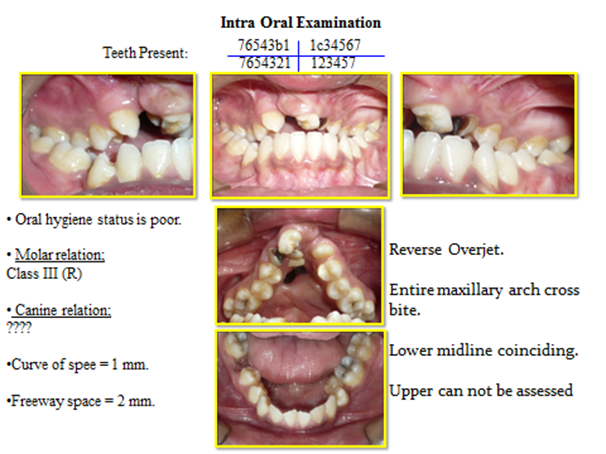
Figure 1: Intraoral photographs
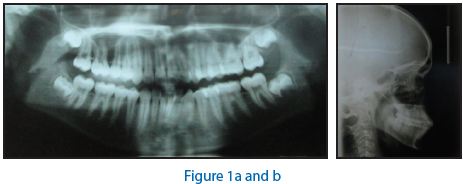
Physical Examination revealed him to be 156 cm in height and weight 44 kgs with mesomorphic body type. Extraoral examination showed dolicocephalic head, oval facial form, competent lips, short upper lip, facial asymmetry, concave profile, anterior divergence, normal mentolabial sulcus. Smiling photograph showed minimal maxillary central crown exposure.
Final diagnosis was skeletal class III jaw relationship and dental Class III malocclusion, having class III molar relation (R) with a total cross-bite.
Treatment objectives:
- To improve his profile.
- To achieve proper alignment of teeth.
- To improve his smile esthetics.
Treatment plan and progress
A plan of upper expansion with lower arch alignment was made. All the retained deciduous teeth and root stumps were extracted. Treatment was started with the insertion of bonded fan shaped hyrax expander (figure 3). Since significant amount of expansion was needed, it was not possible to get the entire expansion with the expander; a modified coffin spring was placed and activated to achieve greater expansion (figure 5). After cross bite correction, an obturator was planned to close the oro-nasal communication (figure 6).
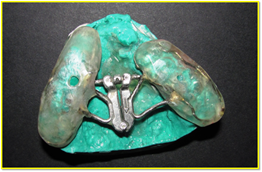
Figure 2: Fan shape expander

Figure 3: Expansion
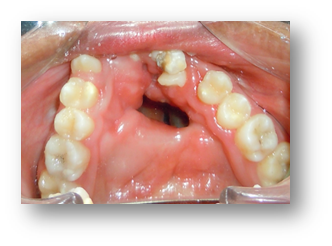
Figure 4: After expansion screw removal
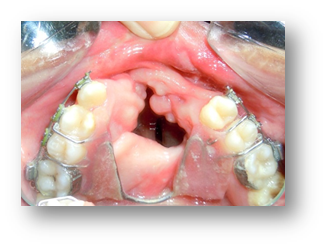
Figure 5: Coffin spring

Figure 6: Obturator
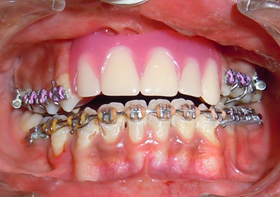


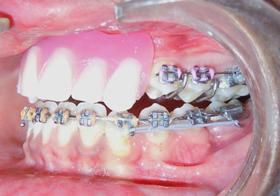
Figure 7: Intraoral photos
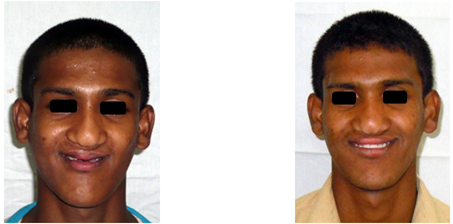
Figure 8: Smile comparison post-treatment
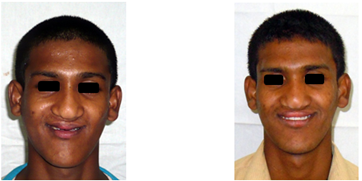
Figure 9: Profile comparison post-treatment
DISCUSSION
Cleft palate can be an autosomal dominant condition with variable penetrance. Etiology may vary from being environmental like maternal epilepsy, drugs like steroids, diazepam, phenytoin and folic acid deficiency. It also can occur as a part of syndromes, including Down’s syndrome and Treacher Collin’s syndrome.4, 5 Primary care is very important in these patients, who often have numerous problems , including feeding, speech, infections and dental problems.
Impression procedures in cleft patients poses a challenge as patient have heightened gag reflex and problems if oro-nasal communication is present. Patients need to be treated more gently even if the common impression materials are used.
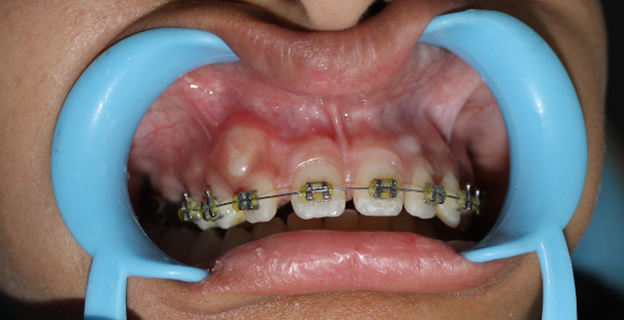
With the help of obturator, not only the feeding problem was overcome, it also helped the patient to achieve a better profile by providing the required lip support and a better speech by closing the oro-nasal communication (figure 8, 9).
CONCLUSION
Management of a cleft palate patient requires a team approach. A correct treatment plan can yield wonderful results. Patience and caring attitude is a must while dealing such patients. In the present case report better mastication, phonation and esthetics was achieved with the help of an obturator. After around 18 months of treatment, patient was highly satisfied with the outcome.
REFERENCES
- Bixler D. Genetics and clefting. Cleft-palate J 1981; 1: 10-18.
- McDonald RE, Avery DR. Dentistry for the child and adolescent CV Mosby co. Fifth edition Multidisciplinary team approach to cleft lip and palate management; 806-839.
- Goldberg WB, Ferguson FS, Miles RJ. Successful use of a feeding obturator for an infant with a cleft palate. Spec Care Dentist 1988;8:86-9.
- Habel A, Sell D, Mars M. Management of Cleft lip and palate. Arch Dis Child 1996; 74: 360-6.
- Kirschner RE, LaRossa D, Cleft lip and palate. Otolaryngol Clin North Am 2000; 33:1191-1215.
Acknowledgement
I would like to thank Dr. Ashima Valiathan and Dr. Arun Urala for their constant support and guidance.
Disclaimer from Guident
The views and opinions expressed in articles published in Guident are solely those of the authors and do not necessarily reflect the views of the editors, the editorial board or the publisher, Ivory India. Guident does not endorse any product, technique or treatment described. Clinical content is intended for qualified dental and medical professionals and is not a substitute for individual clinical judgement. Guident, its editors and the publisher accept no liability for any consequence arising from the use of information published in the journal.
How to cite this article
Dr. Siddharth Mehta, Dr. Anjali Mehtab, Dr. Surendra Lodha. Cleft Palate Case: Treatment with an Obturator. Guident. 2014 Aug;7(9). Available from: https://guident.net/articles/orthodontics/cleft-palate-case-treatment-with-an-obturator.html