Class II Correction with Evaa Appliance
Department of Orthodontics and Dentofacial Orthopaedics Rishi Raj Dental College and Hospital, Bhopal, India
Abstract
The present protocol for the correction of Class II malocclusion with mandibular retrognathism is by using the fixed functional appliances. This article includes a case treated with EVAA fixed functional appliance. A post-pubertal patient with class II division 1 malocclusion was treated with EVAA along with fixed appliance (MBT- 0.022” slot). Deep bite was treated with extrusion of posteriors and proclination of anteriors. It resulted in the favorable skeletal and dentoalveolar changes in the mandible. There was slight proclination of lower incisors. Good soft tissue changes were noted. EVAA is an efficient class II corrector in post-pubertal period. It promotes patient compliance with very minimal breakages.
Key words: EVAA, Class II malocclusion, Fixed functional, Functional
INTRODUCTION
Class II malocclusion presents a major challenge to orthodontists. Functional orthopedic treatment seeks to correct malocclusions and harmonize the shape of the dental arch and oro-facial functions. Fixed functional appliances are appliances that are fitted on the teeth by the operator and cannot be removed by the patient at will1. A number of fixed functional appliances have gained popularity in recent years to achieve better results. Fixed functional appliances are normally known as non compliance class II correctors. However for treatment to be successful, good co-operation is always necessary, especially if skeletal modifications instead of dento alveolar compensation are desired2. EVAA stands for experimental fixed appliance activator. This functional appliance has the advantage of treating class II malocclusion along with fixed appliance therapy in a situation where the patient is nearing the end of growth3.
It is a solid block of acrylic with protruding wires that are inserted in to the tubes of upper molar bands. Fixed appliance can be placed to align the teeth along with orthopedic treatment. Patient who is nearing the end of growth should wear the EVAA at least 16hrs a day. In extreme skeletal deficiency patient should wear the appliance, day and night except during meals4.
CLINICAL CASE
Diagnosis
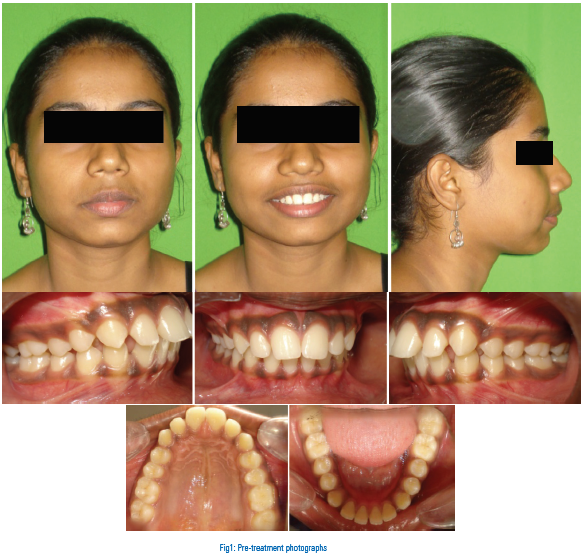
A 14 year old female reported with the chief complaint of gaps between upper and lower front teeth. She had skeletal and dental class II division 1 malocclusion with upper and lower anterior spacing. She had a convex profile, decreased lower facial height, retruded mandible, deep mentolabial sulcus. Model analysis revealed spacing of 4 mm in the upper arch and 8 mm in the lower arch, an overjet of 09 mm and overbite of 6 mm. Lower midline is deviated towards right side by 1mm. 4 mm of curve of spee present in the lower arch (Figure 1).
Treatment Objectives
- Correction of skeletal class II
- Correction of class II canine and molar relation
- Closure of upper and lower anterior spacing
- To correct the midline discrepancy
- To correct the deep curve of spee
- To achieve ideal overjet /overbite
- Correction of convex profile
Treatment plan
Non-extraction was planned because of profile and excess space. EVAA appliance was planned to correct skeletal and dental class II malocclusion.
Treatment Progress
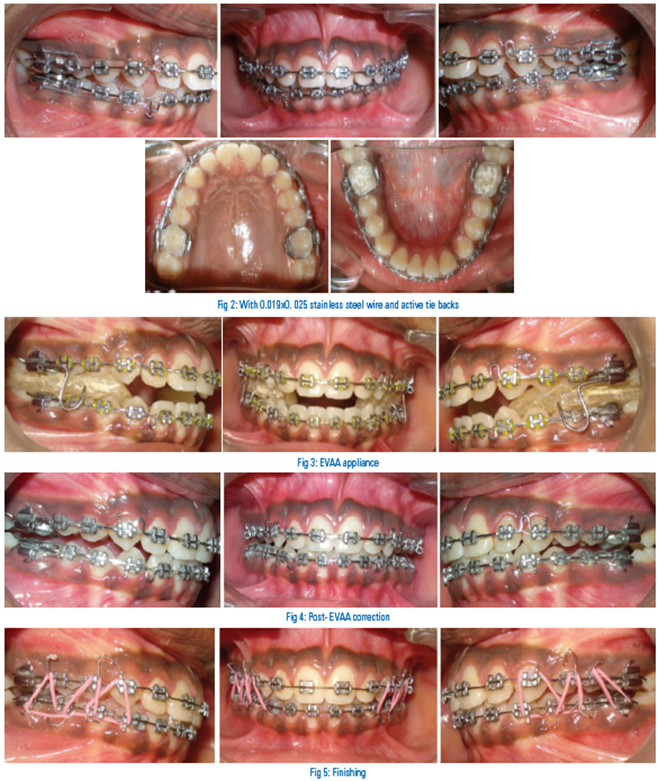
Upper and lower teeths were bonded and initial alignment and leveling was done with upper 0.016” NiTi followed 0.019”×0.025” NiTi. After initial alignment & leveling, 0.019”×0.025” stainless steel was placed in the upper and lower arch. Additional 10º labial root torque was added in the anterior segment of the lower archwire to counteract the lower incisor proclination (Figure 2). Space closure was done with active tie-backs. The upper and lower impression for EVAA appliance was taken with the fixed appliances in place. The construction bite is registered to an edge-to-edge incisal position. The appliance is constructed such that the mandible is forced into a forward position in closing (Figure 3). EVAA phase continued for 6 months (Figure 4). Finishing and settling of occlusion was done with 0.016 round stainless steel and settling elastics (Figure 5). Good dentoalveolar and soft tissue changes were observed after functional phase.
DISCUSSION
By definition, functional appliances are meant to be used in those cases of class II malocclusion, which are caused by mandibular deficiency1, 4. The underlying defect may be a small mandible, or a normal size but posteriorly positioned mandible, or a retrusively placed mandibular dento-alveolar segment on a normal mandible, or a combination of any of these. Extrusion of posterior teeth is commonly indicated in patients with decreased lower anterior face height. EVAA provides optimal force required for the skeletal change. It allows free lateral movements of the mandible and is more comfortable to the patient like flexible functional appliances. Fixed functional appliances facilitate the forward and downward displacement of the mandible. They also cause a posterosuperior displacement of the maxillary dentition and pterygoid plate and thus contribute to the correction of a Class II malocclusion5. Mandibular incisor proclination is the most pronounced dentoalveolar side effect seen during fixed functional treatment. This could be prevented by cinching the mandibular archwire and laceback in the mandibular arch and by incorporating progressive lingual crown torque in the mandibular anterior segment. Inclusion of the second molars during treatment could enhance anchorage and prevent unwanted proclination of anterior teeth6. It works best with MBT 0.022” slot prescription because this bracket system have -6º torque in the lower anterior region and additional -10º labial root torque given in lower archwire helps to counteract the proclining effect of EVAA on the lower anterior teeth.
Advantages
The fixed appliance-EVAA appliance has the following advantages.
- Aligning the teeth and correcting the skeletal class II condition, simultaneously reduces total treatment time.
- After functional therapy, the fixed appliances can remain in place for finishing if desired
- The EVAA appears to produce beneficial orthopedic effects with minimal undesirable dentoalveolar side effect.
- The EVAA is well tolerated by patients.
- Laboratory and chair side procedures are simple and relatively fast.
- Patient comfort and acceptance are excellent
- They promote better compliance
- They offer an extensive range of motion
- They are simple and inexpensive
- They are easier to fit
- They cause less breakage of archwires and appliances and thus fewer emergency appointments Inventory requirements are minimal
- They can be used at any stage of treatment – mixed or permanent
CONCLUSION
The EVAA provides an alternative to other fixed functional class II appliance systems. Together with dental effects, the mandibular displacement achieved leads to an improvement in sagittal discrepancy. It can be used to improve distocclusion and excessive overjet, irrespective of patient compliance.
BIBLIOGRAPHY
- Hans Pancherz. The mechanism of Class II correction in Herbst appliance treatment. A cephalometric investigation .Am J Orthod Dentofac Orthop 1982; Aug: 104 – 113.
- Pancherz H. The Herbst appliance: Its biologic effects and clinical use. Am J Orthod 1985; 87: 1–20.
- Van Der Schueren. . Case Report Combined Fixed-Functional Class II Treatment. J. Clin. Orthod 1994; Jan: 15 - 20.
- Cash, R.G.: Adult nonextraction treatment with a Jasper Jumper, J. Clin. Orthod 1991; 25:43-47.
- Mills JR, The effect of functional appliances on the skeletal pattern. Br J Orthod 1991; 18: 267–75.
- William Vogt. The Forsus Fatigue Resistant Device. J. Clin. Orthod 2006; 40:368-377.
Disclaimer from Guident
The views and opinions expressed in articles published in Guident are solely those of the authors and do not necessarily reflect the views of the editors, the editorial board or the publisher, Ivory India. Guident does not endorse any product, technique or treatment described. Clinical content is intended for qualified dental and medical professionals and is not a substitute for individual clinical judgement. Guident, its editors and the publisher accept no liability for any consequence arising from the use of information published in the journal.
How to cite this article
Dr. Amit Prakash. Class II Correction with Evaa Appliance. Guident. 2013 Nov;6(13). Available from: https://guident.net/articles/orthodontics/class-ii-correction-with-evaa-appliance.html