Implant Supported over Denture
Wisdom Dental Clinics, Jaipur, India
ABSTRACT
Nowadays several options of implant treatment for edentulous patient including both fixed and removable solutions is available. While fixed prostheses seems to be more attractive as it relates truly to “dentate” status still many patients favor removable appliance. This removable choice has become increasingly popular during the recent global financial downturn. The removable implant retained overdenture can be done for significantly less expense and their long-term repair ability and replacement issues are more easily accomplished than those associated with a fixed appliance. This case report presents a 76 year old, partially edentulous male patient who complained of ill fitting denture . Treatment suggested was 3- free standing implant-supported overdenture with locators. The patient is successfully using the overdenture since two years and is satisfied with the treatment.
Keywords - Implant, Overdenture, Locators
INTRODUCTION
Edentulism , which is considered as a poor health outcome and undermine the quality of life. In dentistry the prosthetic management of the edentulous patient has been a major challenge. Patient often experience many problems like pain during mastication, insufficient stability and retention from their denture.1
Some studies reported that overdentures have enhance the quality of life and psychological well-being of edentulous patients .2,3 It has improved chewing ability, requires limited clinical time and has increased the satisfaction with implant-retained overdenture. The overdenture requires limited clinical time and financial expenses. Many clinical studies have reported that overdenture prostheses for the edentulous mandible have a good prognosis in terms of implant survival.4 It has been suggested that the presence of implants to support an overdenture will preserve the remaining residual bony ridge along with retention and stability of the denture. Removable implant-retained overdenture has many advantages over fixed implant prostheses: increase the access for oral hygiene, prosthesis base can be easily modified, improve esthetics by giving provision for labial flange and compensate alveolar bone resorption.5
Attachment choice is dependent upon the required retention, jaw's morphology and anatomy, function and patient compliance for recall visits. In old age patients, those attachment systems are preferred which permit easy prosthesis placement and removal. With overdentures or partial dentures, the Locator implant attachment system is designed which can be used with endosseous implants in the mandible or maxilla.6 These are indicated where there is limited inter-arch space due to low-profile attachment.5 Locator attachments are available in different vertical heights. They are durable, resilient, retentive and have built-in angulations. Their repair and replacement are fast and easy. It is also possible to incorporate the existing denture into the new prosthesis.7
CASE REPORT
A 76 year old, partially edentulous male patient reported to our clinic for replacement of his lower teeth. The chief complaint of the patient was ill fitting mandibular denture. Past medical history was not significant. His dental history included extraction of the periodontally involved teeth and their replacement with immediate denture. These dentures were relined on several occasions still patient was not satisfied because of less retention which unable him to chew properly.
OPG was advised and report revealed resorption of mandibular alveolar ridge. A treatment plan was prepared after a standard protocol. It included fabrication of a 3- free standing implant-supported overdenture for the mandibular arch.
Nobel biocare active implants of 11.5 mm length and 3.75 mm diameter was selected (Figure 1,2).
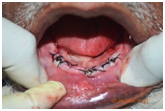
Figure.1:Implant placement done

Fig.2:OPG after implant placement
It was decided to use resin locator type of attachment system. Implant surgery was carried out in a 2-stage surgical protocol. Surgery was performed under local anesthesia.The selected implants were placed at the prepared sites. Surgical cover screws were placed. The flaps were approximated with primary closure. The patient was told not to wear the lower denture for one week following surgery. Instructions were given regarding oral hygiene maintenance. The sutures were removed in one week. The intaglio surface of the denture was relieved. The denture was finished, polished and inserted into the patient’s mouth. This allowed the patient to wear the removable prosthesis during the period of osseointegration without transmitting excessive forces to the surgical sites. The patient was seen on a regular follow-up visits and the denture was relined as needed. After three months patient presented for the second stage surgery.
At this stage, the implants were exposed, the surgical cover screws were removed and the sites were irrigated with sterile normal saline. Healing abutments were placed, and the gingival tissues were allowed to mature for one week (Figure 3).

Figure.3:Healing abutment placed
After one week, the comfort and fit of the dentures was checked before proceeding with the addition of attachments.
Resin locator over-denture abutment of 2 mm diameter was selected. Seating of the abutments was verified. The attachments were placed and O rings were arranged on the abutments. Acrylic resin from the intaglio surface of the denture was removed to allow passive fit of the denture against the tissue (Figure -4,5,6,7).
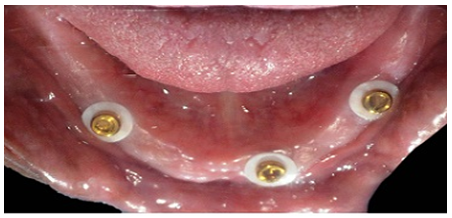
Figure.4:O-Rings placed on locator abutments

Figure.5: Intiligo surface of denture removed
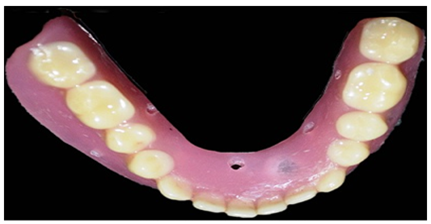
Figure.6:Occlusal view
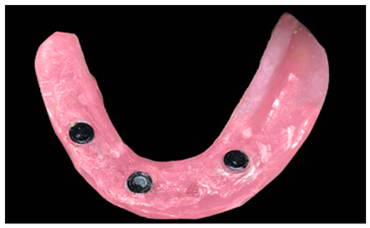
Fig.7:Resin locator placed
The complete seating of the denture was verified and the patient was asked to maintain light occlusal pressure in the centric relation position. The pick-up resin was trimmed and polished in the venting area. Fit and occlusion of the denture was rechecked in centric relation position. Centric relation records were obtained and a laboratory remount for final occlusal refinement was done. Home care instructions were given to the patient. The patient was trained to place and remove the prosthesis properly. First recall was attended after 24 hours. The regular follow up was advised every six months. Patient was instructed to remove their prosthesis at night. A soft single-tufted brush was indicated to keep attachments free from plaque and calculus. The patient is successfully using the overdenture since two years and is satisfied with the treatment.
DISCUSSION
The implant-supported overdenture allows the tongue and perioral musculature to function normally and a remain in place during mandibular movements.8
There are 2 ways to carry out implant-retained overdenture. In the first approach, implants are supported with a rigid interconnecting bar that incorporates retention in overdenture. In the other approach, implants are not connected to each other, and the retention mechanism is provided by an abutment.9
Advantage of the freestanding implants is that they allow the use of the prefabricated stock retentive abutments. The interconnecting implant bar requires more laboratory and clinical procedures in fabrication which increases its treatment cost. Another advantage of the prefabricated stock abutments is that the abutment itself can be easily replaced in case of abutment failure. In case of implant interconnecting bar failure it usually requires remaking of overdenture. Most of the complications and prosthodontic maintenance of these overdenture are related to the attachment components.10
As with any treatment modality, aftercare and maintenance is vital if the overdenture is to be successful. The patient must be advised of this and reviewed regularly. Optimal surgical implant positioning is essential for The success of implant supported restorations is dependent upon their surgical position. An implant-retained overdenture requires meticulous treatment planning than a conventional complete denture. Final placement of the implants should follow the principles of ideal implant parallelism and maximum initial stabilization, and path of placement and removal.
CONCLUSION
Edentulous mandible restoration is a great challenge. Among other options implant-retained overdenture is a simple, cost effective solution. Locators are not only compatible with a high number of implant’s systems but also helps in maintaining oral hygiene by easy placement and removal of prosthesis . Clinicians and dental technicians have to adhere to sound design principles such as simplicity in fabrication, ease of maintenance, repair and cost control.
REFERENCES
- Batenburg RH, Meijer HJ, Raghoebar GM, Vissink A. Treatment concept for mandibular overdentures supported by endosseous implants: a literature review. International Journal of Oral and Maxillofacial Implants. 1998 Jul 1;13(4):539-45.
- AssunçÄo WG, BarÄo VA, Tabata LF, De Sousa EA, Gomes EA, Delben JA. Comparison between complete denture and implantâ€retained overdenture: effect of different mucosa thickness and resiliency on stress distribution. Gerodontology. 2009 Dec;26(4):273-81.
- Balaguer J, García B, Peñarrocha M, Peñarrocha M. Satisfaction of patients fitted with implant-retained overdentures. Med Oral Patol Oral Cir Bucal. 2011 Mar 1;16(2):e204-9.
- Vercruyssen M, Marcelis K, Coucke W, Naert I, Quirynen M. Longâ€term, retrospective evaluation (implant and patientâ€centred outcome) of the twoâ€implantsâ€supported overdenture in the mandible. Part 1: survival rate. Clinical oral implants research. 2010 Apr;21(4):357-65.
- Pasciuta M, Grossmann Y, Finger IM. A prosthetic solution to restoring the edentulous mandible with limited interarch space using an implant-tissue-supported overdenture: a clinical report. The Journal of prosthetic dentistry. 2005 Feb 1;93(2):116-20.
- Locator implant attachment system. Publication of Zest Anchors corporation on the manufacturer websitewww.zestanchors.com
- Cakarer S, Can T, Yaltirik M, Keskin C. Complications associated with the ball, bar and Locator attachments for implant-supported overdentures. Med Oral Patol Oral Cir Bucal. 2011 Nov 1;16(7):e953-9.
- Oetterli M, Kiener P, Mericske-Stern R. A longitudinal study on mandibular implants supporting an overdenture: the influence of retention mechanism and anatomic-prosthetic variables on periimplant parameters. International Journal of prosthodontics. 2001 Nov 1;14(6):536-42.
- Timmerman R, Stoker GT, Wismeijer D, Oosterveld P, Vermeeren JI, Van Waas MA. An eight-year follow-up to a randomized clinical trial of participant satisfaction with three types of mandibular implant-retained overdentures. Journal of dental research. 2004 Aug;83(8):630-3.
- Walton JN. A randomized clinical trial comparing two mandibular implant overdenture designs: 3-year prosthetic outcomes using a six-field protocol. International Journal of Prosthodontics. 2003 May 1;16(3):255-60.
Disclaimer from Guident
The views and opinions expressed in articles published in Guident are solely those of the authors and do not necessarily reflect the views of the editors, the editorial board or the publisher, Ivory India. Guident does not endorse any product, technique or treatment described. Clinical content is intended for qualified dental and medical professionals and is not a substitute for individual clinical judgement. Guident, its editors and the publisher accept no liability for any consequence arising from the use of information published in the journal.
How to cite this article
Dr. Gaurav Gupta Jaipur Dental College, Dr. D.K Gupta Dr. Neelija Gupta Department of Pedodontics and Preventive Dentistry. Implant Supported over Denture. Guident. 2018 Aug;11(9). Available from: https://guident.net/articles/implantology/implant-supported-over-denture.html