
Forensic Odontology
Department of Public Health Dentistry, K. D Dental College & Hospital Mathura
INTRODUCTION
The term 'forensic' implies 'court of law'. The term ‘Forensic’ is derived from a Latin word forensic (is) which means – of or belonging to the forum. From there it is but a small step to the modern definition of forensic as pertaining to, connected with or used in courts of judicature or public discussion and debate. Thus, the forensic sciences encompass the application of specialized scientific and/or technical knowledge to questions of civil and criminal law, especially in court proceedings.1
Forensic dentistry has become an integral part of forensic medicine over the past 100 years. Forensic odontology as a subject in its own right was written in 1898 by Dr Oscar Amoeda who is generally recognized as the father of forensic odontology.2
Traditionally, comparisons have been made between postmortem dental records and the antemortem (living) records (presence of dental fillings, endodontic treatments, crowns or bridges, radiological studies to verify the clinical findings, the presence of malocclusions or dental fractures, etc.) to determine whether both records correspond to the same individual. Such techniques are now less widely used, however, due to the increased efficiency and availability of molecular biological techniques. In this context, the enamel and dentin layer isolate the pulp cavity from the exterior, thereby affording a valuable source of DNA. A number of identification techniques are used by forensic dentists, including rugoscopy, cheiloscopy (lip prints), the obtainment of imprints, or the use of molecular techniques such as polymerase chain reaction (PCR) for analyzing the DNA contained in dental pulp tissue.3
CLASSIFICATION
Based on the major fields of activity: - Avon classified forensic odontology into-
- Civil
- Criminal
- Research.
ROLE AND IMPORTANCE OF FORENSIC ODONTOLOGY
Forensic science plays an important role that can be used in a judicial setting and accepted by the court and the general scientific community to separate truth from untruth. Forensic identifications, by their nature, are multidisciplinary team efforts that typically involve the coordination and cooperation of law enforcement officials, forensic pathologists, forensic odontologists, forensic anthropologists, serologists, criminalists and other specialists as deemed necessary.4
THE FORENSIC TEAM AND ARMAMENTARIUM :
Forensic dentists are usually part of a team of identification specialists that include anthropologists and fingerprint expert, etc. Forensic dentistry team is headed by chief with few members. Dental teams have major role in mass disaster response. There are two types of dental identification team - the traditional locally based team and the newer dental teams integrated into the disaster mortuary operational response team (DMORT) system.
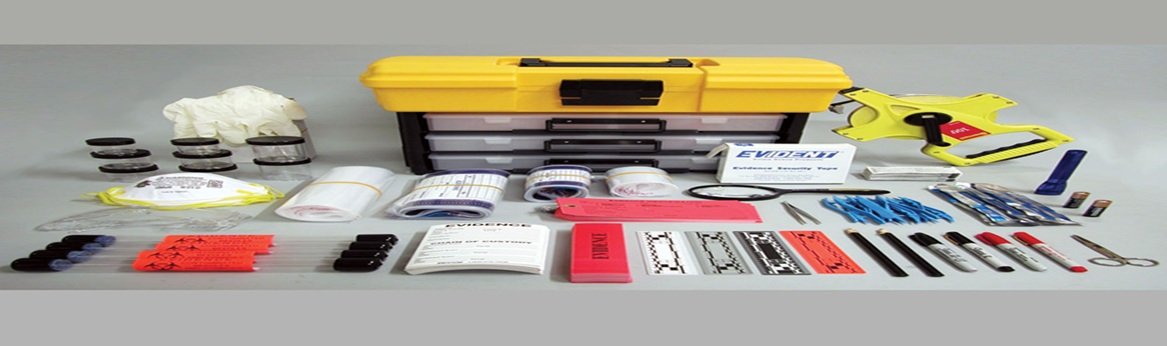
FORENSIC TOOL BOX
EXAMINATION METHODS
There are different types of examination methods in forensic odontology.5
- Visual method
- Photographs
- Radiographs
- Dental impression
- Resection.
STEPS IN COLLECTION OF EVIDENCE AND IDENTIFICATION
There are two forms of dental identification:
- Comparative identification
- Dental profiling
- Comparative dental identification-includes four steps:
- Oral autopsy
- Obtaining dental records
- Comparing post and antemortem dental data
- Writing a report and drawing conclusion.
- Dental profiling:
When antemortem dental records are unavailable and other methods of identification are not possible, the forensic dentist can limit the population pool to which the deceased is likely to belong and thus increase the likelihood of locating antemortem dental records, This process is known as postmortem dental profiling.5 A postmortem dental profile will typically provide information on the deceased, age, ancestry back-ground, sex and typically socioeconomic status & also provide additional information regarding occupation, dietary habits, and dental or systemic disease.6
Forensic anthropologists provide details of osteological studies. Generally, from skull appearance, forensic dentist can determine race. Sex determination is usually based on cranial appearance. Microscopic examination of teeth can confirm sex by the presence or absence of Y- chromatin and DNA analysis can also reveal sex.6
The age of children can be determined by the analysis of tooth development and subsequent comparison with developmental charts. Third molar development is used by some forensic dentist to assign age to young adults. SEM-EDXA (Scanning Electron Microscope- Energy Dispersive X-Ray Analysis) is a method used to examine dentine in relation to age determination.6
If the postmortem profile does not elicit the tentative identity of the deceased it may be necessary to reconstruct the individual's appearance during life.6
SPECIES & RACE DETERMINATION:
Species determination:
Sometime forensic dentist is required to investigate animal bites like that of dog, wolf, cat, tiger, rodents, snakes, shark, crocodiles etc. Hence knowledge of animal dental pattern is required to investigate the case of non-human bites.4,7
Racial determination:
It is generally agreed by physical anthropologists, human biologists and geneticists that all men living today belong to a single species, Homosapiens and they therefore share a common ancestry.
According to Dahlberg the following dento-anthropologic structures are useful for identification purposes and ascertaining racial affinities:4
- Cusp size number and location
- Occlusal groove patterns
- Root systems
- Number and arrangement of teeth
- Individual tooth measurement
- Dimensional proportions between different teeth (e.g., 1st molar: 2nd premolar)
- Occlusion and bony relationship
- Nature of pulp chamber and canal
- Microscopic tooth- surface characteristics.4

SPECIES AND RACE DETERMINATION
AGE ESTIMATION:
Age assessment using teeth was first published by Edwin Saunders (1837). Age of an individual is the sign of maturity which may be divided into chronologic age, anatomical age, dental age, sexual age and mental age.
Development stages of dentition and craniofacial skeleton are well established. Any disturbance during this period produces changes in these tissues and serves as lifelong permanent record. Even after complete development of dentition and craniofacial skeleton certain physical, chemical and biological changes take place which aid in age estimation. Because dentition and bone development are affected by genetic, environment, nutritional and endocrinal factors so chronologic age don’t coincide with skeletal or dental age.5
MEDICOLEGAL IMPORTANCE OF AGE
- CRIMINAL RESPONSIBILITY: Any act done by a child under the age of 7 years is not an offence (Sec 82 IPC).
- JUDICIAL PUNISHMENT: According to juvenile justice act 1986, juvenile means a boy below 16 years and a girl below 18 years. When a juvenile commits an offence, the court may direct that such person may be confined to juvenile home. No juvenile shall be sentenced to death or imprisonment.
- RAPE: Sexual intercourse by man with a girl under 15 years even if she is his own wife or any other girl below 16 years even with her consent is an offence (Sec 375, IPC)
- KIDNAPPING: Kidnapping a minor if the age of boy is under 16 years and age of girl is less than 18 years is an offence.
- EMPLOYMENT: A child below 14 years cannot be employed to work in any factory or mine.
- ATTAINMENT OF MAJORITY: A person attains majority on completion of 18 years and if he/she is under the guardianship of court of wards, he/she attains majority on completion of 21 years . (Section 3, Indian majority act 1875)
- Every person domiciled in India shall attain the age of majority on his completing the age of eighteen years and not before.
- In computing the age of any person, the day on which he was born is to be included as a whole day and he shall be deemed to have attained majority at the beginning of the eighteenth anniversary of that day.
- MARRIAGE: A girl under 18 years and boy under 21 years cannot contract marriage (child marriage restraint act 1978).
Age of majority of persons domiciled in India.:
CHILD MARRIAGE RESTRAIN ACT (1929) • Laws restraining the practice of child marriage have been in force in India since 1929. According to the Child Marriage Restraint Act 1978, the minimum legal age of marriage stands at 18 years for women and 21 years for men.
CHANGES WITH AGE:
- Attrition takes place from the wearing down of the incisal or occlusal surfaces due to mastication. This change is seen both macroscopically and microscopically.5
- Periodontitis, loosening of the teeth or continuous eruption is characterized by changes in the attachment of the tooth. This change again is seen both macroscopically and microscopically.5
- Secondary dentine may develop within the pulp cavity, partly as a direct sign of aging and partly as a reaction against pathologic conditions like caries. This change is seen only in the microscopic sections.5
- Cementum apposition may take place at the root and around it, particularly in connection with periodontitis. It is seen only in the microscopic sections.5
- Root resorption may involve both cementum and dentin.5
- Transparency of the root increases with age and is best appreciated in ground sections.5
SEX DETERMINATION:
Sex can be determined based on data from morphology of skull and mandible, tooth measurement and by DNA analysis of teeth.
When an accurate outcome is achieved, considering that about half of the population would be automatically excluded during search operations.8
CLASSIFICATION OF METHODS:
- Visual method or clinical methods.
- Microscopic methods.
- Advanced methods.
CHEILOSCOPY & RUGOSCOPY
CHEILOSCOPY:
The wrinkles and grooves visible on the lips have been named by Tsuchihashi as ‘sulci labiorum rubrorum’. The imprint produced by these grooves is termed "lip print’, the examination of which is referred to as 'cheiloscopy', These grooves are heritable and are supposed to be individualistic. Lip prints, therefore, can constitute material evidence left at a crime scene much like fingerprints.4
Lip prints bring added evidence to a crime scene that can be valuable, especially in cases lacking other evidence, like fingerprints. Lip prints can be a factor in many different kinds of crimes such as tape when a person has been bound or gagged, prints on a glass that a person drank from, prints on a cigarette butt, and prints on a glass/window if they were pressed up against it. All of these are potential places where lip prints may be found and used in the investigation of a crime. However, the use of lip prints in criminal cases is limited because the credibility of lip prints has not been firmly established in the court system.9
RUGOSCOPY
A useful method of identifying edentate individuals is by examining the palatal rugae patten. The rugae pattern on the deceased's maxilla or maxillary denture may be compared to old dentures that may be recovered from the decedent's residence or plaster models that may be available with the treating dentist.
Palatal rugoscopy was first proposed in 1932, by a Spanish investigator Troban Hermaso. Since then, various classifications had been given. Most studies are based on systems devised by Lysell and Thomas and Kotze, although they may differ in detail.10
BITE MARKS:
Mc Donald et al (1981) states that bite mark injuries are a form of "patterned injury” which means that the configuration is caused by a particular object. Sometimes bite marks are called as "tool marks."5
Mc Donald has defined bite mark as a mark made by the teeth either alone or in combination with other mouth parts.5
Bite mark evidence is admissible under Frye test. which deal with admissibility for scientific evidence. It has three requirements. They are as follows:-
- The scientific principle must be recognizable.
- The scientific principle must be sufficiently established.
- The scientific principle must have gained acceptance in the discipline to which it belongs.
ROLE OF DNA IN HUMAN IDENTIFICATION
In 1953 Watson and Crick discovered the double-helix structure of DNA, which is responsible for the genetic inheritance of human beings. This discovery was the basis for the development of techniques that allow identifying each person based on the DNA sequence. Three decades later, Jeffrey et al (1985) created DNA fingerprints which are radioactive molecular probes which can recognize highly variable regions of DNA and hence determine the individuality of a person. Cases in which there is little material left for identification like in fires, explosions, decomposing bodies, has led forensic investigators to use new molecular biology technologies.11
CHILD ABUSE
Child abuse has been defined as “any act of commission or omission that endangers or impairs a child's physical or emotional health and development". Child abuse may broadly be categorized as physical abuse, sexual abuse, emotional abuse and neglect of the child. Gonococcal and syphilitic lesions of the mouth are commonly associated with sexual abuse.12
Child abuse is also defined as the non-accidental physical injury, minimal or inflicted upon children by persons caring for them (Selwyn et al 1985). It is an overt act of commission of a care taker physical, emotional or sexual.13
Types of child abuse:4
- Physical abuse
- Educational abuse
- Emotional abuse
- Sexual abuse
MASS DISASTER MANAGEMENT
Disasters refer to natural calamities such as earthquakes, floods, tsunami and accidental or man-made events such as airplane crashes or terrorist attacks that result in multiple human fatalities. Such incidents require identification of the postmortem remains due to severe mutilation.14
ROLE OF FORENSIC RADIOLOGY
Forensic radiology is the discipline which comprises the performance, interpretation and reportage of the radiological examinations and procedures which are needed in court procedures or law enforcement. Radiological methods are widely used in identification, age estimation and establishing cause of death.
Use of forensic radiology:
- Suspicious death or murder - Radiographic technique can assist the pathologist in determining the potential cause of death.
- Analysis of adverse medical event - radiographic imaging is integral part of medical process and provides a permanent record of the patient's condition.
- Legal matter - following injury or assaults, radiographic interpretation may provide useful evidence.
- Child abuse radiographic technique provide the evidence of both acute and chronic injuries.
- Drug trafficking - deliberate ingestion or cavity insertion of drugs wrapped material can be identified by CT scan.
- Body identification- it helps in the identification of unknown victims.
- Disease identification - during autopsy, radiologic finding may give a relation to a particular disease.15
COMPUTER ASSISTED IDENTIFICATION:
Computer forensics emerged in response to the escalation of crimes committed by the use of computer systems either as an object of crime, an instrument used to commit a crime or a repository of evidence related to a crime. Computer forensics can be traced back to as early as 1984 when the Federation Bureau Investigation (FBI) laboratory and other law enforcement agencies begun developing programs to examine computer evidence. Research groups like the Computer Analysis and Response Team (CART), the Scientific Working Group on Digital Evidence (SWGDE), the Technical Working Group on Digital Evidence (TWGDE) and the National Institute of Justice (NIJ) have since been formed in order to discuss the computer forensic science as a discipline including the need for a standardized approach to examinations.16
PHOTOGRAPHIC IDENTIFICATION:
Photography is the first non-invasive technique to record a bite mark. One of the most frequently applied methods to analyze bite marks are based on the interpretation of photographic evidence, where a bite mark is compared to model(s) of a suspect's teeth. This examines the history of photographic imaging of bite marks and the various potential distortions associated with digital imaging of bite marks.
One of the earliest recorded uses of photography was in the 1840's where photographs were used to record an image of a face, specifically for police records.16
LEGAL ASPECTS
It refers to the science that applies the principles and practices of the various fields of dentistry to clarity the doubtful questions in a court of justice. It deals with consent in dental practice, professional malpractice, preparation of personal injury report and dentist as an expert witness in the court.17
CONCLUSION
A forensic odontologist carries considerable responsibility since his scientific opinion is frequently asked when all other paths of identification have exhausted. A forensic odontologist is the only one who can connect and evaluate all the skeletal/dental findings in a meticulously detailed way and with irreproachable scientific documentation that requires legal science in the resolution of problems.
The unique characteristics of an individual's dentition in the form of morphology of teeth, variations associated with it and dental restorations are valuable tools in patient's identification. When teeth are lost, other important orofacial structures and tissues also aid in this regard.
A dental professional contributes to this field by keeping accurate dental records and providing all necessary information to the legal authorities. This helps in identifying unknown humans and also recognition of various malpractices, negligence's, frauds or abuses occurring in today's modern world.
Thus, Forensic Odontology is an important and one of the most reliable forms of human identification when all other established methods of identification.
REFERENCES
- Thorakkal Shamim. Forensic Odontology. Journal of the College of Physicians and Surgeons Pakistan 2011; 1(2): 1-4.
- Prasad Srinivasa, Sujatha G, Sivakumar G, Murugnandan. Forensic Dentistry-What a dentist should know. Indian Journal of Multidisciplinary Dentistry 2012; 2(2): 30-35.
- Javier Ata-Ali, Fadi Ata-Ali. Forensic Dentistry in human identification: A review of the literature. Journal of Clinical and Experiment Dentistry 2014; 6(2): 162-167.
- Rajendra and Sivapathasundharam, Shafer’s Textbook of Oral Pathology, 6th edition 2009; 876.
- Masthan K M K. Textbook of Forensic Odontology 2009; 1: 1-2.
- Henrique Ricardo, da Silva Arsenio Alves. Use of DNA technology in Forensic Dentistry. Journal of Applied Oral science 2007; 15(3): 1-6).
- Yaacob Hashirn, Narnbiar Pharbhakaran. Racial characteristics human teeth with special emphasis on the Monoid. Malaysian Journal of Pathology 1996; 18 (1): 1-7.
- Faustino da Costa Yuri Trigueiro. Analysis of canine dimorphism in the estimation of sex. Brazilian Journal Oral Science 2012; 11(3): 406-410.
- Venkatesh Rashmi, Priscilla David Maria. Cheiloscopy: An aid for personal identication. Journal of Forensic Dental Science 2011; 3(2): 67-70.
- Paliwal A, Wanjari S, Parwani R. Palatal Rugoscopy: Establishing identity. Journal of Forensic Dental Science 2010; 2: 27-31.
- Richard H Fixott. Dental Clinics of North America 2001; 45(2): 87-91.
- Rajshekar Mithun, Kruger Estie, Tennant Marc. Photographic imaging distortion and its effect on forensic bite mark analysis. Journal of Advanced and Oral Research 2002; 3(3): 40-44.
- Kellogg N. American Academy of Pediatrics: Oral and Dental aspects of child abuse and neglect. Pediatrics 2005; 116 (6): 59-64.
- American Board of Forensic Odontology, Bite mark Guidelines and Standards: mhtml: file://1:/forensic/ABFO Bitemark.mht. Last accessed on 3/1/2021.
- Lamont, A. The Effects of Child Abuse and Neglect for Children and Adolescents. Retrieved from<http://www.aifs.gov.au/nch/pubs/sheets/rs20/rs20.html>2010). Last accessed on 2/1/2021)
- Patel J, Singh HP, Paresh M, Verma C. Forensic Odontology in the era of Computer and Technology. International Journal of Medical and Dental Science 2013; 2(1).
- T M Smith, D J Reid, J E Sirianni. The accuracy of histological assess of dental development and age at death. Journal Anatomical Society of India 2006; 208 (1): 125-138.
Disclaimer from Guident
The views and opinions expressed in articles published in Guident are solely those of the authors and do not necessarily reflect the views of the editors, the editorial board or the publisher, Ivory India. Guident does not endorse any product, technique or treatment described. Clinical content is intended for qualified dental and medical professionals and is not a substitute for individual clinical judgement. Guident, its editors and the publisher accept no liability for any consequence arising from the use of information published in the journal.
How to cite this article
Dr. Shrikant Rajput, Dr. Navpreet Kaur, Dr. Roopali Gupta. Forensic Odontology. Guident. 2022 Feb;15(3-4). Available from: https://guident.net/articles/general/forensic-odontology.html


