Treating the Unforgiving Canal Non Surgically Digging Till Depth!!
Department of Conservative Dentistry and Endodontics, Seema Dental College And Hospital, Rishikesh
INTRODUCTION
American Association of Endodontists defined Calcific Metamorphosis as “A pulpal response to trauma characterised by rapid deposition of hard tissue within the canal space.” This is also known as obliteration of pulp canal, Dystrophic Calcification, Diffuse Calcification and Calcific Degeneration.
Dental trauma to the permanent dentition can lead to clinical complications and its management may considerably challenge a practitioner.1
Their prevalence varies widely from 8% to 95% of the studied population. The etiological factors are not well understood, apart from trauma, age, gender, various systemic diseases, and long-term irritation such as deep caries and restorations have been proposed as possible implicated factors.2
Negotiation of calcified canals is a challenge and requires patience; good magnification, illumination and proper armamentarium.3,4,5
The first option for treatment of a calcified necrotic tooth is the conventional root canal therapy6, but teeth with severe calcification may present challenges with locating and negotiating root canals. The other options beside nonsurgical endodontic treatment include root resection using a surgical method7 and intentional extraction and replantation.8
CASE REPORT
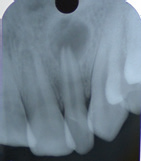
A 78 year old male patient reported to the Department of conservative dentistry and Endodontics with a chief complaint of pain in upper front tooth region since one month. History of previous treatment in the same from two different places. Pain is severe but occasional. H/o sensitivity to cold in the same. On examination Faulty temporary restoration i.r.t 11 and 12. Tooth was tender on percussion i.r.t 11 and 12, Class III Caries i.r.t 11, 12. Radiographically,radiolucency was appreciated on the mesial aspect of the crown approaching the pulp i.r.t 11 and 12. At the periapical region also diffuse radiolucency was appreciated. A non surgical root canal treatment was planned for the tooth 11 and 12.
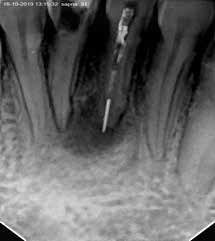
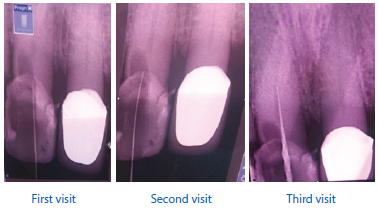
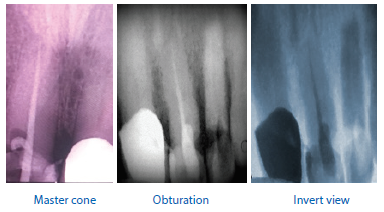
Under local anaesthesia, old restoration was removed i.r.t 11. Orifice was tried to locate but after three visits canal was negotiated. Shaving and Cleaning was done and mastercone was selected and final obturation was done.
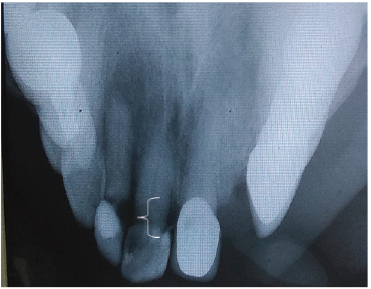
Calcified canal in the coronal 3rd of previously attempted 11
DISCUSSION
The obliterated pulp canal is debatable on showing no symptoms or pathosis of the periapical region. Continuous observation and follow up gives a better intervention before deciding the conclusion. The incidences according to literature on calcified tooth which develops pulpal pathology is at the range of 1-16%.9 A variety of “pathfinding” instruments have been introduced.In this case DG16 probe was used along with C-Pilot files by dentsply to negotiate the obliterated canals. To negotiate these canals, long-necked round drills (LN-drill, Dentsply Maillefer, Oklahoma, USA) may be used with gentle brushing strokes. Ultrasonic endodontic instruments can also help to open up a calcified root canal. When the tip vibrates at a very high rate, it creates miniature sound waves that break up the calcification. Recently, a combination of access refinement ultrasonic tips and magnification has revolutionized the basic concept of access cavity preparation. The uncovering of the floor of the pulp chamber can be accomplished with the help of the CPR 2D or BUC 1 tips (SybronEndo, Orange, California, USA). The pulp stones sometimes can be vibrated or teased out by the CPR 2D or BUC 1 tips; at other times, they can be planned with the help of a BUC 2 tip-a process similar to planing the root surface. Grind the floor until the dark colored dentin becomes visible. It is of critical importance because it dictates and guides the extension of access cavity.10
Chelator preparations have been advocated frequently as adjuncts for root canal preparation, especially in narrow and calcified root canals. Apical dentin is more frequently sclerosed and is more mineralized.11 Ethylenediamine tetra acetic acid (EDTA) acts on calcified tissue by substituting the calcium ions of sclerosed dentin by sodium ions, giving soluble salts. At a normal concentration, EDTA removes 10.6 g of calcium from 100 g of calcium.12
CONCLUSION
It is vital that the clinician not rush down the canal and that files be inserted passively. A difficult canal can be made impossible if an impassable blockage of debris is created and/or a ledge develops. Both these situations are in the control of the clinician.
REFERENCES
- Calcified Canal and Negotiation-A Review Dhinesh Kumar, S. Delphine Priscilla Antony
- Pener S, Cobankara FK, Akgünlü F. Calcifications of the pulp chamber: Prevalence and implicated factors. Clin Oral Investig 2009; 13: 209-15.
- Edds AC, Walden JE, Scheetz JP, Goldsmith LJ, Drisko CL, Eleazer PD Pilot study of correlation of pulp stones with cardiovascular disease. J Endod, 2005; 31: 504–506.
- James VE: Rely pulpal calcifications of permanent of young individuals. J Dent Res, 1958; 37: 973.
- P. C. Foreman, I. E. Barnes: A review of calcium hydroxide. International 297.
- V. Gopikrishna, A. Parameswaran, and D. Kandaswamy, “Criteria for management of calcific metamorphosis: review with a case report,” Indian Journal of Dental Research, vol. 15, no. 2, pp. 54–57, 2004.
- N. Malhotra and K. Mala, “Calcific metamorphosis. Literature review and clinical strategies,” Dental Update, vol. 40, no. 1, pp. 48–58, 2013.
- P. M. Tang, C. P. Chan, C. C. Chen, and A. I. Tsai, “Intentional replantation of a mandibular molar with calcified canal: a case report,” Chang Gung Medical Journal, vol. 19, no. 4, pp. 364–370, 1996.
- Calcified Canal and Negotiation-A Review Dhinesh Kumar, S. Delphine Priscilla Antony.Research J. Phar ma and Tech. 11(18) August 2018.
- Root canals-from concretion to patency. 2015: 5 (1) 13-19.
- Vassiliadis LP, Sklavounos SA, Stavrianos CK. Depth of penetration and appearance of Grossman sealer in the dentinal tubules: An in vivo study. J Endod 1994; 20: 373-6
- Nicholson R, Stark MM, Nguyen N, Scott H. Autoradiographic tracings utilizing Ca45-labeled ethylenediamine tetra acetic acid. Oral Surg Oral Med Oral Pathol 1968; 26: 563-6
Disclaimer from Guident
The views and opinions expressed in articles published in Guident are solely those of the authors and do not necessarily reflect the views of the editors, the editorial board or the publisher, Ivory India. Guident does not endorse any product, technique or treatment described. Clinical content is intended for qualified dental and medical professionals and is not a substitute for individual clinical judgement. Guident, its editors and the publisher accept no liability for any consequence arising from the use of information published in the journal.
How to cite this article
Dr. Annil Dhingra, Dr. Deepika Rawat. Treating the Unforgiving Canal Non Surgically Digging Till Depth!!. Guident. 2020 Mar;13(4). Available from: https://guident.net/articles/endodontics/treating-the-unforgiving-canal-non-surgically-digging-till-depth.html