Open and Closed Sandwiches
Victoria, Australia
The occurrence of proximal caries indicates a susceptibility to decay that will require an environmental modification in the region to prevent further recurrence of caries at this site.
Although improvements in oral hygiene will reduce the chance of further decay, the placement of a restoration with cariostatic properties is a more predictable way of preventing ongoing caries than relying on behavioural changes by a patient.
Metallic, ceramic and resin restorative materials have no ability to protect adjacent tooth structure from recurrent caries. Furthermore self etching bonding systems have a reduced bond strength to enamel that can lead to marginal debonding and dentine caries. Figure 1. Auto cure and resin modified glass ionomer cements have been shown to prevent the demineralization of tooth structure adjacent to the restorative interface, either by pH buffering or the perfusion of fluoride into the tooth.
Whilst it is the opinion of many Australian dentists that glass ionomer cement restorations protect teeth from recurrent caries there are a number of clinical studies suggesting recurrent caries is the most observed reason for replacement of these restorations.
The buffering ability of glass ionomer cements results in the slow breakdown of the surface cement that can give the clinical impression of caries even though closer examination reveals no softening of dentine at the restorative interface.
OPEN SANDWICH
The “open sandwich” technique involves the placement of a glass ionomer cement restoration into the base of a proximal cavity and filling the preparation with glass ionomer up to the level of the dento enamel junction. The final portion of the restoration is placed with composite resin to provide wear resistance and aesthetics on the occlusal surface. The main benefit of the “open sandwich” is the large surface area of glass ionomer cement available for buffering any changes in acidic pH. Figure 2 shows an “open sandwich” restoration. The resin modified glass ionomer cement bond (dyed blue to identify the interface) chemically bonds the glass ionomer cement to the composite resin overlay. The problem here is that over time the glass ionomer

Figure 1
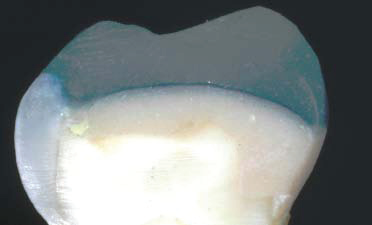
Figure 2
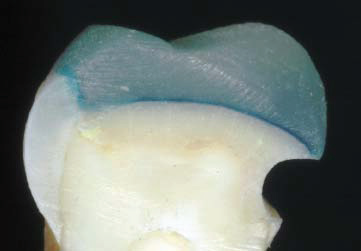
Figure 3

Figure 4

Figure 5
cement succumbs to acid break down over the surface resulting in food packing and giving the impression of recurrent caries within the glass ionomer. Figure 3
CLOSED SANDWICH
The traditional “closed sandwich” technique involves placing the glass ionomer at the base of the proximal box so as it falls just short of the external cavo surface. After setting, the glass ionomer cement is etched with phosphoric acid and a dentine bonding agent applied before placing a composite resin into the proximal box and occlusal surface, leaving the glass ionomer cement encased with the preparation. This procedure offers no protection from proximal caries until failure of the dentine bonding agent.
The application of a resin modified glass ionomer cement bonding agent (Fuji Bond LC, Fuji II LC, GC Corp, Japan. Vitremer 3M ESPE, USA) that extends to the outer cavo margin enables the marginal tooth structure to continue to receive the dual benefits of a glass ionomer cement, namely, fluoride infusion as well as the buffering capacity (although somewhat reduced).
This may be achieved in either two ways.
COMPOSITE RESIN CO CURE TECHNIQUE
Bond a thin layer of a resin modified glass ionomer cement bonding agent directly onto etched enamel and dentine. Next place a second layer of resin modified glass ionomer cement bonding agent followed immediately by the application of a composite resin prior to light curing.
The first layer of resin modified GIC bond cures all the HEMA and seals the cavity while the second layer acts as a polymerization stress release during photo initiation of the composite resin. For cavities over 2mm deep a further layer of resin modified glass ionomer cement bonding agent can be used as a stress breaker between layers of composite resin Figure 4 (RMGIC bond has been dyed blue for clarification purposes)
A video of composite resin co cure technique may be viewed at www.dentalk.com.au
GLASS IONOMER CEMENT CO CURE TECHNIQUE
Following cavity preparation and etching of dentine and enamel surfaces, an increment of auto cure glass ionomer cement is placed into the proximal box and over the floor of the cavity extending up to the dento enamel junction around the perimeter of the preparation or just short of the cavo margin at the base of the proximal box.
Either prior to or at the immediate set of the auto cure glass ionomer cement, a layer of resin modified glass ionomer cement bonding agent is brushed over the auto cure glass ionomer cement and up to the outer perimeter of the preparation.
An increment of composite resin is next placed over the auto cure glass ionomer cement to fill the cavity followed immediately by photo curing the preparation.
Upon photo initiation the composite resin cures and undergoes polymerization shrinkage before the resin modified glass ionomer bond has cured resulting in a stress free bond to tooth structure at the cavity perimeter. Resin modified glass ionomer cement bond chemically bonds composite resin to glass ionomer cement and the exothermic setting reaction of the composite resin heats the auto cure glass ionomer cement initiating a cascade setting reaction of the auto cure glass ionomer cement to occur between 20 to 40 seconds depending on the ambient temperature. Figure 5 (RMGIC bond has been dyed blue for clarification purposes)
A video of glass ionomer cement co cure technique may be viewed at www.dentalk.com.au
The successful placement of a proximal restoration requires a predictable outcome that offers protection from further caries at the cavo margins.
Apart from these benefits, the ”co cure closed sandwich technique” creates stress free cavo margins and is more clinically efficient to place than incremental placement of composite resin using a dentine bonding agent or the traditional set and etch techniques prescribed for sandwich restorations.
References available from the author geoffbds@dentalk.com.au
Previous Aesthetic Updates may be viewed at www.dentalk.com.au / publications
Disclaimer from Guident
The views and opinions expressed in articles published in Guident are solely those of the authors and do not necessarily reflect the views of the editors, the editorial board or the publisher, Ivory India. Guident does not endorse any product, technique or treatment described. Clinical content is intended for qualified dental and medical professionals and is not a substitute for individual clinical judgement. Guident, its editors and the publisher accept no liability for any consequence arising from the use of information published in the journal.
How to cite this article
Dr. Geoffrey M Knight. Open and Closed Sandwiches. Guident. 2014 Mar;7(4). Available from: https://guident.net/articles/aesthetic-dentistry/open-and-closed-sandwiches.html